Yasin Iqra, Saeed Usmani Afshan, Mohsin Jibran, Asif Rehan Bin, Kahlid Nazish, Syed Aamir Ali
Gynecologic Oncology, Shaukat Khanum Memorial Cancer Hospital and Research Centre, Lahore, PAK.
Department of Surgery, Akhtar Saeed Medical and Dental College, Lahore, PAK.
Cureus. 2022 Mar 15;14(3):e23180. doi: 10.7759/cureus.23180. eCollection 2022 Mar.
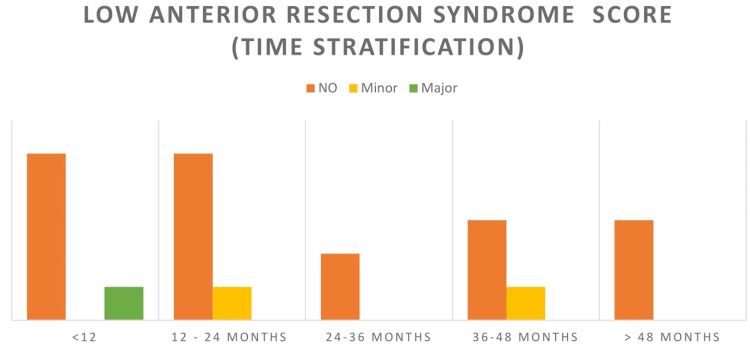
Background In this study, we aimed to determine the prevalence and risk factors of low anterior resection syndrome (LARS) in epithelial ovarian cancer (EOC) surgery. Methodology A descriptive cross-sectional study was conducted at the Gynecologic Oncology Section of the Department of Surgical Oncology, Shaukat Khanum Memorial Cancer Hospital & Research Centre, Lahore, Pakistan. Using non-probability consecutive sampling technique, all patients who underwent cytoreductive surgery involving low anterior resection for EOC between January 2016 and January 2021 were included. Patients were assessed for LARS symptoms using the LARS score, along with its risk factors. Descriptive statistics, that is, continuous variables were expressed as the median and interquartile range, while categorical variables were expressed as frequencies and percentages. The LARS score was categorized according to a two-tier model with "no or minor LARS" and "major LARS." Univariate analyses were performed by the chi-square tests providing odds ratios and 95% confidence intervals to identify risk factors for major LARS. Results Overall, 95% of cases had LARS scores that fell in "no or minor LARS," while only 5% of cases had "major LARS." Univariate analyses relieved no statistically significant association between the occurrence of major LARS and any of the risk factors. Conclusions The prevalence of LARS was 5%, and no risk factors were associated with major LARS in our study population.
背景 在本研究中,我们旨在确定上皮性卵巢癌(EOC)手术中低位前切除综合征(LARS)的患病率及危险因素。
方法 在巴基斯坦拉合尔市绍卡特汗姆纪念癌症医院及研究中心外科肿瘤学系妇科肿瘤学部进行了一项描述性横断面研究。采用非概率连续抽样技术,纳入了2016年1月至2021年1月期间因EOC接受包括低位前切除在内的细胞减灭术的所有患者。使用LARS评分评估患者的LARS症状及其危险因素。描述性统计中,连续变量以中位数和四分位数间距表示,分类变量以频率和百分比表示。LARS评分根据“无或轻度LARS”和“重度LARS”的两级模型进行分类。通过卡方检验进行单因素分析,提供比值比和95%置信区间以确定重度LARS的危险因素。
结果 总体而言,95%的病例LARS评分属于“无或轻度LARS”,而只有5%的病例为“重度LARS”。单因素分析显示重度LARS的发生与任何危险因素之间无统计学显著关联。
结论 在我们的研究人群中,LARS的患病率为5%,且无危险因素与重度LARS相关。