Wei Tao, Zhu Ning, Jiang Weihua, Xing Xiao-Liang
Department of Surgical Oncology, Urumqi Friendship Hospital, Urumqi, China.
School of Public Health and Laboratory Medicine, Hunan Provincial Key Laboratory for Synthetic Biology of Traditional Chinese Medicine, Hunan University of Medicine, Huaihua, China.
Front Oncol. 2022 Apr 4;12:844642. doi: 10.3389/fonc.2022.844642. eCollection 2022.
Heterogeneity of breast cancer (BRCA) is significantly correlated with its prognosis. Target therapy for ferroptosis and immunity is a new cancer treatment option discovered in recent years. In the present study, we aimed to identify ferroptosis- and immune-related long non-coding RNAs (lncRNAs) to accurately predict the prognosis and diagnosis of patients with breast infiltrating duct and lobular carcinoma by integrated analyses.
The corresponding data for the patients with breast infiltrating duct and lobular carcinoma by integrated analyses were obtained from The Cancer Genome Atlas (TCGA). Analyses of univariate and multivariate Cox regressions were used to identify the suitable candidate biomarkers.
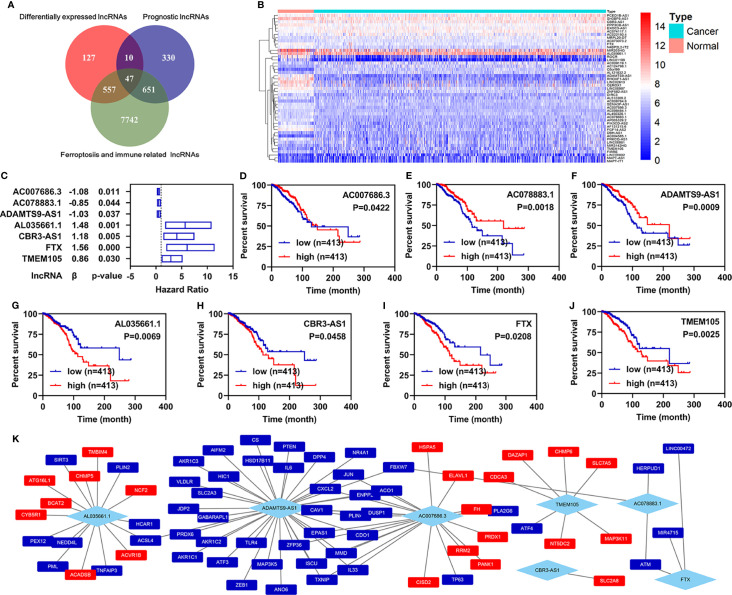
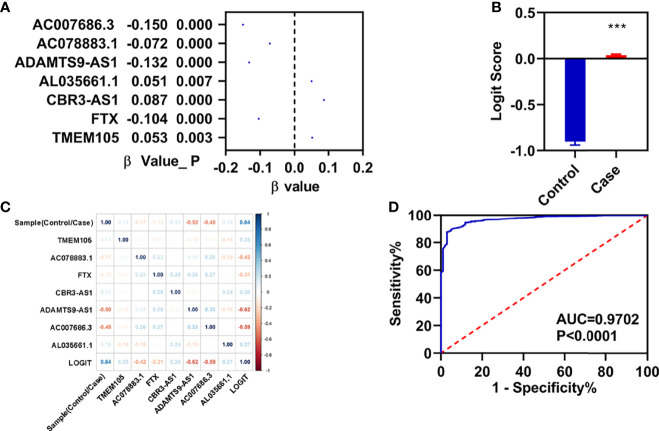
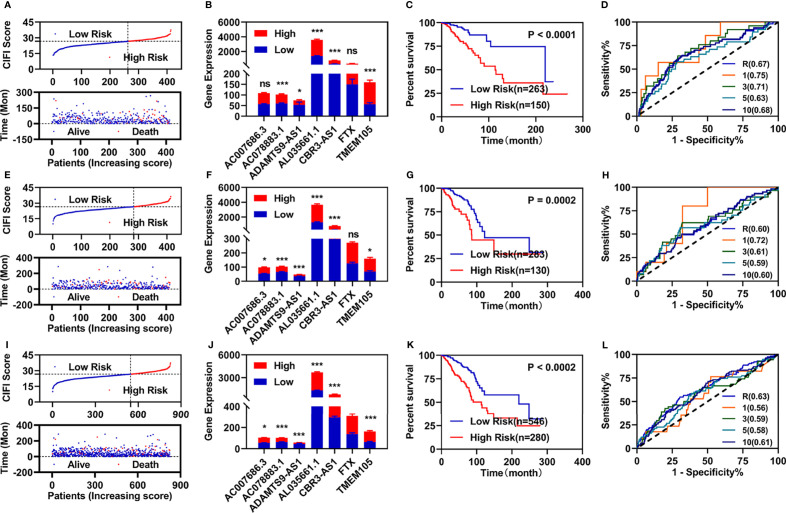
We found that seven ferroptosis- and immune-related differentially expressed lncRNAs (FI-DELs) (AC007686.3, AC078883.1, ADAMTS9-AS1, AL035661.1, CBR3-AS1, FTX, and TMEM105) were correlated with the overall survival of patients with breast infiltrating duct and lobular carcinoma. The areas under the receiver operating characteristic (AUCs) value of the prognosis model were all over 0.6 in training, validation, and entire groups. The sensitivity and specificity of the diagnosis model was 87.84% and 97.06%, respectively.
Through a series of bioinformatics analyses, we found that the seven FI-DELs could serve as prognostic and diagnostic biomarkers for patients with breast infiltrating duct and lobular carcinoma. However, whether these seven biomarkers could be really applied to the clinic requires further investigations.
乳腺癌(BRCA)的异质性与其预后显著相关。铁死亡和免疫的靶向治疗是近年来发现的一种新的癌症治疗选择。在本研究中,我们旨在通过综合分析鉴定与铁死亡和免疫相关的长链非编码RNA(lncRNA),以准确预测乳腺浸润性导管癌和小叶癌患者的预后和诊断。
通过综合分析从癌症基因组图谱(TCGA)获得乳腺浸润性导管癌和小叶癌患者的相应数据。采用单变量和多变量Cox回归分析来鉴定合适的候选生物标志物。
我们发现7种与铁死亡和免疫相关的差异表达lncRNA(FI-DELs)(AC007686.3、AC078883.1、ADAMTS9-AS1、AL035661.1、CBR3-AS1、FTX和TMEM105)与乳腺浸润性导管癌和小叶癌患者的总生存期相关。预后模型在训练组、验证组和全组中的受试者操作特征曲线下面积(AUC)值均超过0.6。诊断模型的敏感性和特异性分别为87.84%和97.06%。
通过一系列生物信息学分析,我们发现这7种FI-DELs可作为乳腺浸润性导管癌和小叶癌患者的预后和诊断生物标志物。然而,这7种生物标志物是否真的能应用于临床还需要进一步研究。