School of Architecture, Tianjin University, Tianjin, China.
School of Architecture, Harbin Institute of Technology (Shenzhen), Shenzhen, China.
Front Public Health. 2022 Apr 4;10:861743. doi: 10.3389/fpubh.2022.861743. eCollection 2022.
Adolescence is a crucial stage for health behavior development, which is associated with health in adulthood. School closures caused by the coronavirus disease 2019 (COVID-19) pandemic have exposed adolescents to an increased risk of obesity due to a lack of physical activity. Although social network interventions provide an effective approach for promoting health-related behavior, current practices neglect gender differences in adolescent behavioral patterns and emotional preferences. The aim of this study was to examine the effectiveness of centrality-based methods integrated with of gender contexts in a social network intervention to improve adolescent's health behavior.
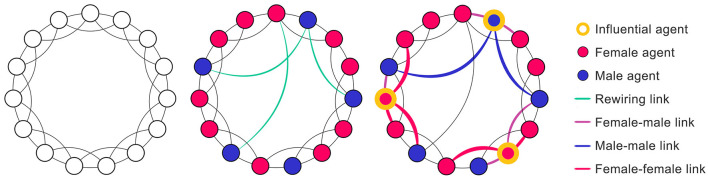
We developed an agent-based model (ABM) that supports the small-world characteristics of adolescent social networks. Health-related data for junior middle school students ( = 234, 48% girls) were collected in November 2018, 2019 and 2020 in Tianjin, China. We simulated multiple network-based interventions with different criteria for influential agents (i.e., betweenness centrality, closeness centrality, eigenvector centrality, and PageRank) and a random condition. The rules for generating peer influence and accelerating behavioral changes were based on the diffusion of innovations theory, with gender specifications.
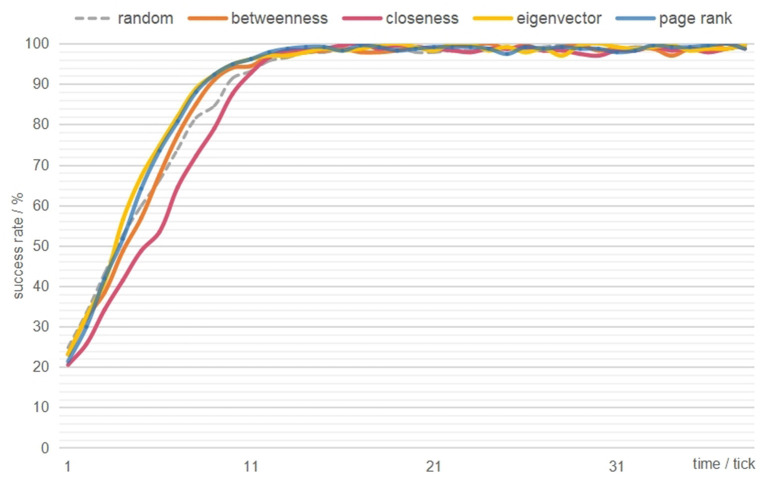
After the school closures, there was a significant increase in the prevalence of overweight and obesity among adolescents, with a greater increase in girls than in boys (+8.85% vs. +1.65%, < 0.001). Simulations showed that centrality-based network interventions were more effective than the random condition (average 6.17% per tick vs. 5.22% per tick, < 0.05), with a higher efficiency in girls than boys (average 3.68% vs. 2.99% per tick, < 0.05). PageRank outperformed other centrality conditions at the population level (6.37% per tick, p < 0.05). In girls, betweenness centrality was the best method (3.85% per tick, < 0.05), while in boys, PageRank still had the greatest efficiency (3.21% per tick, < 0.05).
We found evidence for gender differences in the negative impact of COVID-19-related school closures and the potential for centrality-based social network interventions to affect adolescent health behavior. Therefore, we emphasize the importance of gender-specific targeting strategies to further promote health-related school programs in the post-pandemic era.
青春期是健康行为发展的关键阶段,与成年期的健康息息相关。由于缺乏身体活动,新冠病毒疾病 2019(COVID-19)大流行导致的学校关闭使青少年面临肥胖风险增加。尽管社交网络干预为促进健康相关行为提供了一种有效方法,但目前的实践忽视了青少年行为模式和情绪偏好的性别差异。本研究旨在检验基于中心度的方法与社交网络干预中性别背景相结合,以改善青少年健康行为的有效性。
我们开发了一个支持青少年社交网络小世界特征的基于主体的模型(ABM)。2018 年 11 月、2019 年和 2020 年在中国天津收集了初中生(n=234,48%为女生)的健康相关数据。我们模拟了具有不同影响力代理人标准(即,介数中心度、接近中心度、特征向量中心度和 PageRank)和随机条件的多种基于网络的干预。同伴影响和加速行为变化的规则基于创新扩散理论,并具有性别规范。
学校关闭后,青少年超重和肥胖的患病率显著增加,女生的增幅大于男生(+8.85%比+1.65%,<0.001)。模拟结果表明,基于中心度的网络干预比随机条件更有效(平均每 tick 增加 6.17%比每 tick 增加 5.22%,<0.05),且对女生的效果优于男生(平均每 tick 增加 3.68%比每 tick 增加 2.99%,<0.05)。在人群水平上,PageRank 优于其他中心度条件(每 tick 增加 6.37%,p<0.05)。在女生中,介数中心度是最佳方法(每 tick 增加 3.85%,<0.05),而在男生中,PageRank 仍然具有最大效率(每 tick 增加 3.21%,<0.05)。
我们发现有证据表明,COVID-19 相关学校关闭对青少年的负面影响存在性别差异,并且基于中心度的社交网络干预有潜力影响青少年的健康行为。因此,我们强调需要针对特定性别制定策略,以在后疫情时代进一步促进与健康相关的学校计划。