Tidona Flavio, Zago Miriam, Carminati Domenico, Giraffa Giorgio
Council for Agricultural Research and Economics, Research Centre for Animal Production and Aquaculture (CREA-ZA), Lodi, Italy.
Front Nutr. 2022 Apr 4;9:859694. doi: 10.3389/fnut.2022.859694. eCollection 2022.
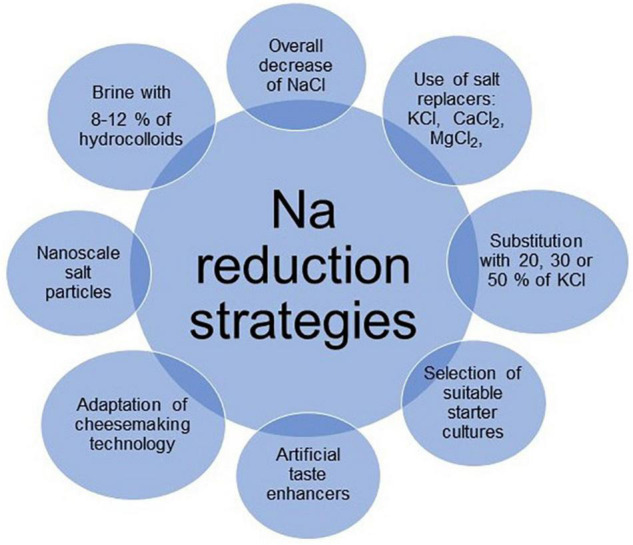
Public awareness about excessive sodium intake and nutrition claims related to salt content entail the need for food industries to carefully reconsider the composition and processing of high sodium foods. Although in some products the reformulation with alternative ingredients is commonly practiced, in cheese the reduction of salt is still a challenging task, as sodium chloride exerts multiple and fundamental functions. Salt favors the drainage of the residual whey, enhances the taste and the aroma profile, regulates the texture, the final pH, the water activity, and affects the microbial growth. Ultimately, salt content modulates the activity of starter and non-starter lactic acid bacteria (NSLAB) during cheese manufacturing and ripening, influencing the shelf-life. Any modification of the salting procedure, either by reducing the level of sodium chloride content or by replacing it with other salting agents, may affect the delicate equilibrium within the above-mentioned parameters, leading to changes in cheese quality. The decrease of Na content may be differently approached according to cheese type and technology (e.g., soft, semi-hard, hard, and mold-ripened cheeses). Accordingly, targeted strategies could be put in place to maintain the overall quality and safety of different cheeses categories.
公众对过量钠摄入以及与盐含量相关的营养声明的认知,使得食品行业有必要仔细重新考虑高钠食品的成分和加工过程。尽管在某些产品中,用替代成分重新配方是常见做法,但在奶酪中,减少盐分仍然是一项具有挑战性的任务,因为氯化钠具有多种重要功能。盐有利于残留乳清的排出,增强口感和香气特征,调节质地、最终pH值、水分活度,并影响微生物生长。最终,盐含量在奶酪制造和成熟过程中调节发酵剂和非发酵剂乳酸菌(NSLAB)的活性,影响保质期。盐渍程序的任何改变,无论是通过降低氯化钠含量水平还是用其他盐渍剂替代它,都可能影响上述参数之间的微妙平衡,导致奶酪质量发生变化。根据奶酪类型和工艺(如软质、半硬质、硬质和霉菌成熟奶酪),降低钠含量的方法可能会有所不同。因此,可以制定有针对性的策略来维持不同奶酪类别的整体质量和安全性。