Amaral Marrero Natalia P, Thomovsky Stephanie A, Linder Jessica E, Bowditch Jessica, Lind Mallory, Kazmierczak Kristine A, Moore George E, Lewis Melissa J
Department of Veterinary Clinical Sciences, Purdue University College of Veterinary Medicine, West Lafayette, IN, United States.
Department of Veterinary Administration, College of Veterinary Medicine, Purdue University, West Lafayette, IN, United States.
Front Vet Sci. 2022 Apr 4;9:877402. doi: 10.3389/fvets.2022.877402. eCollection 2022.
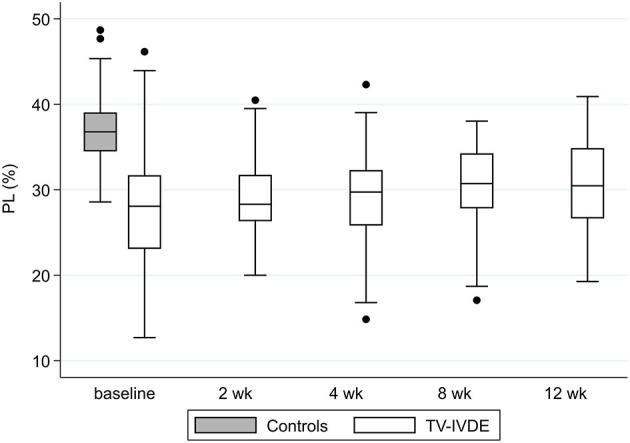
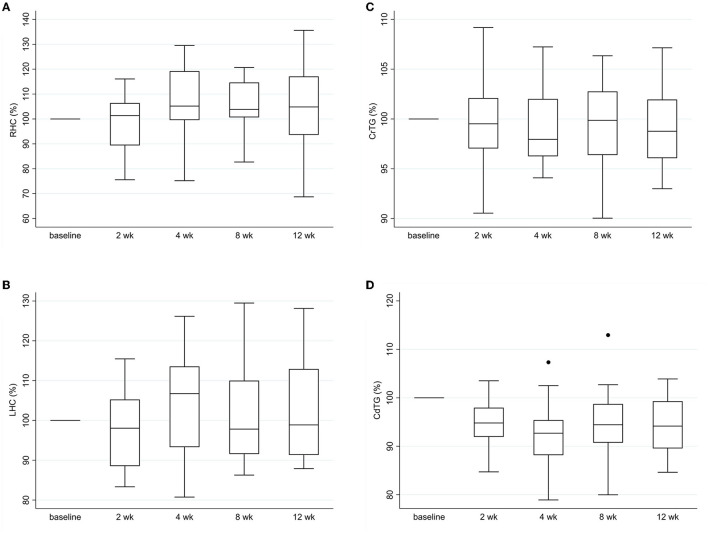
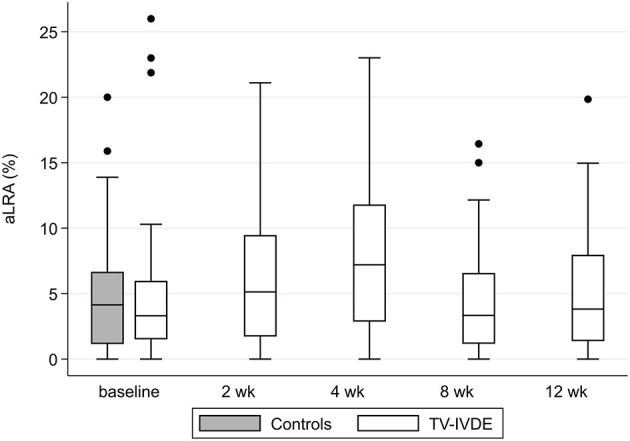
Dogs with thoracolumbar intervertebral disc extrusion (TL-IVDE) can exhibit variable neurologic deficits after decompressive surgery. The objectives of this study were to quantify changes in static weight distribution (SWD) and limb and body circumference over time in dogs recovering from surgery for TL-IVDE. Dogs with acute TL-IVDE were prospectively evaluated at baseline (48-72 h post-operatively), 2, 4, 8, and 12 weeks post-operatively. Commercially-available digital scales were used to measure weight distributed to the pelvic limbs (PL%) and asymmetry between left and right pelvic limbs (LRA), each expressed as a percentage of total body weight. Trunk and thigh circumference measurements were performed using a spring-loaded tape measurement device. Measurements were performed in triplicate, compared to neurologically normal small breed control dogs and analyzed for changes over time. P <0.05 was significant. Twenty-one dogs were enrolled; 18 regained ambulation and 3 did not by study completion. PL% increased from 27.6% at baseline to 30.7% at 12 weeks but remained lower than in control dogs (37%) at all time points ( < 0.0001), even excluding dogs still non-ambulatory at 12 weeks ( < 0.025). LRA was similar to the control dogs, and did not have an association with surgical side. Caudal trunk girth decreased over time to 95% of baseline ( = 0.0002), but this was no longer significant after accounting for reductions in body weight ( = 0.30). Forward shifting of body weight persisted in dogs with TL-IVDE 12 weeks after surgery even among ambulatory dogs. SWD and circumference measurements could provide additional objective measures to monitor recovery.
患有胸腰椎椎间盘突出症(TL-IVDE)的犬只在减压手术后可能会出现不同程度的神经功能缺损。本研究的目的是量化接受TL-IVDE手术的犬只术后恢复过程中静态体重分布(SWD)以及肢体和身体周长随时间的变化。对患有急性TL-IVDE的犬只在基线期(术后48 - 72小时)、术后2周、4周、8周和12周进行前瞻性评估。使用市售数字秤测量分配到后肢的体重(PL%)以及左右后肢之间的不对称性(LRA),两者均以占总体重的百分比表示。使用弹簧卷尺测量装置进行躯干和大腿周长测量。测量重复进行三次,与神经功能正常的小型犬对照进行比较,并分析随时间的变化。P < 0.05具有统计学意义。共纳入21只犬;到研究结束时,18只恢复行走,3只未恢复。PL%从基线时的27.6%增加到12周时的30.7%,但在所有时间点均低于对照犬(37%)(P < 0.0001),即使排除12周时仍未恢复行走的犬只也是如此(P < 0.025)。LRA与对照犬相似,且与手术侧无关。尾侧躯干周长随时间减少至基线的95%(P = 0.0002),但在考虑体重减轻因素后不再具有统计学意义(P = 0.30)。即使在术后12周能够行走的患有TL-IVDE的犬只中,体重向前转移的情况仍然存在。SWD和周长测量可为监测恢复情况提供额外的客观指标。