Surgical Research Laboratory and Section of Hepatobiliary Surgery and Liver Transplantation, Department of Surgery, University of Groningen, University Medical Center Groningen, Groningen, the Netherlands.
Int J Lab Hematol. 2022 Sep;44 Suppl 1(Suppl 1):79-88. doi: 10.1111/ijlh.13856. Epub 2022 Apr 21.
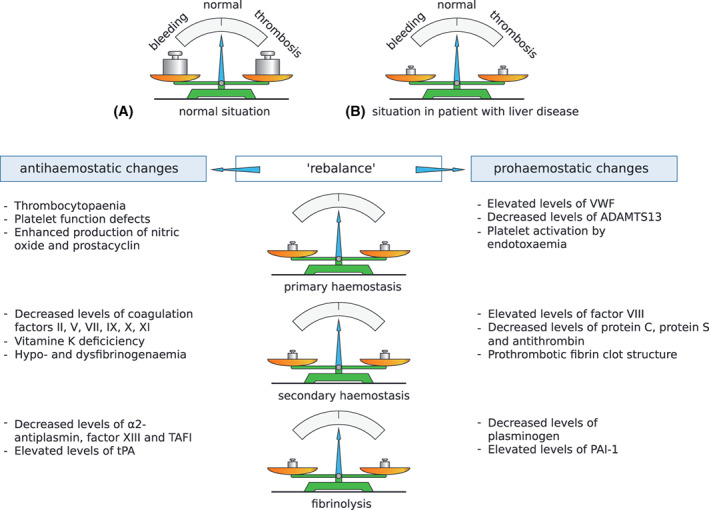
Patients with liver disease often develop complex changes in their haemostatic system. Frequently observed changes include thrombocytopaenia and altered plasma levels of most of the proteins involved in haemostasis. Although liver disease was historically classified as a haemostasis-related bleeding disorder, it has now been well established that the antihaemostatic changes that promote bleeding are compensated for by prohaemostatic changes. Conventional coagulation tests however do not accurately reflect these prohaemostatic changes, resulting in an underestimation of haemostatic potential. Novel coagulation tests, such as viscoelastic tests (VETs) and thrombin generation assays (TGAs) better reflect the net result of the haemostatic changes in patients with liver disease, and demonstrate a new, "rebalanced" haemostatic status. Although rebalanced, this haemostatic status is more fragile than in patients without liver disease. Patients with liver disease are therefore not only at risk of bleeding but also at risk of thrombosis. Notably, however, many haemostatic complications in liver disease are not related to the haemostatic failure. It is, therefore, crucial to identify the cause of the bleed or thrombotic complication in order to provide adequate treatment. In this paper, we will elaborate on the haemostatic changes that occur in liver disease, reflect on laboratory and clinical studies over the last few years, and explore the pathophysiologies of bleeding and thrombosis in this specific patient group.
肝病患者的止血系统常发生复杂变化。常观察到的变化包括血小板减少和大多数参与止血的蛋白质的血浆水平改变。尽管肝病在历史上被归类为与止血相关的出血性疾病,但现在已经明确,促进出血的抗止血变化被促凝血变化所代偿。然而,常规凝血试验并不能准确反映这些促凝血变化,导致对止血潜能的低估。新型凝血试验,如黏弹性试验(VET)和凝血酶生成试验(TGA),更好地反映了肝病患者止血变化的净结果,并显示出一种新的、“重新平衡”的止血状态。尽管重新平衡,这种止血状态比无肝病患者更脆弱。因此,肝病患者不仅有出血风险,而且有血栓形成风险。值得注意的是,然而,肝病中的许多止血并发症与止血失败无关。因此,确定出血或血栓并发症的原因对于提供适当的治疗至关重要。在本文中,我们将详细阐述肝病中发生的止血变化,反思过去几年的实验室和临床研究,并探讨该特定患者群体中出血和血栓形成的病理生理学。