Mukta Md Saddam Hossain, Islam Salekul, Shatabda Swakkhar, Ali Mohammed Eunus, Zaman Akib
Department of Computer Science and Engineering, United International University, Dhaka 1212, Bangladesh.
Department of Computer Science and Engineering, Bangladesh University of Engineering & Technology, Dhaka 1000, Bangladesh.
Behav Sci (Basel). 2022 Mar 23;12(4):87. doi: 10.3390/bs12040087.
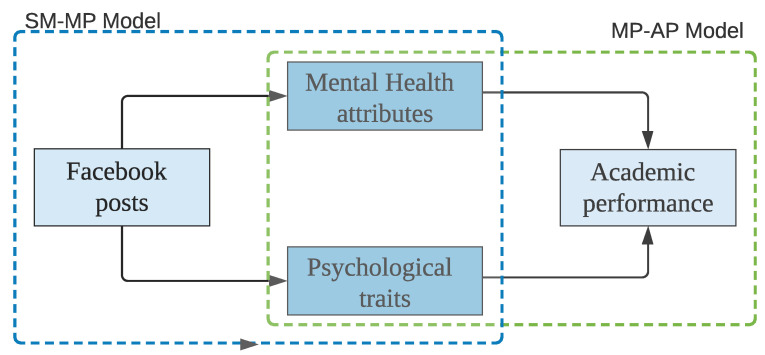
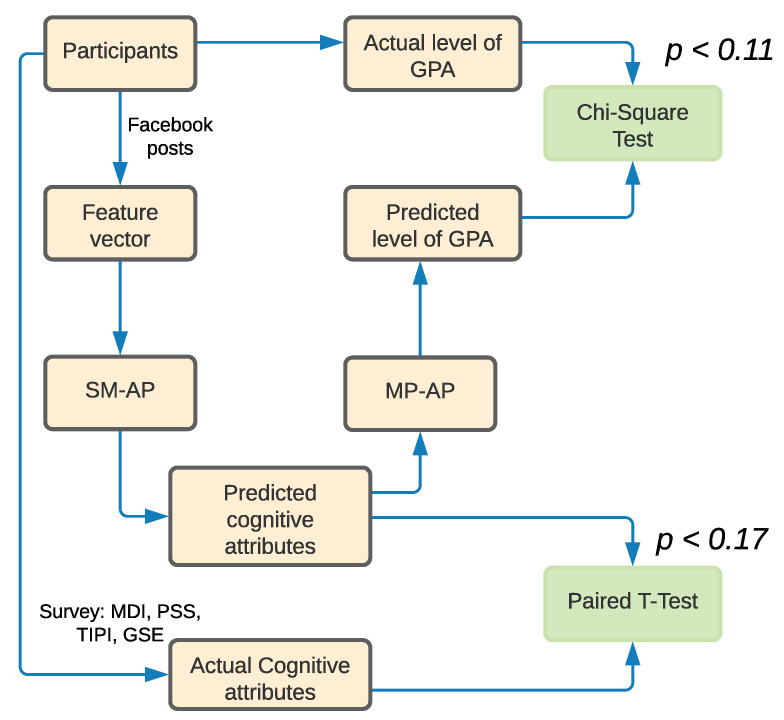
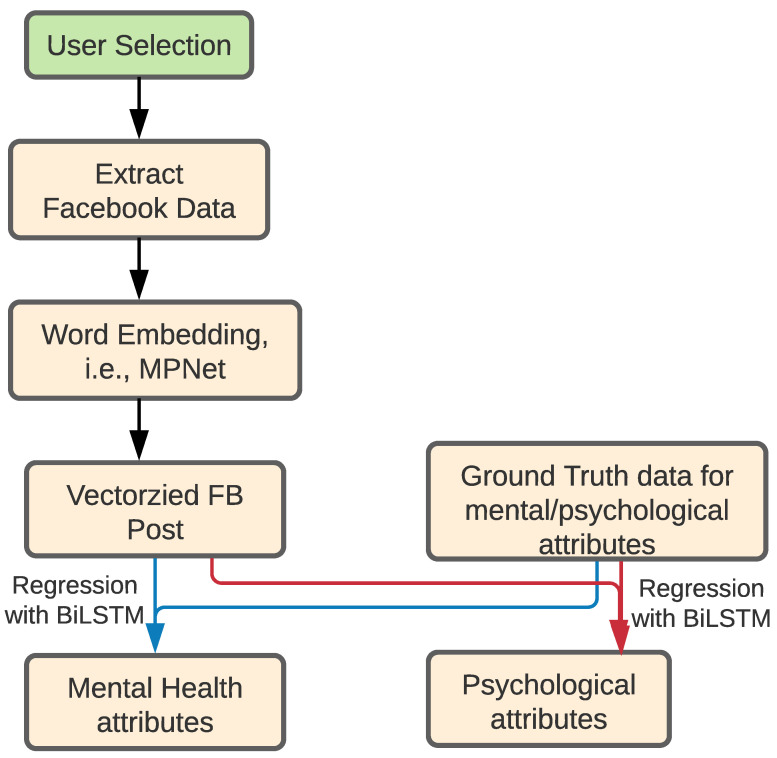
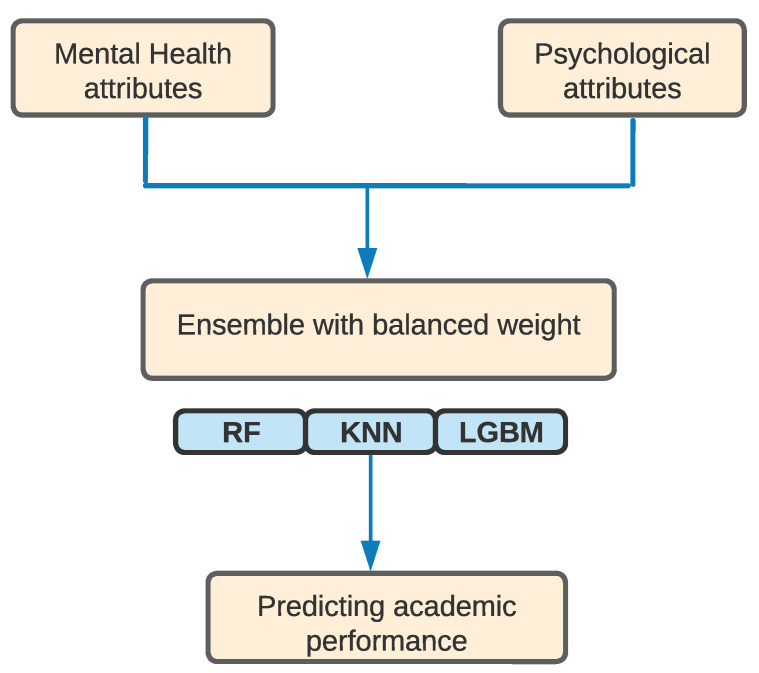
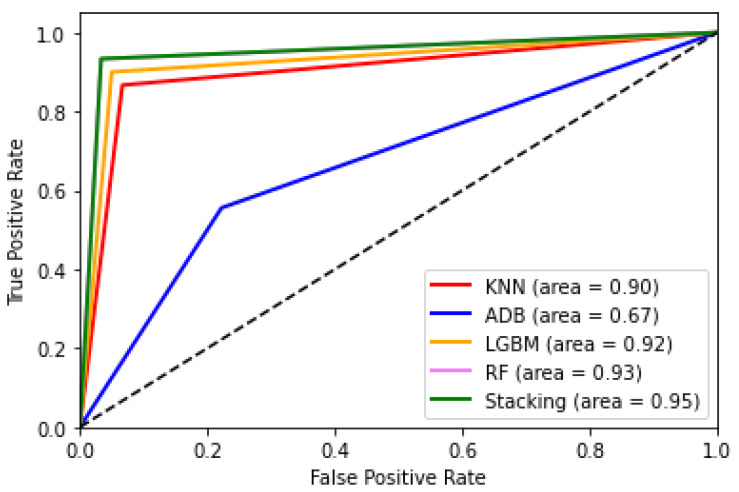
Social media have become an indispensable part of peoples' daily lives. Research suggests that interactions on social media partly exhibit individuals' personality, sentiment, and behavior. In this study, we examine the association between students' mental health and psychological attributes derived from social media interactions and academic performance. We build a classification model where students' psychological attributes and mental health issues will be predicted from their social media interactions. Then, students' academic performance will be identified from their predicted psychological attributes and mental health issues in the previous level. Firstly, we select samples by using judgmental sampling technique and collect the textual content from students' Facebook news feeds. Then, we derive feature vectors using MPNet (Masked and Permuted Pre-training for Language Understanding), which is one of the latest pre-trained sentence transformer models. Secondly, we find two different levels of correlations: (i) users' social media usage and their psychological attributes and mental health status and (ii) users' psychological attributes and mental health status and their academic performance. Thirdly, we build a two-level hybrid model to predict academic performance (i.e., Grade Point Average (GPA)) from students' Facebook posts: (1) from Facebook posts to mental health and psychological attributes using a regression model ( model) and (2) from psychological and mental attributes to the academic performance using a classifier model ( model). Later, we conduct an evaluation study by using real-life samples to validate the performance of the model and compare the performance with Baseline Models (i.e., Linguistic Inquiry and Word Count (LIWC) and Empath). Our model shows a strong performance with a microaverage f-score of 0.94 and an AUC-ROC score of 0.95. Finally, we build an ensemble model by combining both the psychological attributes and the mental health models and find that our combined model outperforms the independent models.
社交媒体已成为人们日常生活中不可或缺的一部分。研究表明,社交媒体上的互动部分展现了个人的性格、情绪和行为。在本研究中,我们考察了学生的心理健康与源自社交媒体互动的心理属性以及学业成绩之间的关联。我们构建了一个分类模型,用于根据学生的社交媒体互动来预测他们的心理属性和心理健康问题。然后,在前一阶段预测出的心理属性和心理健康问题的基础上,确定学生的学业成绩。首先,我们采用判断抽样技术选取样本,并从学生的脸书动态中收集文本内容。然后,我们使用MPNet(用于语言理解的掩码和置换预训练)导出特征向量,MPNet是最新的预训练句子变换器模型之一。其次,我们发现了两个不同层次的相关性:(i)用户的社交媒体使用情况与其心理属性和心理健康状况;(ii)用户的心理属性和心理健康状况与其学业成绩。第三,我们构建了一个两级混合模型,用于根据学生的脸书帖子预测学业成绩(即平均绩点(GPA)):(1)使用回归模型(模型)从脸书帖子预测心理健康和心理属性;(2)使用分类器模型(模型)从心理和心理属性预测学业成绩。之后,我们使用现实生活样本进行评估研究,以验证模型的性能,并与基线模型(即语言查询与字数统计(LIWC)和共情)比较性能。我们的模型表现出色,微平均F分数为0.94,AUC-ROC分数为0.95。最后,我们通过结合心理属性模型和心理健康模型构建了一个集成模型,发现我们的组合模型优于独立模型。