Jiang Yanyan, An Hedi, Xi Qian, Yang Weiting, Xie Hongrong, Li Yang, Huang Dongya
Department of Neurology, Shanghai East Hospital, Tongji University School of Medicine, Shanghai 200120, China.
Department of Radiology, Shanghai East Hospital, Tongji University School of Medicine, Shanghai 200120, China.
Brain Sci. 2022 Mar 30;12(4):463. doi: 10.3390/brainsci12040463.
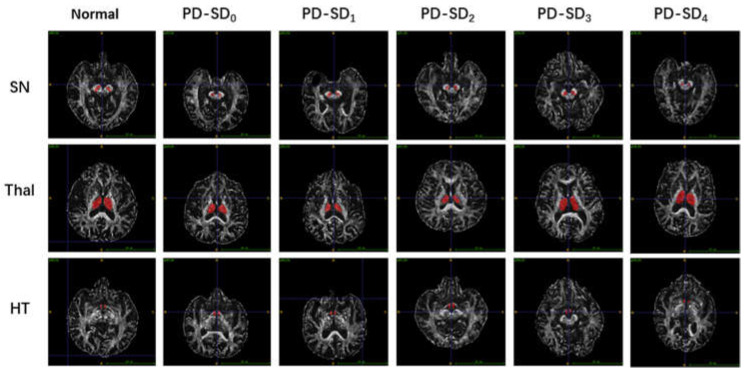
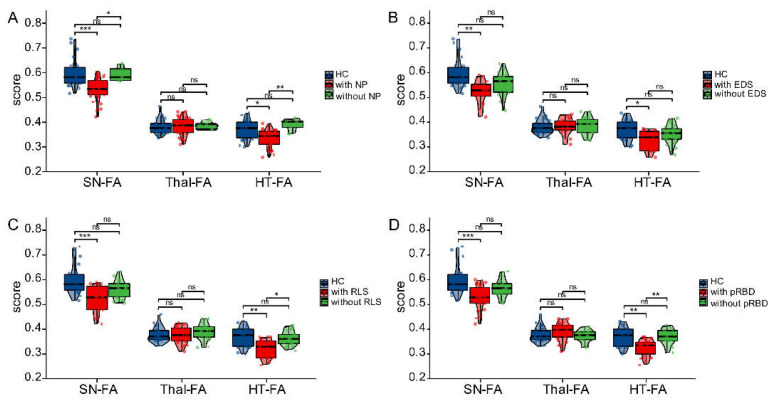
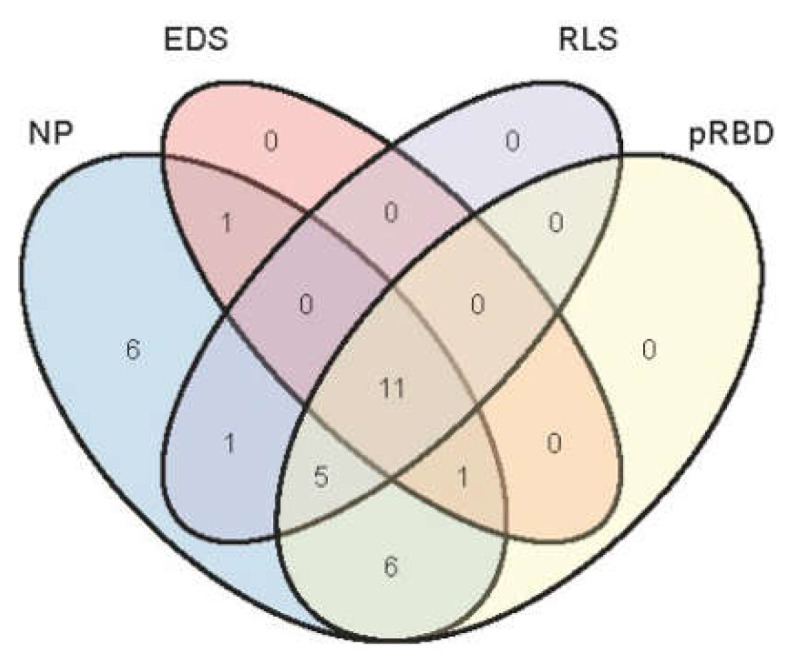
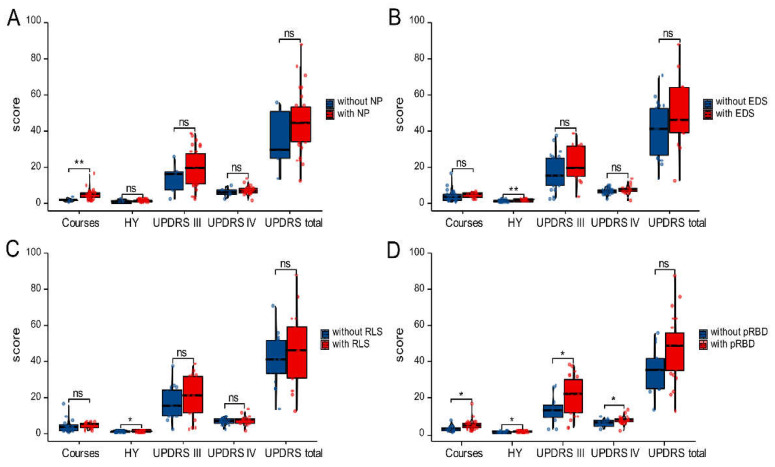
Parkinson’s disease (PD) is a progressive age-related movement disorder caused by dopaminergic neuron loss in the substantia nigra. Diffusion-based magnetic resonance imaging (MRI) studies—namely, diffusion tensor imaging (DTI)—have been performed in the context of PD, either with or without the involvement of sleep disorders (SDs), to deepen our understanding of cerebral microstructural alterations. Analyzing the clinical characteristics and neuroimaging features of SDs in early PD patients is beneficial for early diagnosis and timely invention. In our present study, we enrolled 36 early PD patients (31 patients with SDs and 5 patients without) and 22 healthy controls. Different types of SDs were assessed using the Rapid Eye Movement Sleep Behavior Disorder Questionnaire—Hong Kong, Epworth Sleepiness Scale, International Restless Legs Scale and PD Sleep Scale-2. Brain MRI examinations were carried out in all the participants, and a region-of-interest (ROI) analysis was used to determine the DTI-based fractional anisotropy (FA) values in the substantia nigra (SN), thalamus (Thal) and hypothalamus (HT). The results illustrate that SDs showed a higher prevalence in the early PD patients than in the healthy controls (86.11% vs. 27.27%). Early PD patients with nighttime problems (NPs) had longer courses of PD than those without (5.097 ± 2.925 vs. 2.200 ± 1.095; p < 0.05), and these patients with excessive daytime sleepiness (EDS) or restless legs syndrome (RLS) had more advanced Hoehn and Yahr stages (HY stage) than those without (1.522 ± 0.511 and 1.526 ± 0.513, respectively; both p < 0.05). Compared with the early PD patients without probable rapid eye movement sleep behavior disorder (pRBD), those with pRBD had longer courses, more advanced HY stages and worse motor and non-motor symptoms of PD (course(years), 3.385 ± 1.895 vs. 5.435 ± 3.160; HY stages, 1.462 ± 0.477 vs. 1.848 ± 0.553; UPDRS, 13.538 ± 7.333 vs. 21.783 ± 10.766; UPDRS, 6.538 ± 1.898 vs. 7.957 ± 2.345; all p < 0.05). In addition, the different number of SD types in early PD patients was significantly inversely associated with the severity of damage in the SN and HT. All of the early PD patients with various SDs had injuries in the SN, in whom the damage was more pronounced in patients with NP than those without. Moreover, early PD patients with NP, RLS or pRBD had worse degrees of HT damage than those without. The current study demonstrated the pathophysiological features and neuroimaging changes in early PD patients with various types of sleep disorders, which will help in early diagnosis and therapy.
帕金森病(PD)是一种与年龄相关的进行性运动障碍,由黑质中的多巴胺能神经元丢失引起。基于扩散的磁共振成像(MRI)研究——即扩散张量成像(DTI)——已在PD患者中开展,无论是否伴有睡眠障碍(SDs),以加深我们对脑微结构改变的理解。分析早期PD患者SDs的临床特征和神经影像学特征有助于早期诊断和及时干预。在本研究中,我们纳入了36例早期PD患者(31例伴有SDs,5例不伴有)和22名健康对照者。使用快速眼动睡眠行为障碍问卷——香港版、爱泼华嗜睡量表、国际不宁腿量表和PD睡眠量表-2评估不同类型的SDs。对所有参与者进行脑部MRI检查,并采用感兴趣区(ROI)分析来确定黑质(SN)、丘脑(Thal)和下丘脑(HT)基于DTI的分数各向异性(FA)值。结果表明,SDs在早期PD患者中的患病率高于健康对照者(86.11%对27.27%)。有夜间问题(NPs)的早期PD患者的PD病程长于无夜间问题的患者(5.097±2.925对2.200±1.095;p<0.05),这些有日间过度嗜睡(EDS)或不宁腿综合征(RLS)的患者的Hoehn和Yahr分期(HY分期)比无这些症状的患者更严重(分别为1.522±0.511和1.526±0.513;均p<0.05)。与无可能快速眼动睡眠行为障碍(pRBD)的早期PD患者相比,有pRBD的患者病程更长、HY分期更严重,且PD的运动和非运动症状更差(病程(年),3.385±1.895对5.435±3.160;HY分期,1.462±0.477对1.848±0.553;统一帕金森病评定量表(UPDRS),13.538±7.333对21.783±10.766;UPDRS,6.538±1.898对7.957±2.345;均p<0.05)。此外,早期PD患者中不同SD类型的数量与SN和HT的损伤严重程度显著负相关。所有患有各种SDs的早期PD患者的SN均有损伤,其中有NPs的患者的损伤比无NPs的患者更明显。此外,有NP、RLS或pRBD的早期PD患者的HT损伤程度比无这些症状的患者更严重。本研究展示了不同类型睡眠障碍的早期PD患者的病理生理特征和神经影像学变化,这将有助于早期诊断和治疗。