Ingram School of Nursing, McGill University, Montreal, QC H3A 0G4, Canada.
Jewish General Hospital, Montreal, QC H3T 1E2, Canada.
Curr Oncol. 2022 Apr 17;29(4):2848-2863. doi: 10.3390/curroncol29040232.
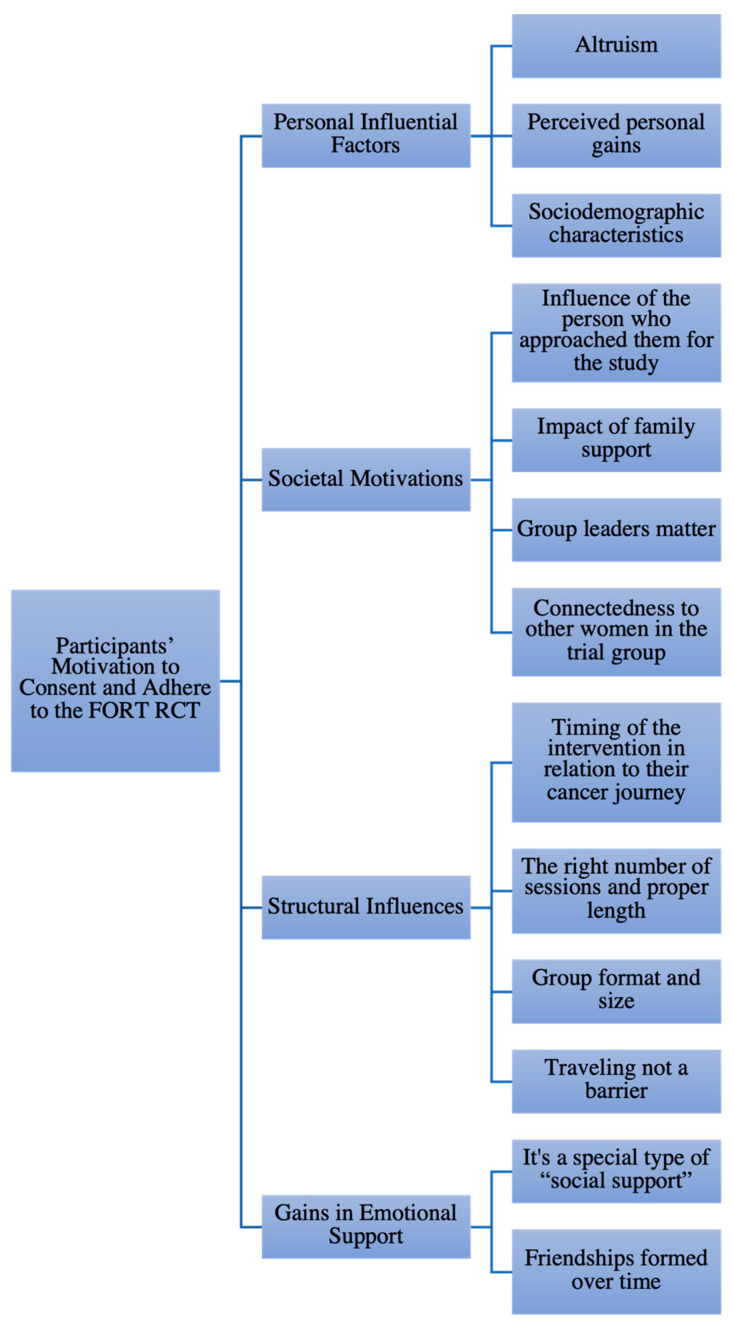
The aim of this qualitative study was to identify the motivational factors that influence cancer survivors to participate and adhere to the fear of cancer recurrence (FCR) FORT randomized controlled trial (RCT). Fifteen women diagnosed with breast and gynecological cancer who took part in the FORT RCT were interviewed about their experience to consent and adhere to the trial. The transcribed interviews were content analyzed within a relational autonomy framework. The analysis revealed that the participants' motivation to consent and adhere to the FORT RCT was structured around thirteen subthemes grouped into four overarching themes: (1) Personal Influential Factors; (2) Societal Motivations; (3) Structural Influences; and (4) Gains in Emotional Support. The unique structures of the trial such as the group format, the friendships formed with other participants in their group and with the group leaders, and the right timing of the trial within their cancer survivorship trajectory all contributed to their motivation to consent and adhere to the FORT RCT. While their initial motivation to participate was mostly altruistic, it was their personal gains obtained over the course of the trial that contributed to their adherence. Potential gains in emotional and social support from psycho-oncology trials should be capitalized when approaching future participants as a mean to improve on motivations to consent and adhere.
本定性研究旨在确定激励癌症幸存者参与并坚持恐惧癌症复发(FCR)FORT 随机对照试验(RCT)的因素。对参加 FORT RCT 的 15 名被诊断患有乳腺癌和妇科癌症的女性进行了采访,以了解她们同意并坚持试验的经验。在关系自主框架内对转录访谈进行了内容分析。分析结果显示,参与者同意并坚持 FORT RCT 的动机围绕着 13 个小标题组织,分为四个主要主题:(1)个人影响因素;(2)社会动机;(3)结构影响;(4)情感支持的收益。该试验的独特结构,如小组形式、与小组中的其他参与者以及与小组领导建立的友谊,以及试验在癌症生存轨迹中的适当时间,都促成了他们同意并坚持 FORT RCT 的动机。虽然他们最初参与的动机主要是利他主义的,但正是他们在试验过程中获得的个人收益促成了他们的坚持。在招募未来参与者时,应充分利用心理肿瘤学试验可能获得的情感和社会支持方面的潜在收益,以提高同意和坚持的动机。