Pietrogrande Maria Chiara, Romanato Luisa, Russo Mara
Department of Chemical, Pharmaceutical and Agricultural Sciences, University of Ferrara, 44121 Ferrara, Italy.
Toxics. 2022 Apr 16;10(4):196. doi: 10.3390/toxics10040196.
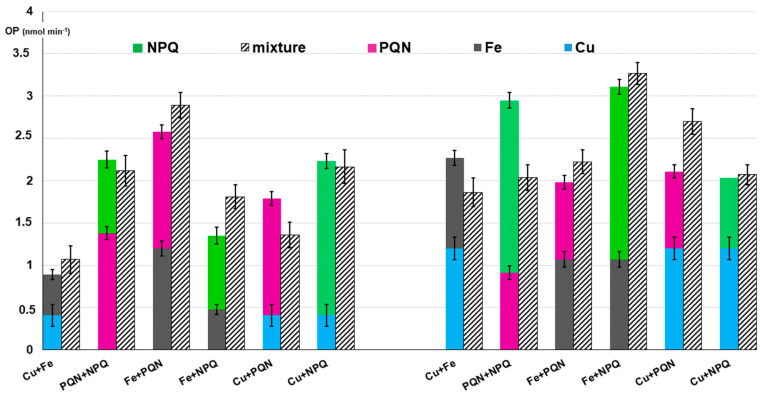
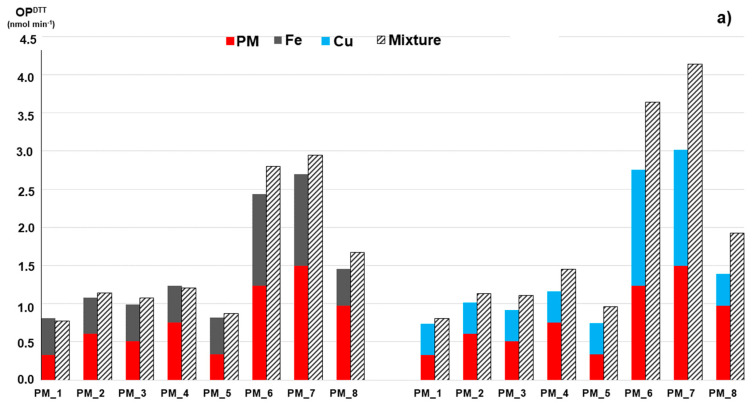
Quantifying the component-specific contribution to the oxidative potential (OP) of ambient particle matter (PM) is the key information to properly representing its acute health hazards. In this study, we investigated the interactions between the major contributors to OP, i.e., transition metals and quinones, to highlight the relative effects of these species to the total OP. Several synergistic and antagonistic interactions were found that significantly change the redox properties of their binary mixtures, increasing or decreasing the values computed by a simple additive model. Such results from the standard solutions were confirmed by extending the study to atmospheric PM samples collected in winter in the Lombardia region, a hot spot for air pollution in northern Italy. This work highlights that a solid estimation of oxidative properties of ambient PM requires an interaction-based approach accounting for the interaction effects between metals and quinones.
量化环境颗粒物(PM)各成分对氧化电位(OP)的特定贡献,是准确描述其急性健康危害的关键信息。在本研究中,我们调查了OP的主要贡献者(即过渡金属和醌类)之间的相互作用,以突出这些物种对总OP的相对影响。发现了几种协同和拮抗相互作用,这些相互作用显著改变了其二元混合物的氧化还原特性,增加或降低了通过简单加和模型计算的值。通过将研究扩展到意大利北部空气污染热点地区伦巴第大区冬季采集的大气PM样本,证实了标准溶液的这些结果。这项工作强调,对环境PM氧化特性的可靠估计需要一种基于相互作用的方法,该方法要考虑金属和醌类之间的相互作用效应。