Grupo de Investigación en Toxinología, Alternativas Terapéuticas y Alimentarias, Facultad de Ciencias Farmacéuticas y Alimentarias, Universidad de Antioquia, Medellin 1226, Colombia.
Centro de Investigación en Recursos Naturales y Sustentabilidad, Universidad Bernardo O'Higgins, Santiago 8320000, Chile.
Toxins (Basel). 2022 Apr 9;14(4):265. doi: 10.3390/toxins14040265.
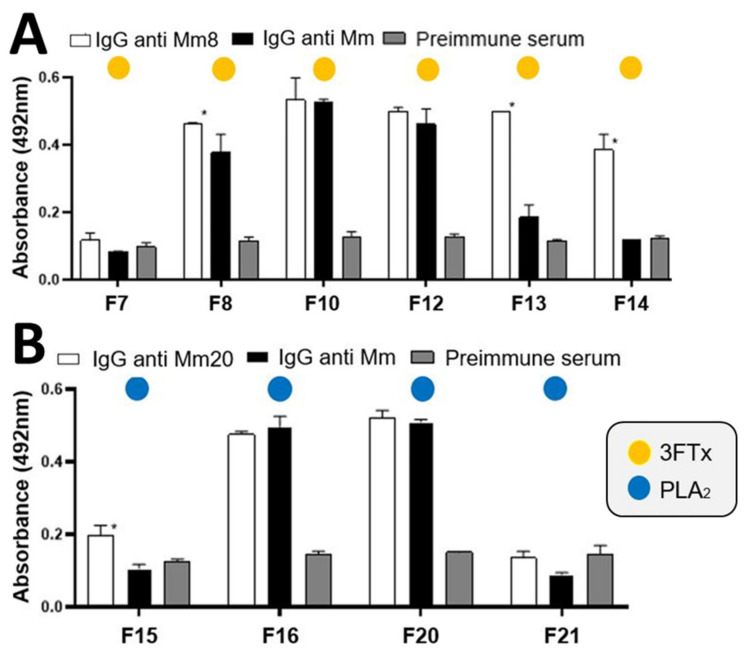
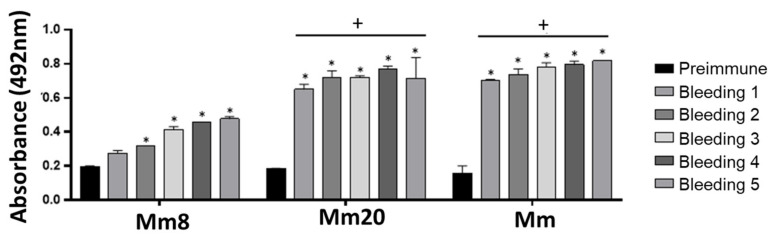
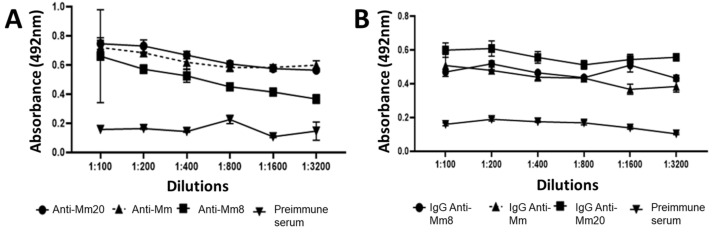
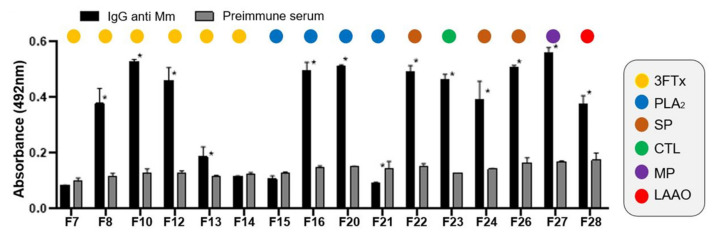
In Colombia, the genus includes 30 species, of which and are the most widely distributed. causes less than 3% of the approximately 5000 cases of snakebite per year. The elapid envenomation caused by the snakes from the genus, are characterized by the severity of their clinical manifestations, due to the venom neurotoxic components such as three-finger toxins (3FTx) and phospholipases (PLA). The treatment for snakebites is the administration of specific antivenoms, however, some of them have limitations in their neutralizing ability. A strategy proposed to improve antivenoms is to produce antibodies against the main components of the venom. The aim of this work was to produce an antivenom, using an immunization protocol including the main 3FTx and PLA responsible for lethality. The antibody titers were determined by ELISA in rabbits' serum. The immunized animals elicited a response against toxins and whole venom. The Immunoglobulin G (IgGs) obtained were able to neutralize the lethal effect of their homologous toxins. A combination of antivenom from with antitoxins improved their neutralizing ability. In the same way, a mixture of anti 3FTx and PLA protected the mice from a 1.5 median lethal dose (LD) of venom. The results showed that this might be a way to improve antibody titers specificity against the relevant toxins in venom and indicated that there is a possibility to develop and use recombinant 3FTx and PLA toxins as immunogens to produce antivenoms. Additionally, this represents an alternative to reduce the amount of venom used in anti-coral antivenom production.
在哥伦比亚,属包括 30 种,其中 和 分布最广。 在每年大约 5000 例蛇伤病例中,不到 3%是由 引起的。由 属的蛇引起的眼镜蛇科蛇毒中毒,其临床症状严重,这是由于毒液中的神经毒性成分,如三指毒素 (3FTx) 和磷脂酶 (PLA)。蛇伤的治疗是使用特异性抗蛇毒血清,但其中一些在中和能力方面存在局限性。为了提高抗蛇毒血清的效果,提出了一种策略,即用毒液的主要成分生产抗体。本工作的目的是使用包括主要 3FTx 和 PLA 的免疫方案生产抗蛇毒血清,这些成分与致死性有关。用 ELISA 在兔血清中测定抗体滴度。免疫动物对毒素和全毒液产生了反应。获得的免疫球蛋白 G (IgGs) 能够中和同源毒素的致死作用。与 抗蛇毒血清和抗毒素的组合提高了它们的中和能力。同样,抗 3FTx 和 PLA 的混合物可保护小鼠免受 1.5 中位数致死剂量 (LD) 的 毒液的侵害。结果表明,这可能是提高针对 毒液中相关毒素的抗体特异性滴度的一种方法,并表明有可能开发和使用重组 3FTx 和 PLA 毒素作为免疫原来生产抗蛇毒血清。此外,这代表了一种减少抗珊瑚蛇毒血清生产中使用毒液量的替代方法。