Guangxi Key Laboratory for Polysaccharide Materials and Modifications, School of Marine Sciences and Biotechnology, Guangxi Minzu University, Nanning, 530008, China.
BMC Plant Biol. 2022 Apr 22;22(1):208. doi: 10.1186/s12870-022-03591-z.
Plant growth-promoting rhizobacteria (PGPR) release volatile organic compounds (VOCs), which promote plant growth.
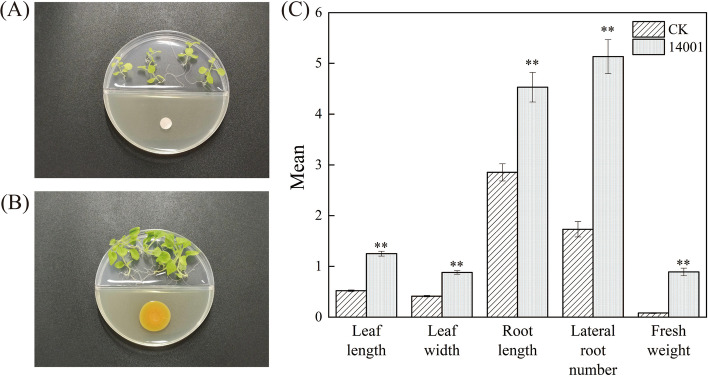
A potential PGPR strain GX14001 was isolated from marine samples, and the VOCs produced by GX14001 significantly promoted tobacco (Nicotiana benthamiana) growth in a plate experiment. Based on 16S rRNA sequence alignment and physiological and biochemical characterization, GX14001 was identified as Microbacterium aurantiacum. Comparative transcriptome analysis was conducted between GX14001 VOCs-treated tobacco and the control; it was found that 1286 genes were upregulated and 1088 genes were downregulated. Gene ontology (GO) analysis showed that upregulated genes were involved in three biological processes: polysaccharide metabolic, polysaccharide catabolic and carbohydrate metabolic. The downregulated genes were involved in six biological processes, namely cell redox homeostasis, cellular homeostasis, carbohydrate metabolic process, homeostatic process, obsolete electron transport, and regulation of biological quality. Kyoto encyclopedia of genes and genomes (KEGG) pathway analysis showed that 190 upregulated differentially expressed genes were mainly involved in plant hormone signal transduction, phenylpropyl biosynthesis, plant-pathogen interaction, and flavonoid biosynthesis. The 148 downregulated differentially expressed genes were mainly involved in plant hormone signal transduction and the metabolism of ascorbic, aldehyde, and pyruvate acids. Further analysis revealed that many genes were differentially expressed in the metabolic pathways of plant hormone signals, which were speculated to be the main reason why GX14001 VOCs promoted tobacco growth. To further study its regulatory mechanism, we found that GX14001 promoted plant growth through auxin, salicylic acid, and gibberellin in Arabidopsis mutant experiments.
The VOCs produced by Microbacterium aurantiacum GX14001 may promote the growth of tobacco through the auxin, salicylic acid and gibberellin pathways.
植物促生根际细菌(PGPR)会释放挥发性有机化合物(VOCs),从而促进植物生长。
从海洋样本中分离到一株具有促生潜力的 PGPR 菌株 GX14001,该菌株产生的 VOCs 在平板实验中显著促进了烟草(Nicotiana benthamiana)的生长。通过 16S rRNA 序列比对和生理生化特性分析,GX14001 被鉴定为橙色微杆菌。对 GX14001VOCs 处理的烟草和对照烟草进行比较转录组分析,发现 1286 个基因上调,1088 个基因下调。基因本体(GO)分析表明,上调基因参与了三个生物学过程:多糖代谢、多糖分解和碳水化合物代谢。下调基因参与了六个生物学过程,即细胞氧化还原稳态、细胞内稳态、碳水化合物代谢过程、稳态过程、废弃电子传递和生物质量调节。京都基因与基因组百科全书(KEGG)通路分析表明,190 个上调差异表达基因主要参与植物激素信号转导、苯丙氨酸生物合成、植物-病原体相互作用和类黄酮生物合成。148 个下调差异表达基因主要参与植物激素信号转导和抗坏血酸、醛和丙酮酸的代谢。进一步分析表明,许多基因在植物激素信号代谢途径中差异表达,这被推测是 GX14001VOCs 促进烟草生长的主要原因。为了进一步研究其调控机制,我们发现 GX14001 通过拟南芥突变体实验中的生长素、水杨酸和赤霉素促进植物生长。
橙色微杆菌 GX14001 产生的 VOCs 可能通过生长素、水杨酸和赤霉素途径促进烟草生长。