Department of Surgery and Anatomy, Ribeirão Preto Medical School, University of São Paulo, Av. Bandeirantes, 3900, Ribeirão Preto, SP, Zip code: 14048-900, Brazil.
Federal University of Juiz de Fora, Juiz de Fora, Brazil.
BMC Gastroenterol. 2022 Apr 21;22(1):199. doi: 10.1186/s12876-022-02280-3.
The effectiveness of ustekinumab (UST) in the treatment of Crohn's disease (CD) has been demonstrated in the pivotal Phase 3 UNITI 1 and 2 and IM-UNITI studies in both anti-TNF-naïve and anti-TNF-exposed patients. Given the selective nature of pivotal trial designs, real-world effectiveness and safety studies are warranted. We report our experience with UST treatment in a large, real-world multicenter cohort of Brazilian patients with CD.
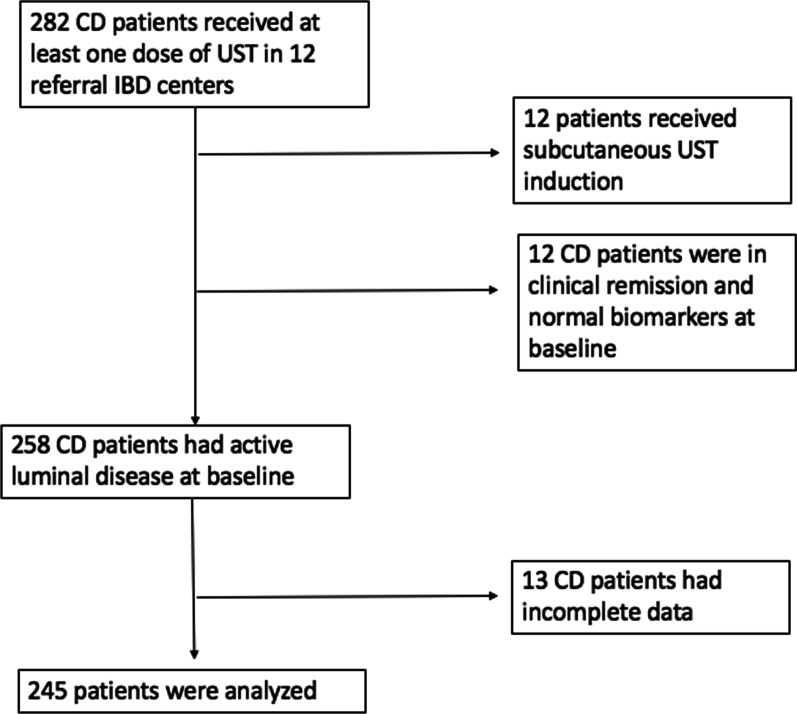
We performed a retrospective multicenter study including patients with CD, predominantly biologically refractory CD, who received UST. The primary endpoint was the proportion of patients in clinical remission at weeks 8, 24 and 56. Possible predictors of clinical and biological response/remission and safety outcomes were also assessed.
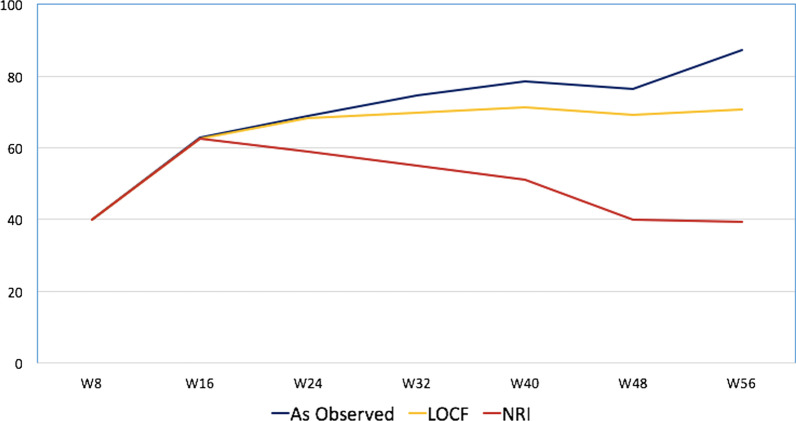
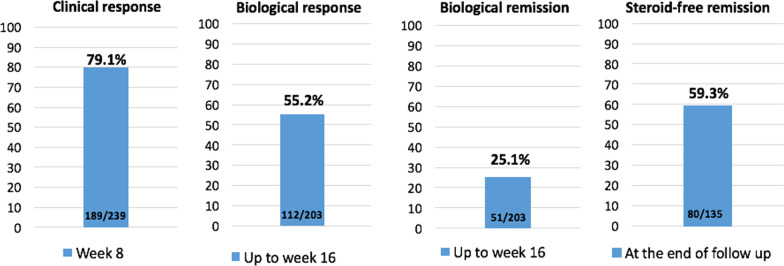
Overall, 245 CD (mean age 39.9 [15-87]) patients were enrolled. Most patients (86.5%) had been previously exposed to biologics. According to nonresponder imputation analysis, the proportions of patients in clinical remission at weeks 8, 24 and 56 were 41.0% (n = 98/239), 64.0% (n = 153/239) and 39.3% (n = 94/239), respectively. A biological response was achieved in 55.4% of patients at week 8, and 59.3% were in steroid-free remission at the end of follow-up. No significant differences in either clinical or biological remission were noted between bio-naïve and bio-experienced patients. Forty-eight patients (19.6%) presented 60 adverse events during the follow-up, of which 8 (13.3%) were considered serious adverse events (3.2% of 245 patients). Overall, a proximal disease location, younger age, perianal involvement, and smoking were associated with lower rates of clinical remission over time.
UST therapy was effective and safe in the long term in this large real-life cohort of Brazilian patients with refractory CD, regardless of previous exposure to other biological agents.
乌司奴单抗(UST)在抗 TNF 初治和经治患者的关键 3 期 UNITI 1 和 2 以及 IM-UNITI 研究中已被证实可有效治疗克罗恩病(CD)。鉴于关键性试验设计的选择性,真实世界的有效性和安全性研究是必要的。我们报告了在巴西一个大型真实世界多中心 CD 患者队列中使用 UST 治疗的经验。
我们进行了一项回顾性多中心研究,纳入了接受 UST 治疗的 CD 患者,主要为生物难治性 CD 患者。主要终点是第 8、24 和 56 周时处于临床缓解的患者比例。还评估了临床和生物学反应/缓解及安全性结局的可能预测因素。
总体而言,共纳入 245 例 CD(平均年龄 39.9 [15-87] 岁)患者。大多数患者(86.5%)曾接受过生物制剂治疗。根据无应答者推断分析,第 8、24 和 56 周时处于临床缓解的患者比例分别为 41.0%(n=98/239)、64.0%(n=153/239)和 39.3%(n=94/239)。第 8 周时 55.4%的患者实现了生物学应答,随访结束时 59.3%的患者处于无激素缓解状态。生物初治和生物经治患者之间的临床或生物学缓解率无显著差异。48 例患者(19.6%)在随访期间出现 60 例不良事件,其中 8 例(13.3%)被认为是严重不良事件(245 例患者中的 3.2%)。总体而言,近端疾病部位、年龄较小、肛周受累和吸烟与随时间推移临床缓解率较低相关。
在这项巴西难治性 CD 大型真实世界队列中,UST 治疗长期有效且安全,无论患者之前是否接触过其他生物制剂。