Department of Quality and Education, Aarhus University Hospital, Olof Palmes Allé 13, stuen, DK-8200, Aarhus, Denmark.
Administration, Randers Regional Hospital, Skovlyvej 15, DK-8930, Randers, Denmark.
BMC Med Educ. 2022 Apr 22;22(1):306. doi: 10.1186/s12909-022-03357-z.
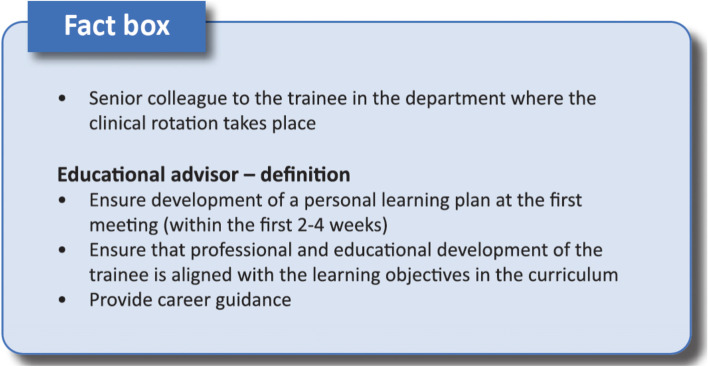
In Denmark a national formal advisory program (NFAP) is mandatory in Postgraduate Medical Education (PGME). According to this, an educational advisor is assigned to each doctor in every clinical rotation to guide and oversee the work and learning progress of the trainee. This study explores why newly graduated trainees evaluated the appraisal meetings in the advisory program as either beneficial (successes) or not beneficial (non-successes).
Inspired by the Success Case Method, a survey was conducted among all 129 doctors employed in their first six-month clinical rotation of postgraduate medical education (PGY1) in the Central Denmark Region. A cluster analysis resulted in a group with eight successes respectively seven non-successes. Semi-structured interviews were conducted with six successes and five non-successes.
In contrast to non-successes, the successes had longer appraisal meetings and their advisor introduced them to purpose and process of meetings including use of the personal learning plan. Successes received feedback on clinical skills, overall global performance and career plans. The successes perceived their advisors as prepared, skilled and motivated and the advisor acted as a contact person. To the successes, the appraisal meetings fostered clarification of and reflections on educational goals, progress and career as well as self-confidence and a sense of security.
Success with appraisal meetings seemed to depend on advisor's skills and motivation including willingness to prioritize time for this task. The results from this study indicate the importance of faculty development. It also raises the question if all doctors should serve as advisors or if this task should be assigned to the most motivated candidates.
在丹麦,研究生医学教育(PGME)中必须有国家正式咨询计划(NFAP)。根据该计划,为每个在临床轮转中的医生分配一名教育顾问,以指导和监督培训生的工作和学习进展。本研究探讨了为什么新毕业的受训者将咨询计划中的评估会议评估为有益(成功)或无益(非成功)。
受成功案例方法的启发,对丹麦中部地区所有 129 名从事研究生医学教育(PGY1)的第一个六个月临床轮转的医生进行了调查。聚类分析产生了一个有 8 个成功案例和 7 个非成功案例的小组。对六个成功案例和五个非成功案例进行了半结构化访谈。
与非成功案例相比,成功案例的评估会议时间更长,他们的顾问向他们介绍了会议的目的和流程,包括使用个人学习计划。成功案例收到了有关临床技能、整体表现和职业规划的反馈。成功案例认为他们的顾问有准备、有技能和有动力,顾问充当了联系人。对成功案例来说,评估会议促进了对教育目标、进展和职业的澄清和反思,以及自信和安全感。
评估会议的成功似乎取决于顾问的技能和积极性,包括愿意优先考虑这项任务的时间。本研究的结果表明师资发展的重要性。这也提出了一个问题,即是否所有医生都应该担任顾问,或者这项任务是否应该分配给最有积极性的候选人。