Specialist Laboratory Medicine, St James University Hospital, Leeds Teaching Hospitals NHS Trust, Leeds, UK.
Haemostasis Research Unit, University College London, London, UK.
Int J Lab Hematol. 2022 Oct;44(5):817-822. doi: 10.1111/ijlh.13855. Epub 2022 Apr 22.
Severe coronavirus disease 2019 (COVID-19) is characterized by marked hypoxaemia and lung oedema, often accompanied by disordered blood coagulation and fibrinolytic systems, endothelial damage and intravascular fibrin deposition.
PATIENTS/METHODS: We present a retrospective observational study of 104 patients admitted to hospital with COVID-19. Plasma samples were collected within 72 h of admission. In addition to routine coagulation and haematology testing, soluble thrombomodulin (sTM), thrombin-antithrombin (TAT), tissue plasminogen activator-plasminogen activator inhibitor 1 complex (tPAI-C) and plasmin-α2 antiplasmin complex (PIC) were performed by automated chemiluminescent enzyme immunoassays.
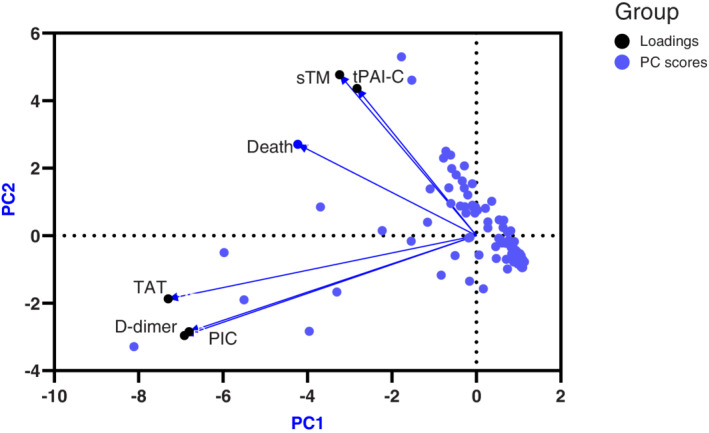
Significantly higher levels of D-dimer, TAT, sTM and tPAI-C were observed in non-survivors compared to survivors. To confirm which parameters were independent risk factors for mortality, multiple logistic regression was performed on D-dimer, TAT. sTM, tPAI-C and PIC data. Only increasing sTM was significantly associated with mortality, with an odds ratio of 1.065 for each 1.0 TU/mL increment (95% CI 1.025-1.115).
Of the haemostatic variables measured, sTM, which can be rapidly assayed, is the best independent predictor of mortality in patients hospitalized with COVID-19, and this suggests that endothelial dysfunction plays an important role in disease progression.
严重的 2019 年冠状病毒病(COVID-19)的特征是明显的低氧血症和肺水肿,常伴有凝血和纤维蛋白溶解系统紊乱、内皮损伤和血管内纤维蛋白沉积。
患者/方法:我们报告了 104 例 COVID-19 住院患者的回顾性观察性研究。在入院后 72 小时内采集血浆样本。除了常规凝血和血液学检测外,还通过自动化化学发光酶免疫测定法检测可溶性血栓调节蛋白(sTM)、凝血酶-抗凝血酶(TAT)、组织纤溶酶原激活物-纤溶酶原激活物抑制剂 1 复合物(tPAI-C)和纤溶酶-α2 抗纤溶酶复合物(PIC)。
与幸存者相比,非幸存者的 D-二聚体、TAT、sTM 和 tPAI-C 水平显著升高。为了确认哪些参数是死亡率的独立危险因素,对 D-二聚体、TAT、sTM、tPAI-C 和 PIC 数据进行了多变量逻辑回归分析。只有 sTM 的增加与死亡率显著相关,每增加 1.0 TU/mL,比值比为 1.065(95%CI 1.025-1.115)。
在所测量的止血变量中,sTM 是 COVID-19 住院患者死亡率的最佳独立预测因子,这表明内皮功能障碍在疾病进展中起重要作用。