Department of Anatomy, National University of Singapore, Singapore, 119260, Singapore.
Neurobiology Research Programme, Life Sciences Institute, National University of Singapore, Singapore, 119260, Singapore.
Neuromolecular Med. 2022 Dec;24(4):363-373. doi: 10.1007/s12017-022-08706-1. Epub 2022 Apr 22.
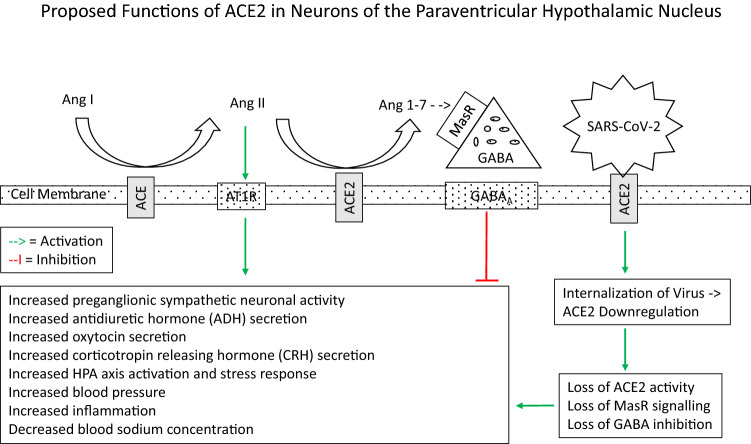
The SARS-CoV-2 virus gains entry to cells by binding to angiotensin-converting enzyme 2 (ACE2). Since circumventricular organs and parts of the hypothalamus lack a blood-brain barrier, and immunohistochemical studies demonstrate that ACE2 is highly expressed in circumventricular organs which are intimately connected to the hypothalamus, and the hypothalamus itself, these might be easy entry points for SARS-CoV-2 into the brain via the circulation. High ACE2 protein expression is found in the subfornical organ, area postrema, and the paraventricular nucleus of the hypothalamus (PVH). The subfornical organ and PVH are parts of a circuit to regulate osmolarity in the blood, through the secretion of anti-diuretic hormone into the posterior pituitary. The PVH is also the stress response centre in the brain. It controls not only pre-ganglionic sympathetic neurons, but is also a source of corticotropin-releasing hormone, that induces the secretion of adrenocorticotropic hormone from the anterior pituitary. It is proposed that the function of ACE2 in the circumventricular organs and the PVH could be diminished by binding with SARS-CoV-2, thus leading to a reduction in the ACE2/Ang (1-7)/Mas receptor (MasR) signalling axis, that modulates ACE/Ang II/AT1R signalling. This could result in increased presympathetic activity/neuroendocrine secretion from the PVH, and effects on the hypothalamic-pituitary-adrenal axis activity. Besides the bloodstream, the hypothalamus might also be affected by SARS-CoV-2 via transneuronal spread along the olfactory/limbic pathways. Exploring potential therapeutic pathways to prevent or attenuate neurological symptoms of COVID-19, including drugs which modulate ACE signalling, remains an important area of unmet medical need.
SARS-CoV-2 病毒通过与血管紧张素转换酶 2(ACE2)结合进入细胞。由于室周器官和下丘脑的某些部分缺乏血脑屏障,免疫组织化学研究表明 ACE2 在室周器官中高度表达,而室周器官与下丘脑密切相连,下丘脑本身也是如此,这些可能是 SARS-CoV-2 通过循环进入大脑的容易进入点。在脑室内器官、后穹窿和下丘脑室旁核(PVH)中发现高 ACE2 蛋白表达。脑室内器官和 PVH 是调节血液渗透压的回路的一部分,通过将抗利尿激素分泌到垂体后叶。PVH 也是大脑中的应激反应中心。它不仅控制节前交感神经元,还是促肾上腺皮质激素释放激素的来源,可诱导垂体前叶分泌促肾上腺皮质激素。据推测,ACE2 在室周器官和 PVH 中的功能可能因与 SARS-CoV-2 结合而减弱,从而导致 ACE2/Ang(1-7)/Mas 受体(MasR)信号轴减少,调节 ACE/Ang II/AT1R 信号。这可能导致 PVH 中交感神经前活动/神经内分泌分泌增加,并对下丘脑-垂体-肾上腺轴活动产生影响。除了血液,SARS-CoV-2 还可能通过沿着嗅觉/边缘途径的神经元间传播而影响下丘脑。探索预防或减轻 COVID-19 神经症状的潜在治疗途径,包括调节 ACE 信号的药物,仍然是一个未满足的重要医疗需求领域。