Department of Ecological Modelling, Helmholtz-Centre for Environmental Research GmbH-UFZ, Leipzig, Germany.
Unit for Veterinary Public Health and Epidemiology, University of Veterinary Medicine Vienna, Vienna, Austria.
PLoS One. 2022 Apr 22;17(4):e0267196. doi: 10.1371/journal.pone.0267196. eCollection 2022.
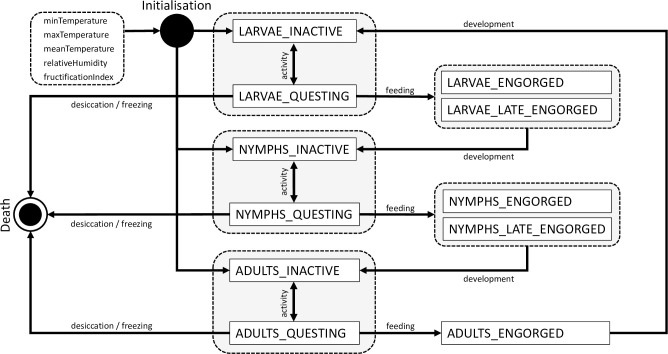
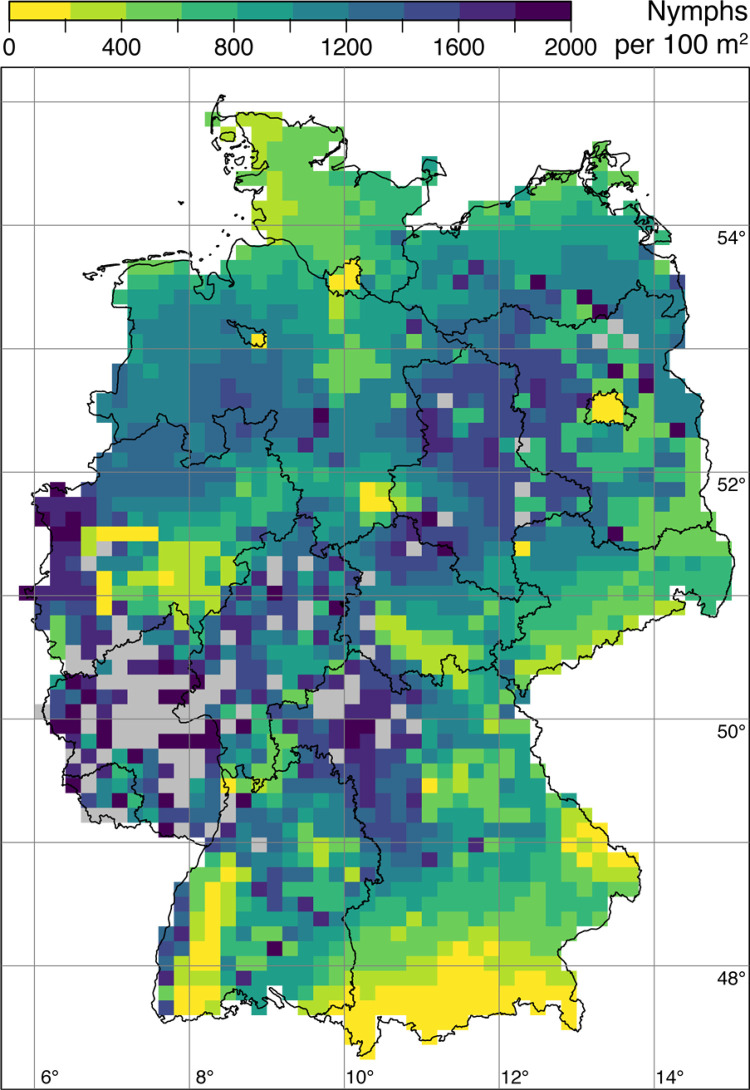
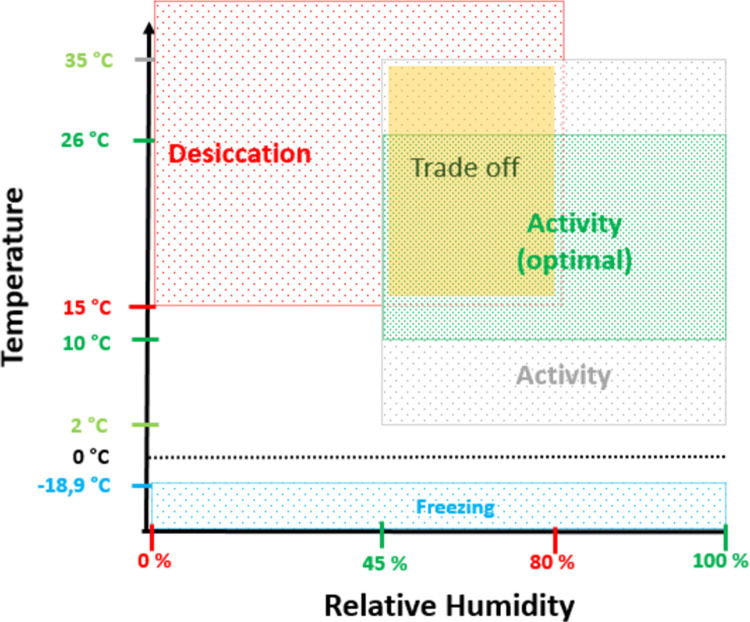
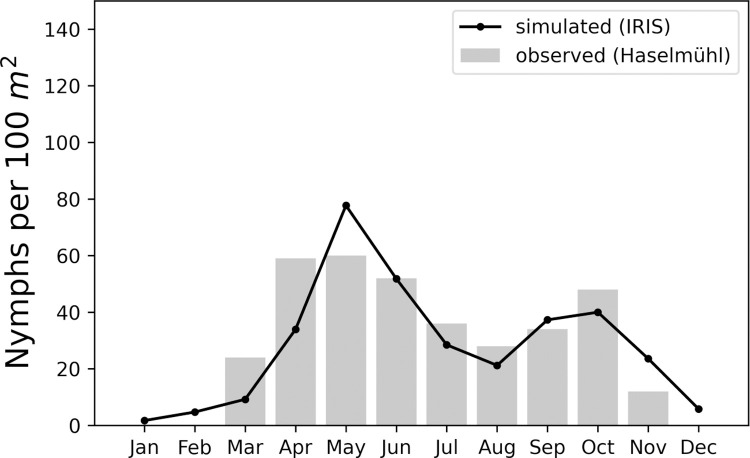
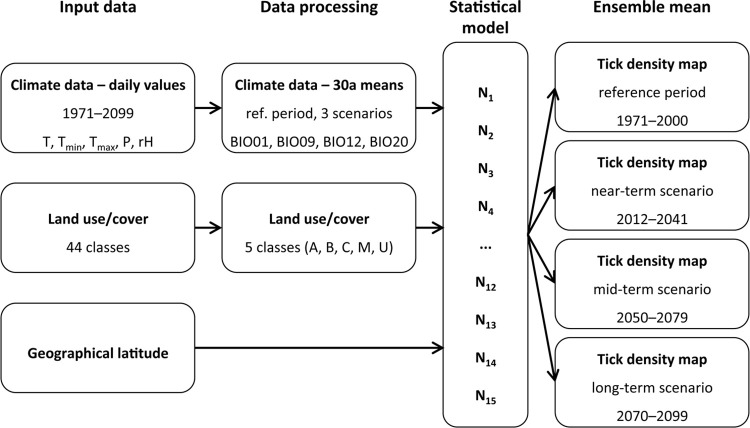
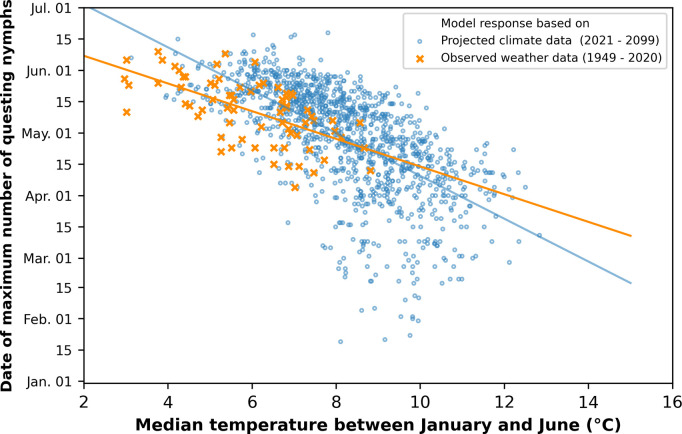
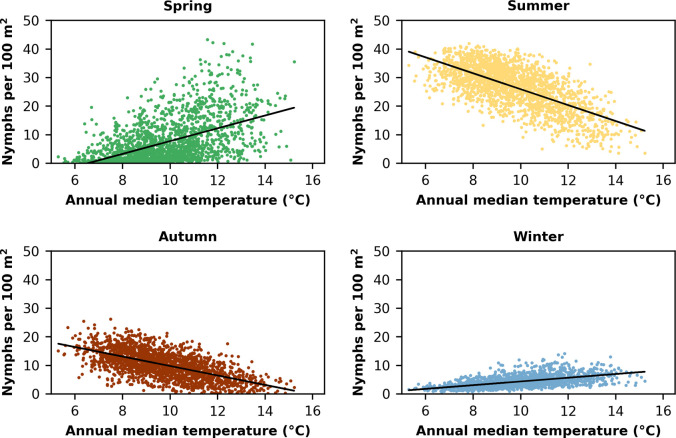
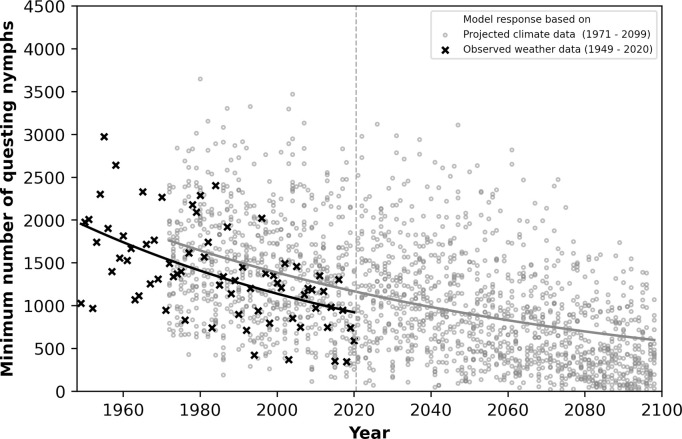
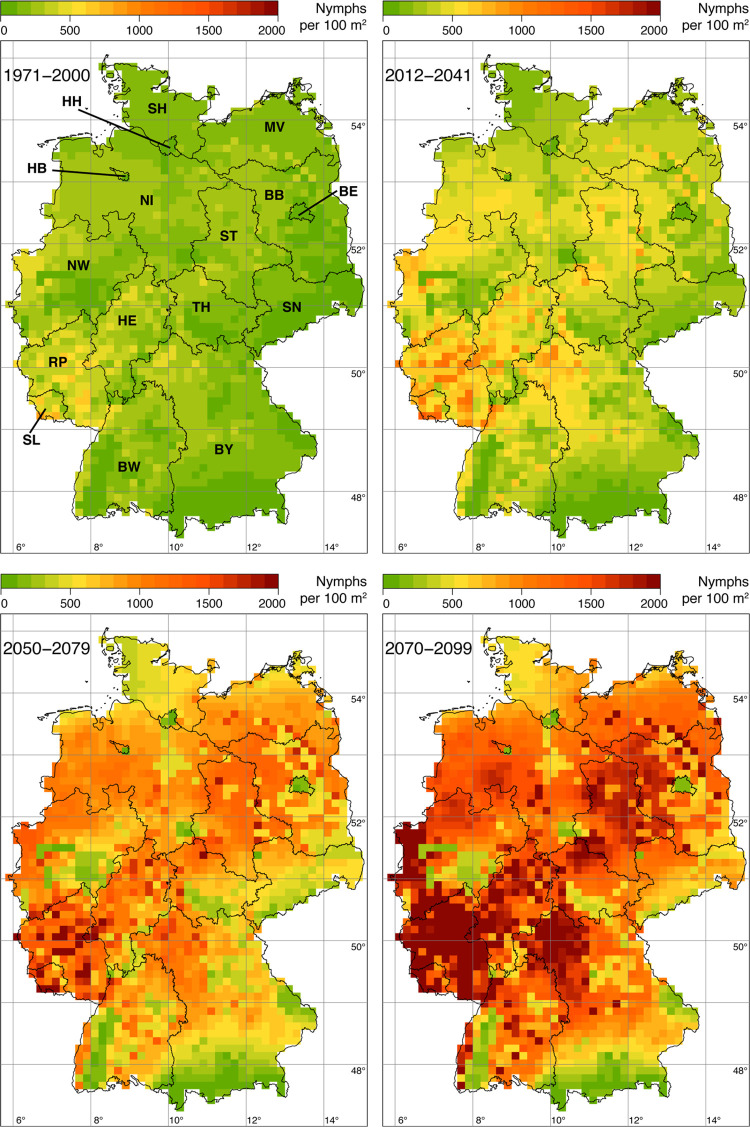
Models can be applied to extrapolate consequences of climate change for complex ecological systems in the future. The acknowledged systems' behaviour at present is projected into the future considering climate projection data. Such an approach can be used to addresses the future activity and density of the castor bean tick Ixodes ricinus, the most widespread tick species in Europe. It is an important vector of pathogens causing Lyme borreliosis and tick-borne encephalitis. The population dynamics depend on several biotic and abiotic factors. Such complexity makes it difficult to predict the future dynamics and density of I. ricinus and associated health risk for humans. The objective of this study is to force ecological models with high-resolution climate projection data to extrapolate I. ricinus tick density and activity patterns into the future. We used climate projection data of temperature, precipitation, and relative humidity for the period 1971-2099 from 15 different climate models. Tick activity was investigated using a climate-driven cohort-based population model. We simulated the seasonal population dynamics using climate data between 1971 and 2099 and observed weather data since 1949 at a specific location in southern Germany. We evaluated derived quantities of local tick ecology, e.g. the maximum questing activity of the nymphal stage. Furthermore, we predicted spatial density changes by extrapolating a German-wide tick density model. We compared the tick density of the reference period (1971-2000) with the counter-factual densities under the near-term scenario (2012-2041), mid-term scenario (2050-2079) and long-term scenario (2070-2099). We found that the nymphal questing peak would shift towards early seasons of the year. Also, we found high spatial heterogeneity across Germany, with predicted hotspots of up to 2,000 nymphs per 100 m2 and coldspots with constant density. As our results suggest extreme changes in tick behaviour and density, we discuss why caution is needed when extrapolating climate data-driven models into the distant future when data on future climate drive the model projection.
模型可用于推断未来气候变化对复杂生态系统的影响。考虑到气候预测数据,当前公认的系统行为将被投射到未来。这种方法可用于预测欧洲分布最广泛的 tick 物种蓖麻 tick Ixodes ricinus 的未来活动和密度。它是引起莱姆病和 tick-borne encephalitis 的病原体的重要载体。种群动态取决于多种生物和非生物因素。这种复杂性使得难以预测 I. ricinus 的未来动态和密度以及与之相关的人类健康风险。本研究的目的是利用高分辨率气候预测数据强制生态模型,推断 I. ricinus tick 的密度和活动模式的未来情况。我们使用了来自 15 种不同气候模型的 1971-2099 年期间的温度、降水和相对湿度气候预测数据。使用基于气候的群体种群模型研究 tick 活动。我们使用 1971 年至 2099 年的气候数据模拟季节性种群动态,并观察了自 1949 年以来德国南部特定地点的实际天气数据。我们评估了当地 tick 生态学的衍生量,例如若虫阶段的最大觅食活动。此外,我们通过外推德国范围内的 tick 密度模型来预测空间密度变化。我们将参考期(1971-2000 年)的 tick 密度与近期限(2012-2041 年)、中期限(2050-2079 年)和长期限(2070-2099 年)的反事实密度进行了比较。我们发现,若虫的觅食高峰期将提前到一年中的早期季节。此外,我们在德国发现了很高的空间异质性,预测热点区域每 100 平方米多达 2000 只若虫,而冷点区域密度则保持不变。由于我们的结果表明 tick 行为和密度会发生极端变化,因此当根据未来气候数据驱动模型预测时,我们讨论了在遥远的未来需要谨慎行事的原因。