Gianferrari Giulia, Martinelli Ilaria, Zucchi Elisabetta, Simonini Cecilia, Fini Nicola, Vinceti Marco, Ferro Salvatore, Gessani Annalisa, Canali Elena, Valzania Franco, Sette Elisabetta, Pugliatti Maura, Tugnoli Valeria, Zinno Lucia, Stano Salvatore, Santangelo Mario, De Pasqua Silvia, Terlizzi Emilio, Guidetti Donata, Medici Doriana, Salvi Fabrizio, Liguori Rocco, Vacchiano Veria, Casmiro Mario, Querzani Pietro, Currò Dossi Marco, Patuelli Alberto, Morresi Simonetta, Longoni Marco, De Massis Patrizia, Rinaldi Rita, Borghi Annamaria, Amedei Amedeo, Mandrioli Jessica
Department of Biomedical, Metabolic and Neural Sciences, University of Modena and Reggio Emilia, 41125 Modena, Italy.
Department of Neurosciences, Azienda Ospedaliero Universitaria di Modena, 41125 Modena, Italy.
Biomedicines. 2022 Mar 31;10(4):819. doi: 10.3390/biomedicines10040819.
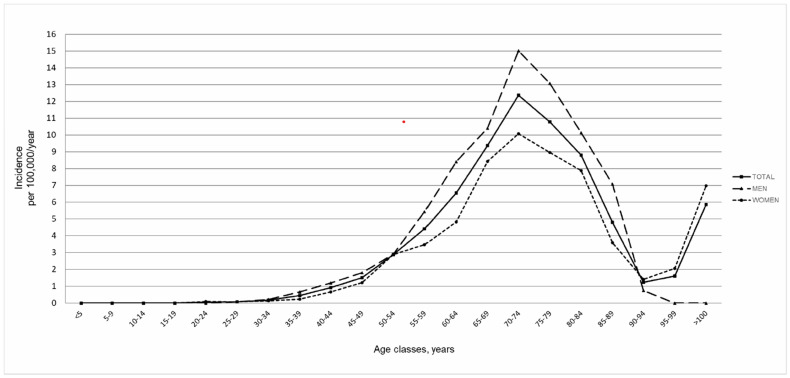
Increased incidence rates of amyotrophic lateral sclerosis (ALS) have been recently reported across various Western countries, although geographic and temporal variations in terms of incidence, clinical features and genetics are not fully elucidated. This study aimed to describe demographic, clinical feature and genotype-phenotype correlations of ALS cases over the last decade in the Emilia Romagna Region (ERR). From 2009 to 2019, our prospective population-based registry of ALS in the ERR of Northern Italy recorded 1613 patients receiving a diagnosis of ALS. The age- and sex-adjusted incidence rate was 3.13/100,000 population (M/F ratio: 1.21). The mean age at onset was 67.01 years; women, bulbar and respiratory phenotypes were associated with an older age, while C9orf72-mutated patients were generally younger. After peaking at 70-75 years, incidence rates, among women only, showed a bimodal distribution with a second slight increase after reaching 90 years of age. Familial cases comprised 12%, of which one quarter could be attributed to an ALS-related mutation. More than 70% of C9orf72-expanded patients had a family history of ALS/fronto-temporal dementia (FTD); 22.58% of patients with FTD at diagnosis had C9orf72 expansion (OR 6.34, = 0.004). In addition to a high ALS incidence suggesting exhaustiveness of case ascertainment, this study highlights interesting phenotype-genotype correlations in the ALS population of ERR.
最近有报道称,在各个西方国家,肌萎缩侧索硬化症(ALS)的发病率有所上升,尽管在发病率、临床特征和遗传学方面的地理和时间差异尚未完全阐明。本研究旨在描述艾米利亚-罗马涅地区(ERR)过去十年中ALS病例的人口统计学、临床特征以及基因型-表型相关性。2009年至2019年期间,我们在意大利北部ERR地区基于人群的ALS前瞻性登记处记录了1613例被诊断为ALS的患者。年龄和性别调整后的发病率为3.13/10万人口(男/女比例:1.21)。发病时的平均年龄为67.01岁;女性、延髓和呼吸表型与较高年龄相关,而C9orf72突变患者通常较年轻。在70 - 75岁达到峰值后,仅女性的发病率呈双峰分布,在90岁后出现第二次轻微上升。家族性病例占12%,其中四分之一可归因于与ALS相关的突变。超过70%的C9orf72扩增患者有ALS/额颞叶痴呆(FTD)家族史;22.58%的FTD诊断患者有C9orf72扩增(比值比6.34,P = 0.004)。除了较高的ALS发病率表明病例确定详尽外,本研究还突出了ERR地区ALS人群中有趣的表型-基因型相关性。