Mohamed Amal Ahmed, Allam Ahmed E, Aref Ahmed M, Mahmoud Maha Osama, Eldesoky Noha A, Fawazy Naglaa, Sakr Yasser, Sobeih Mohamed Emam, Albogami Sarah, Fayad Eman, Althobaiti Fayez, Jafri Ibrahim, Alsharif Ghadi, El-Sayed Marwa, Abdelgeliel Asmaa Sayed, Abdel Aziz Rania S
Department of Biochemistry and Molecular Biology, National Hepatology and Tropical Medicine Research Institute, Cairo 11511, Egypt.
Department of Pharmacognosy, Faculty of Pharmacy, Al-Azhar University, Assiut 71524, Egypt.
Diagnostics (Basel). 2022 Mar 23;12(4):789. doi: 10.3390/diagnostics12040789.
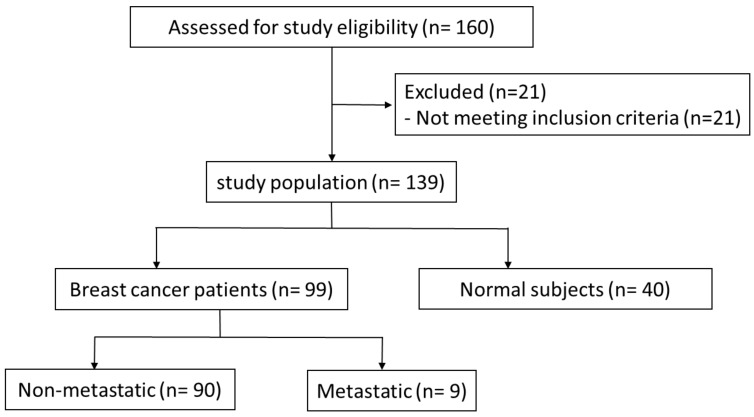
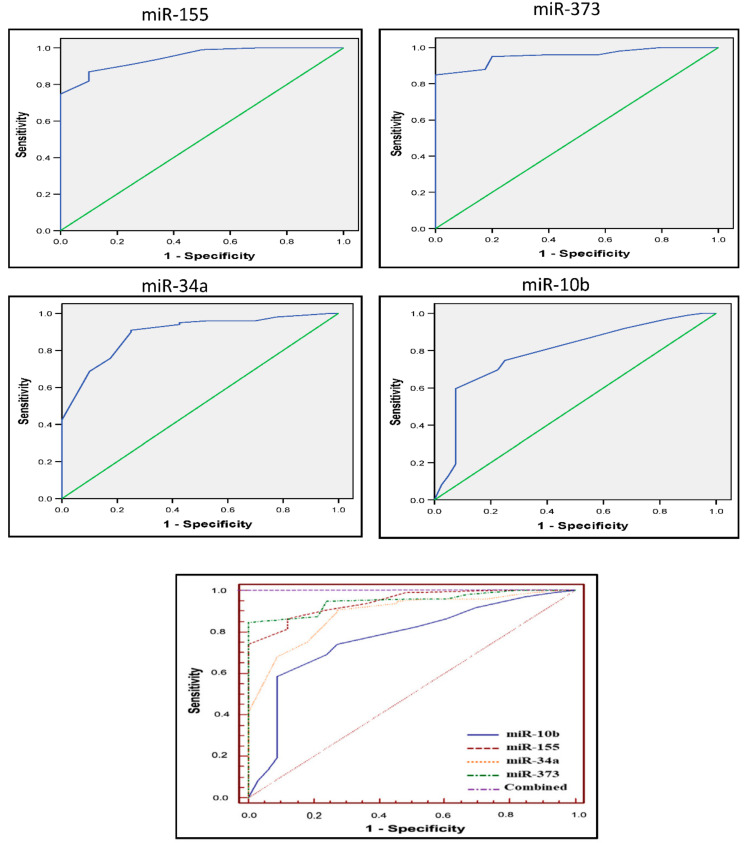
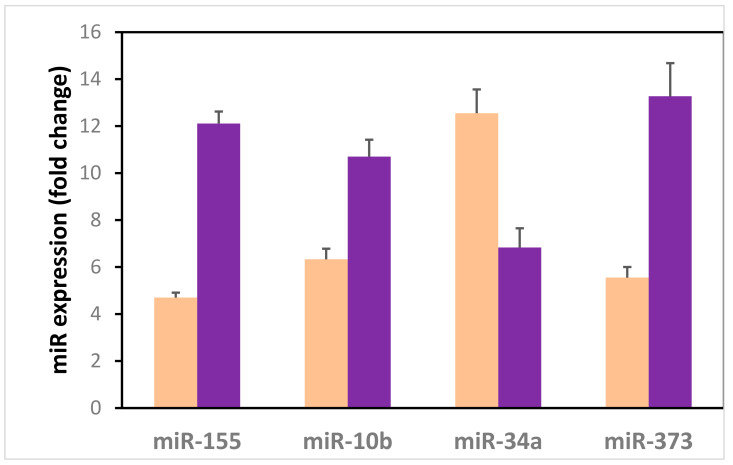
Background: Early detection and screening of breast cancer (BC) might help improve the prognosis of BC patients. This study evaluated the use of serum microRNAs (miRs) as non-invasive biomarkers in BC patients. Methods: Using quantitative real-time polymerase chain reaction, we evaluated the serum expression of four candidate miRs (miR-155, miR-373, miR-10b, and miR-34a) in 99 Egyptian BC patients and 40 healthy subjects (as a control). The miRs expression was correlated with clinicopathological data. In addition, the sensitivity and specificity of the miRs were determined using receiver operating characteristic (ROC) curve analysis. Results: Serum miR-155, miR-373, and miR-10b expression were significantly upregulated (p < 0.001), while serum miR-34a was downregulated (p < 0.00) in nonmetastatic (M0) BC patients compared to the control group. In addition, serum miR-155 and miR-10b were upregulated in BC patients with large tumor sizes and extensive nodal involvement (p < 0.001). ROC curve analysis showed high diagnostic accuracy (area under the curve = 1.0) when the four miRs were combined. Serum miR-373 was significantly upregulated in the human epidermal growth factor 2−negative (p < 0.001), estrogen receptor−positive (p < 0.005), and progesterone receptor (PR)-positive (p < 0.024) in BC patients, and serum miR-155 was significantly upregulated in PR-negative (p < 0.001) BC patients while both serum miR-155 and miR-373 were positively correlated with the tumor grade. Conclusions: Circulating serum miR-155, miR-373, miR-10b, and miR-34a are potential biomarkers for early BC detection in Egyptian patients and their combination shows high sensitivity and specificity.
乳腺癌(BC)的早期检测和筛查可能有助于改善BC患者的预后。本研究评估了血清微小RNA(miRs)作为BC患者非侵入性生物标志物的应用。方法:采用定量实时聚合酶链反应,我们评估了99例埃及BC患者和40例健康受试者(作为对照)中四种候选miRs(miR-155、miR-373、miR-10b和miR-34a)的血清表达。miRs表达与临床病理数据相关。此外,使用受试者工作特征(ROC)曲线分析确定miRs的敏感性和特异性。结果:与对照组相比,非转移性(M0)BC患者血清miR-155、miR-373和miR-10b表达显著上调(p < 0.001),而血清miR-34a下调(p < 0.00)。此外,肿瘤体积大且有广泛淋巴结转移的BC患者血清miR-155和miR-10b上调(p < 0.001)。当四种miRs联合使用时,ROC曲线分析显示出高诊断准确性(曲线下面积 = 1.0)。BC患者中,血清miR-373在人表皮生长因子2阴性(p < 0.001)、雌激素受体阳性(p < 0.005)和孕激素受体(PR)阳性(p < 0.024)患者中显著上调,血清miR-155在PR阴性(p < 0.001)BC患者中显著上调,而血清miR-155和miR-373均与肿瘤分级呈正相关。结论:循环血清miR-155、miR-373、miR-10b和miR-34a是埃及患者早期BC检测的潜在生物标志物,它们的联合显示出高敏感性和特异性。