Trifan Anca, Rotaru Adrian, Stafie Remus, Stratina Ermina, Zenovia Sebastian, Nastasa Robert, Huiban Laura, Cuciureanu Tudor, Muzîca Cristina, Chiriac Stefan, Gîrleanu Irina, Sîngeap Ana-Maria, Sfarti Catalin, Cojocariu Camelia, Stanciu Carol
Department of Gastroenterology, Grigore T. Popa University of Medicine and Pharmacy, 700115 Iasi, Romania.
Institute of Gastroenterology and Hepatology, "St. Spiridon" University Hospital, 700111 Iasi, Romania.
Diagnostics (Basel). 2022 Mar 24;12(4):801. doi: 10.3390/diagnostics12040801.
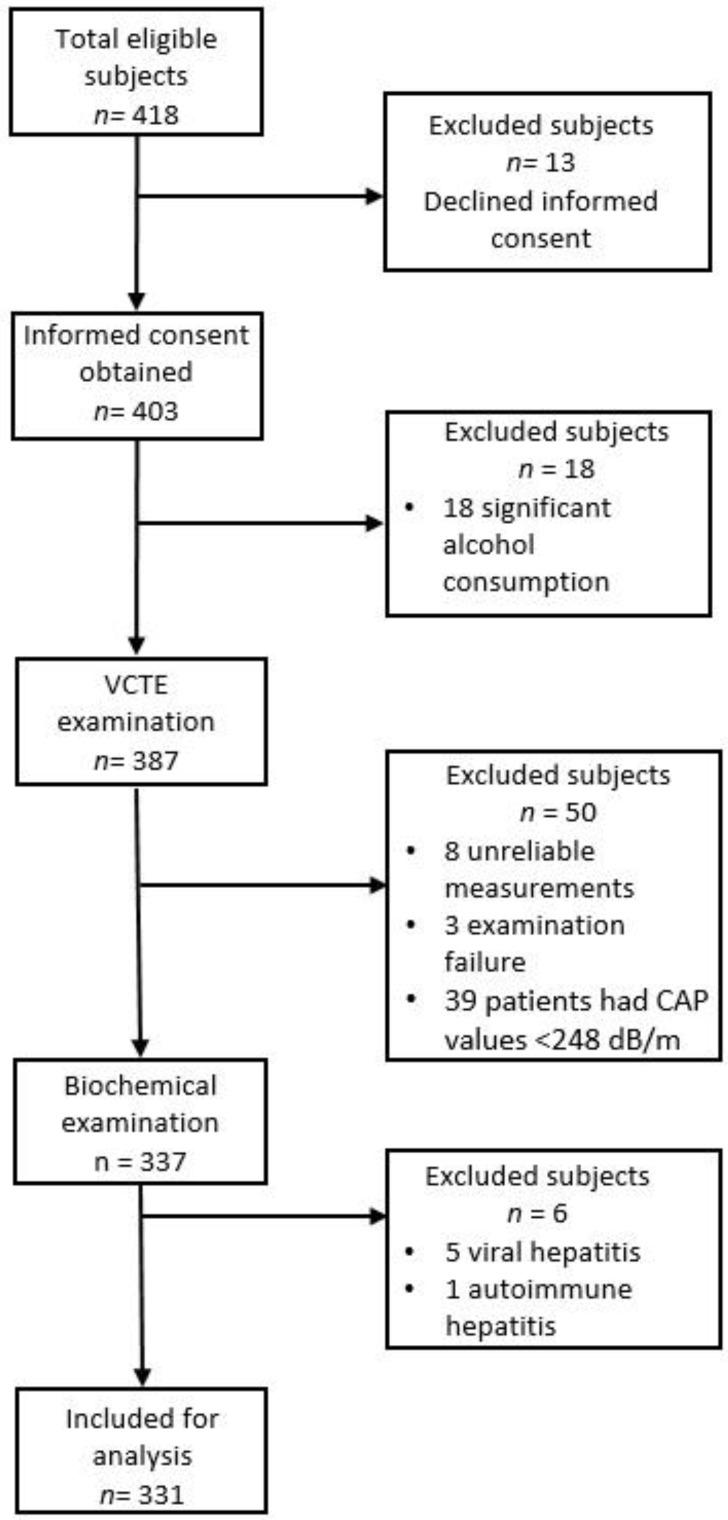
Non-alcoholic fatty liver disease (NAFLD) has had, over the past few decades, a progressively growing prevalence among the general population all over the world, in parallel with metabolic conditions such as type 2 diabetes mellitus (T2DM), dyslipidemia, and obesity. However, NAFLD is also detected in 10−13% of subjects with a body mass index (BMI) ≤ 25 kg/m² (lean-NAFLD), whose major risk factors remain unknown. In this study, we aimed to characterize the clinical features and associated risk factors of lean-NAFLD in comparison with obese-NAFLD patients. Consecutive patients diagnosed with NAFLD by vibration-controlled transient elastography and controlled attenuation parameter were prospectively enrolled. Biological and clinical data obtained from the participants were stratified according to their BMI in two groups: lean-NAFLD and obese-NAFLD. In total, 331 patients (56.8% males) were included in the final analysis. Most of the subjects were obese-NAFLD (n = 258, 77.9%) and had a higher prevalence of T2DM, dyslipidemia, and components of the metabolic syndrome, together with abnormal biological parameters. Regarding liver stiffness measurements, the proportion of subjects with at least significant fibrosis (≥F2) was approximately twofold higher among obese-NAFLD (43.81%) in comparison with lean-NAFLD patients (23.29%). Moreover, obese individuals had a higher risk for liver fibrosis (OR = 2.6, 95%, CI 1.5−4.42, p < 0.001) than lean individuals. Although associated metabolic conditions and at least significant liver fibrosis were present in approximately one-quarter of the patients, these were more frequent among obese-NAFLD patients. Therefore, individualized screening strategies for NAFLD should be established according to BMI.
在过去几十年中,非酒精性脂肪性肝病(NAFLD)在全球普通人群中的患病率呈逐渐上升趋势,这与2型糖尿病(T2DM)、血脂异常和肥胖等代谢状况并存。然而,在体重指数(BMI)≤25 kg/m²的受试者中,也有10%-13%被检测出患有NAFLD(瘦型NAFLD),其主要危险因素尚不清楚。在本研究中,我们旨在比较瘦型NAFLD与肥胖型NAFLD患者的临床特征及相关危险因素。通过振动控制瞬时弹性成像和受控衰减参数诊断为NAFLD的连续患者被前瞻性纳入研究。根据参与者的BMI将从他们那里获得的生物学和临床数据分为两组:瘦型NAFLD和肥胖型NAFLD。最终分析共纳入331例患者(56.8%为男性)。大多数受试者为肥胖型NAFLD(n = 258,77.9%),其T2DM、血脂异常和代谢综合征成分的患病率较高,同时生物学参数也异常。关于肝脏硬度测量,肥胖型NAFLD患者中至少有显著纤维化(≥F2)的受试者比例(43.81%)约为瘦型NAFLD患者(23.29%)的两倍。此外,肥胖个体发生肝纤维化的风险(OR = 2.6,95%CI 1.5-4.42,p < 0.001)高于瘦个体。尽管约四分之一的患者存在相关代谢状况和至少显著的肝纤维化,但这些情况在肥胖型NAFLD患者中更为常见。因此,应根据BMI制定NAFLD的个体化筛查策略。