Biochemistry Unit, Department of Biology, University of Pisa, Via S. Zeno 51, 56127 Pisa, Italy.
Interdepartmental Research Center Nutrafood "Nutraceuticals and Food for Health", University of Pisa, 56127 Pisa, Italy.
Biomolecules. 2022 Mar 22;12(4):485. doi: 10.3390/biom12040485.
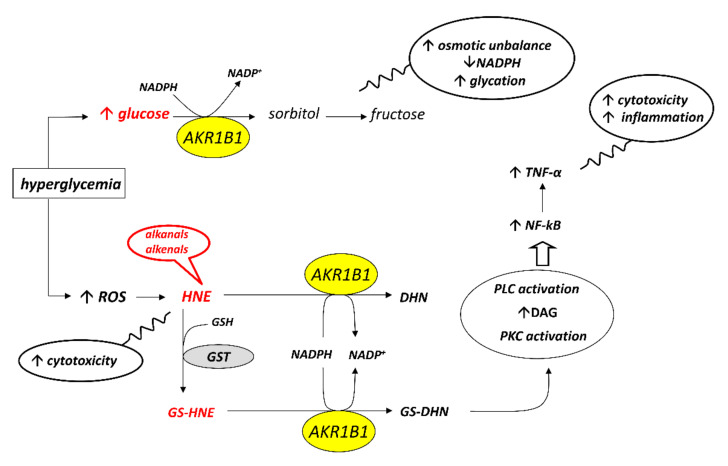
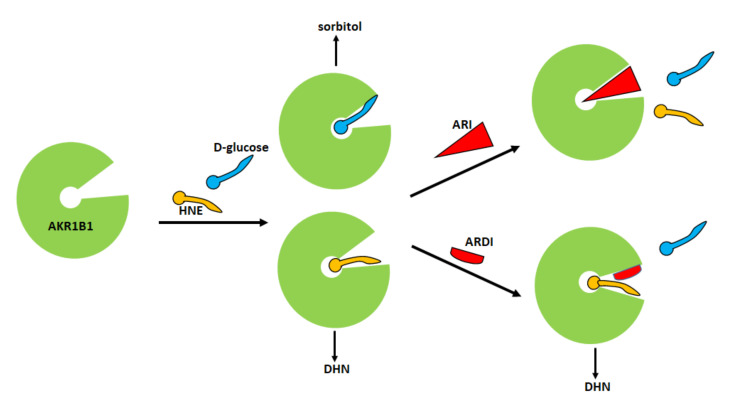
Aldose reductase, classified within the aldo-keto reductase family as AKR1B1, is an NADPH dependent enzyme that catalyzes the reduction of hydrophilic as well as hydrophobic aldehydes. AKR1B1 is the first enzyme of the so-called polyol pathway that allows the conversion of glucose into sorbitol, which in turn is oxidized to fructose by sorbitol dehydrogenase. The activation of the polyol pathway in hyperglycemic conditions is generally accepted as the event that is responsible for a series of long-term complications of diabetes such as retinopathy, cataract, nephropathy and neuropathy. The role of AKR1B1 in the onset of diabetic complications has made this enzyme the target for the development of molecules capable of inhibiting its activity. Virtually all synthesized compounds have so far failed as drugs for the treatment of diabetic complications. This failure may be partly due to the ability of AKR1B1 to reduce alkenals and alkanals, produced in oxidative stress conditions, thus acting as a detoxifying agent. In recent years we have proposed an alternative approach to the inhibition of AKR1B1, suggesting the possibility of a differential inhibition of the enzyme through molecules able to preferentially inhibit the reduction of either hydrophilic or hydrophobic substrates. The rationale and examples of this new generation of aldose reductase differential inhibitors (ARDIs) are presented.
醛糖还原酶(aldose reductase),归类于醛酮还原酶家族(aldo-keto reductase family)中的 AKR1B1,是一种 NADPH 依赖性酶,能够催化亲水性和疏水性醛的还原。AKR1B1 是所谓多元醇途径的第一个酶,允许将葡萄糖转化为山梨醇,山梨醇继而被山梨醇脱氢酶氧化为果糖。高血糖条件下多元醇途径的激活被普遍认为是导致糖尿病一系列长期并发症(如视网膜病变、白内障、肾病和神经病变)的原因。AKR1B1 在糖尿病并发症发病中的作用使该酶成为开发能够抑制其活性的分子的目标。迄今为止,几乎所有合成的化合物都未能作为治疗糖尿病并发症的药物。这种失败可能部分归因于 AKR1B1 还原氧化应激条件下产生的烯醛和链烷醛的能力,从而起到解毒剂的作用。近年来,我们提出了一种抑制 AKR1B1 的替代方法,提出了通过能够优先抑制亲水性或疏水性底物还原的分子来实现对酶的差异抑制的可能性。本文介绍了这种新一代醛糖还原酶差异抑制剂(ARDIs)的原理和实例。