Gallina Filippo Tommaso, Bertolaccini Luca, Forcella Daniele, Mohamed Shehab, Ceddia Serena, Melis Enrico, Fusco Francesca, Bardoni Claudia, Marinelli Daniele, Buglioni Simonetta, Visca Paolo, Cappuzzo Federico, Spaggiari Lorenzo, Facciolo Francesco
Thoracic Surgery Department, IRCCS Regina Elena National Cancer Institute, 00144 Rome, Italy.
Department of Thoracic Surgery, IEO, European Institute of Oncology IRCCS, 20100 Milan, Italy.
Cancers (Basel). 2022 Apr 13;14(8):1949. doi: 10.3390/cancers14081949.
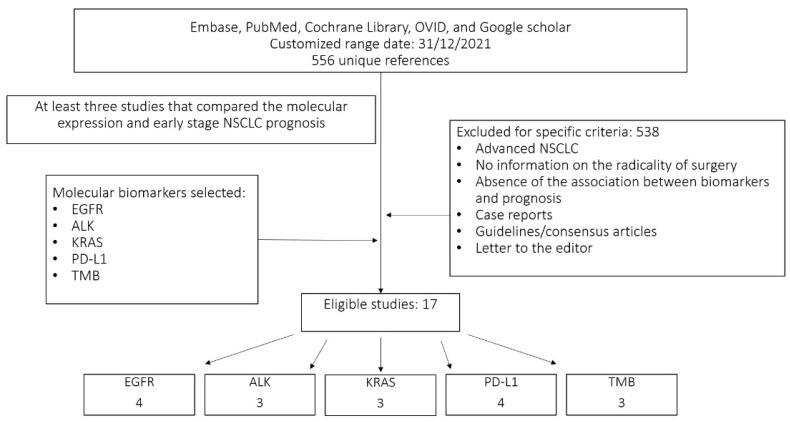
Next-generation sequencing has become a cornerstone in clinical oncology practice and is recommended for the appropriate use of tailored therapies in NSCLC. While NGS has already been standardised in advanced-stage NSCLC, its use is still uncommon in the early stages. The recent approval of Osimertinib for resected EGFR-mutated NSCLC in an adjuvant setting has launched the hypothesis that other targeted therapies used in metastatic patients can also lead to improved early-stage outcomes of NSCLC. The impact of molecular biomarkers on the prognosis of patients undergoing radical surgery for NSCLC is still unclear. Notably, the heterogeneous populations included in the studies that analysed surgical patients could be the main reason for these results. In this review, we report the most important studies that analysed the impact of principal molecular biomarkers on the survival outcomes of patients who underwent radical surgery for NSCLC.
下一代测序已成为临床肿瘤学实践的基石,并被推荐用于非小细胞肺癌(NSCLC)中量身定制疗法的合理应用。虽然下一代测序在晚期NSCLC中已实现标准化,但其在早期阶段的应用仍不常见。奥希替尼最近被批准用于辅助治疗切除的表皮生长因子受体(EGFR)突变的NSCLC,这引发了一种假设,即用于转移性患者的其他靶向治疗也可能改善NSCLC的早期治疗效果。分子生物标志物对接受NSCLC根治性手术患者预后的影响仍不明确。值得注意的是,分析手术患者的研究中纳入的异质性人群可能是导致这些结果的主要原因。在本综述中,我们报告了最重要的研究,这些研究分析了主要分子生物标志物对接受NSCLC根治性手术患者生存结果的影响。