Nagel Anna, Popeda Marta, Muchlinska Anna, Sadej Rafal, Szade Jolanta, Zielinski Jacek, Skokowski Jaroslaw, Niemira Magdalena, Kretowski Adam, Markiewicz Aleksandra, Zaczek Anna J
Laboratory of Translational Oncology, Intercollegiate Faculty of Biotechnology, Medical University of Gdansk, 80-211 Gdansk, Poland.
Laboratory of Molecular Enzymology and Oncology, Intercollegiate Faculty of Biotechnology, Medical University of Gdansk, 80-211 Gdansk, Poland.
Cancers (Basel). 2022 Apr 15;14(8):2005. doi: 10.3390/cancers14082005.
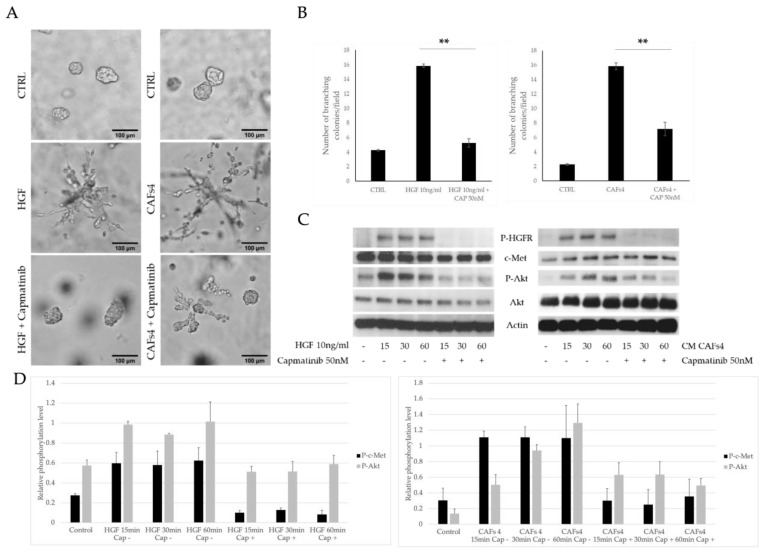
Background: Cancer-associated fibroblasts (CAFs) are the most abundant cell type in the tumor microenvironment (TME). Estrogen receptor alpha 36 (ERα36), the alternatively spliced variant of ERα, is described as an unfavorable factor when expressed in cancer cells. ERα can be expressed also in CAFs; however, the role of ERα36 in CAFs is unknown. Methods: Four CAF cultures were isolated from chemotherapy-naïve BC patients and characterized for ERα36 expression and the NanoString gene expression panel using isolated RNA. Conditioned media from CAF cultures were used to assess the influence of CAFs on triple-negative breast cancer (TNBC) cells using a matrigel 3D culture assay. Results: We found that ERα36high CAFs significantly induced the branching of TNBC cells in vitro (p < 0.001). They also produced a set of pro-tumorigenic cytokines compared to ERα36low CAFs, among which hepatocyte growth factor (HGF) was the main inducer of TNBC cell invasive phenotype in vitro (p < 0.001). Tumor stroma rich in ERα36high CAFs was correlated with high Ki67 expression (p = 0.041) and tumor-associated macrophages markers (CD68 and CD163, p = 0.041 for both). HGF was found to be an unfavorable prognostic factor in TCGA database analysis (p = 0.03 for DFS and p = 0.04 for OS). Conclusions: Breast cancer-associated fibroblasts represent distinct subtypes based on ERα36 expression. We propose that ERα36high CAFs could account for an unfavorable prognosis for TNBC patients.
癌症相关成纤维细胞(CAFs)是肿瘤微环境(TME)中最丰富的细胞类型。雌激素受体α36(ERα36)是ERα的可变剪接变体,在癌细胞中表达时被认为是一个不利因素。ERα也可在CAFs中表达;然而,ERα36在CAFs中的作用尚不清楚。方法:从未经化疗的乳腺癌患者中分离出四种CAF培养物,使用分离的RNA对ERα36表达和NanoString基因表达谱进行表征。使用基质胶3D培养试验,用CAF培养物的条件培养基评估CAFs对三阴性乳腺癌(TNBC)细胞的影响。结果:我们发现,ERα36高表达的CAFs在体外显著诱导TNBC细胞分支(p < 0.001)。与ERα36低表达的CAFs相比,它们还产生了一组促肿瘤细胞因子,其中肝细胞生长因子(HGF)是体外TNBC细胞侵袭表型的主要诱导因子(p < 0.001)。富含ERα36高表达CAFs的肿瘤基质与高Ki67表达(p = 0.041)和肿瘤相关巨噬细胞标志物(CD68和CD163,两者p = 0.041)相关。在TCGA数据库分析中,HGF被发现是一个不利的预后因素(DFS的p = 0.03,OS的p = 0.04)。结论:基于ERα36表达,乳腺癌相关成纤维细胞代表不同的亚型。我们认为,ERα36高表达的CAFs可能是TNBC患者预后不良的原因。