Vallogini Giulia, Festa Paola, Matarazzo Giorgio, Gentile Tina, Garret-Bernardin Annelyse, Zanette Gastone, Galeotti Angela
Dentistry Unit, Bambino Gesù Children's Hospital, IRCCS, 00165 Rome, Italy.
Neuroscience Department, University of Padua, 35128 Padua, Italy.
Children (Basel). 2022 Mar 24;9(4):460. doi: 10.3390/children9040460.
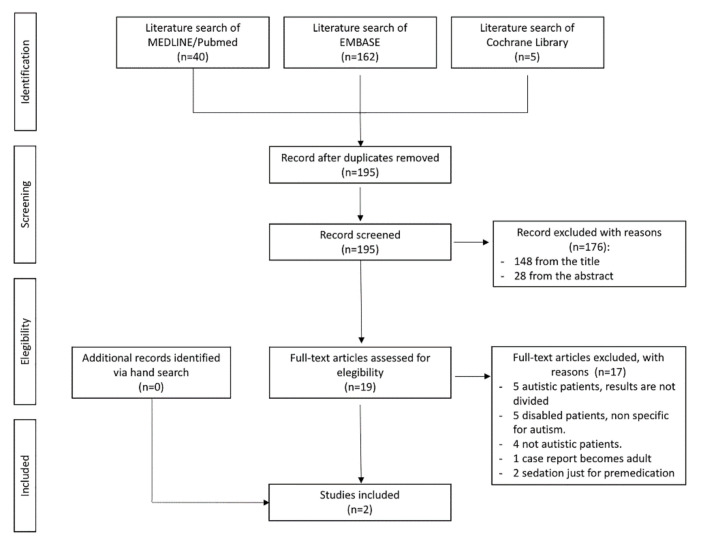
(1) Background: the variety of autism spectrum disorder makes the definition of guidelines for dental care a challenging task. The aim of this review was to evaluate the literature concerning the use of conscious sedation for dental treatments in pediatric autistic patients. (2) Methods: we searched MEDLINE/PubMed, EMBASE, Cochrane databases in order to identify pertinent studies. The search strategy was based on these areas of interest: autistic spectrum disorder, pediatric patients, dentistry, tranquilizing agents, and conscious sedation. (3) Results: the search yielded 177 non-duplicated articles, of which 24 articles were retrieved for full text review, and 2 were found to address our review aim. The first paper was a retrospective study that included 83 autistic patients sedated either with an oral premedication combined with nitrous oxide/oxygen inhalation or with nitrous oxide/oxygen inhalation alone; the second article was a prospective trial on the effectiveness of 0.3 mg/kg of oral diazepam with 0.5 mg/kg of oral midazolam in 13 sedated uncooperative autistic patients. (4) Conclusions: this review highlights the insufficiency of studies that can provide concrete indications for the dental treatment in conscious sedation of pediatric patients with autism. New studies are needed to better define the appropriate drugs, dosages, sedation level and evaluate patient cooperation.
(1) 背景:自闭症谱系障碍的多样性使得制定牙科护理指南成为一项具有挑战性的任务。本综述的目的是评估有关在患有自闭症的儿科患者牙科治疗中使用清醒镇静的文献。(2) 方法:我们检索了MEDLINE/PubMed、EMBASE和Cochrane数据库,以识别相关研究。检索策略基于以下感兴趣的领域:自闭症谱系障碍、儿科患者、牙科、镇静剂和清醒镇静。(3) 结果:检索产生了177篇不重复的文章,其中24篇文章被检索出来进行全文审查,发现有2篇文章涉及我们的综述目的。第一篇论文是一项回顾性研究,纳入了83名接受镇静的自闭症患者,这些患者要么接受口服术前用药联合氧化亚氮/氧气吸入镇静,要么仅接受氧化亚氮/氧气吸入镇静;第二篇文章是一项前瞻性试验,研究0.3mg/kg口服地西泮与0.5mg/kg口服咪达唑仑对13名接受镇静的不合作自闭症患者的有效性。(4) 结论:本综述强调了能够为自闭症儿科患者清醒镇静下的牙科治疗提供具体指征的研究不足。需要开展新的研究,以更好地确定合适的药物、剂量、镇静水平并评估患者的配合情况。