Kasti Arezina, Petsis Konstantinos, Lambrinou Sophia, Katsas Konstantinos, Nikolaki Maroulla, Papanikolaou Ioannis S, Hatziagelaki Erifili, Triantafyllou Konstantinos
Department of Nutrition and Dietetics, ATTIKON University General Hospital, 12462 Athens, Greece.
Institute of Preventive Medicine Environmental and Occupational Health Prolepsis, 15125 Athens, Greece.
Microorganisms. 2022 Mar 30;10(4):751. doi: 10.3390/microorganisms10040751.
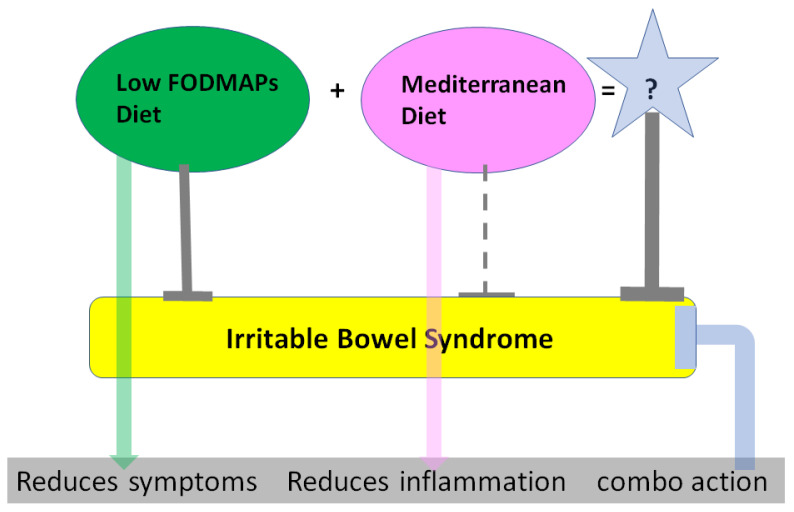
Among other factors, food intolerance is cardinal in triggering irritable bowel syndrome (IBS) symptoms in a significant percentage of patients. As a result, specific dietary patterns are the first-line therapeutic approach. The low-FODMAP diet (LFD) is gaining ground as the most well-documented diet intervention that significantly reduces IBS symptoms. Though the LFD improves symptoms, the diet's impact on intestinal low-grade inflammation, one of the cardinal mechanisms contributing to symptom development, remains doubtful. On the other hand, the Mediterranean diet (MedDiet) is recommended for chronic low-grade inflammation-related diseases because of its anti-inflammatory properties, derived predominantly from olive oil and phenolic compounds. Thus far, the role of a modified LFD, enriched with the MedDiet's anti-inflammatory components, has not been evaluated in IBS patients. This review aims to examine the hypothesis of a potential combination of the immunomodulatory effects of the MedDiet with the LFD to improve IBS symptoms.
在诸多因素中,食物不耐受在相当比例的患者中是引发肠易激综合征(IBS)症状的主要因素。因此,特定的饮食模式是一线治疗方法。低发酵性寡糖、双糖、单糖和多元醇饮食(LFD)作为有充分文献记载的、能显著减轻IBS症状的饮食干预措施,正逐渐流行起来。尽管LFD能改善症状,但该饮食对肠道低度炎症(导致症状产生的主要机制之一)的影响仍存疑问。另一方面,地中海饮食(MedDiet)因其主要源自橄榄油和酚类化合物的抗炎特性,被推荐用于治疗与慢性低度炎症相关的疾病。到目前为止,富含MedDiet抗炎成分的改良LFD在IBS患者中的作用尚未得到评估。本综述旨在探讨MedDiet的免疫调节作用与LFD潜在结合以改善IBS症状这一假说。