Servicio de Endocrinología y Nutrición, Hospital Clínico Universitario de Valladolid, 47003 Valladolid, Spain.
Centro de Investigación en Endocrinología y Nutrición (IENVA), Universidad de Valladolid, 47002 Valladolid, Spain.
Nutrients. 2022 Apr 10;14(8):1573. doi: 10.3390/nu14081573.
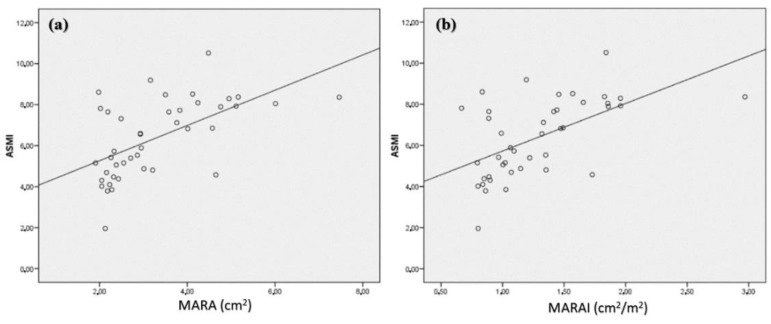
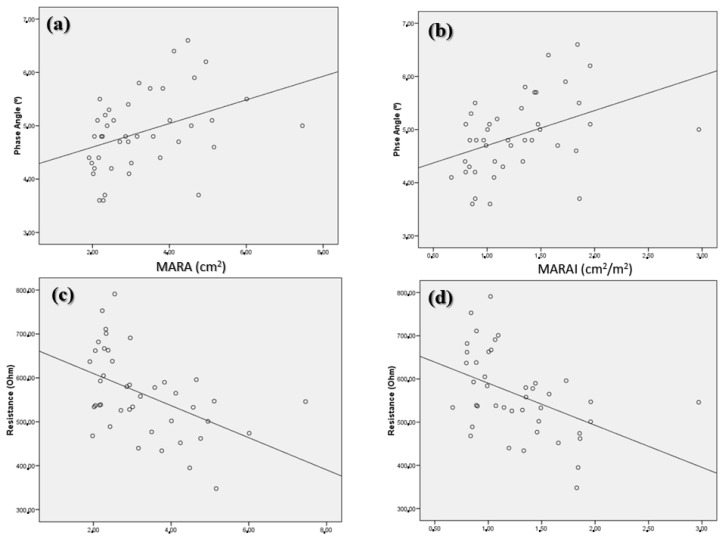
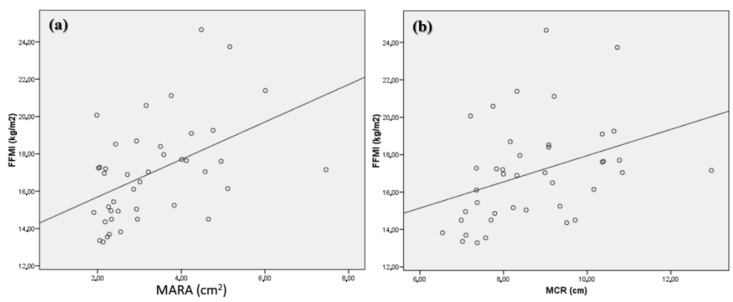
Background: Muscular ultrasonography is a technique that allows assessing the amount and quality of muscle in a specific body region. The aim of the study was to compare the value of muscle ultrasonography in diagnosis of malnutrition with techniques such as anthropometry, handgrip strength and impedanciometry in patients with oncological pathology. Methods: Cross-sectional study in 43 patients with oncological pathology and high nutritional risk. Classical anthropometry (body mass index (BMI), arm circumference (AC), calf circumference (CC) and estimated appendicular muscle mass index (ASMI)) was performed. Body composition was measured with impedanciometry (BIA), phase angle (PA) and fat-free mass index (FFMI) and muscle ultrasonography of quadriceps rectus femoris (muscle area (MARA) and circumference (MCR) in section transverse). Malnutrition was diagnosed using the GLIM criteria and sarcopenia was assessed using EWGSOP2 criteria. Results: The mean age was 68.26 years (±11.88 years). In total, 23/20 of the patients were men/women. The BMI was 23.51 (4.75) kg/m2. The ASMI was 6.40 (1.86) kg/m2. The MARA was 3.31 cm2 in ultrasonography. In impedanciometry, phase angle was 4.91 (0.75)°; the FFMI was 17.01 kg/m2 (±2.65 kg/m2). A positive correlation was observed between the MARA with anthropometric measurements (AC: r = 0.39, p = 0.009; CC: r = 0.44, p < 0.01; ASMI: r = 0.47, p < 0.001); and with BIA (FFMI: r = 0.48, p < 0.01 and PA: r = 0.45, p < 0.001). Differences were observed when comparing the MARA based on the diagnosis of sarcopenia (Sarcopenia: 2.47 cm2 (±0.54 cm2); no sarcopenia: 3.65 cm2 (±1.34 cm2); p = 0.02). Conclusions: Muscle ultrasonography correlates with body composition measurement techniques such as BIA and anthropometry in patients with cancer.
肌肉超声检查技术可用于评估特定身体区域的肌肉量和质量。本研究旨在比较肌肉超声检查在诊断肿瘤患者营养不良方面的价值,并与人体测量学、握力和阻抗测量等技术进行比较。
对 43 名患有肿瘤且具有高营养风险的患者进行横断面研究。进行经典人体测量学(体重指数(BMI)、臂围(AC)、小腿围(CC)和估计四肢肌肉质量指数(ASMI))。通过生物电阻抗分析法(BIA)、相位角(PA)和去脂体重指数(FFMI)以及股四头肌直肌的超声检查(肌肉面积(MARA)和横截面积(MCR))测量身体成分。使用 GLIM 标准诊断营养不良,使用 EWGSOP2 标准评估肌少症。
患者平均年龄为 68.26 岁(±11.88 岁)。共 23 名男性/20 名女性。BMI 为 23.51(4.75)kg/m2。ASMI 为 6.40(1.86)kg/m2。超声检查中 MARA 为 3.31cm2。在阻抗测量中,相位角为 4.91(0.75)°;FFMI 为 17.01kg/m2(±2.65kg/m2)。MARA 与人体测量学测量值(AC:r=0.39,p=0.009;CC:r=0.44,p<0.01;ASMI:r=0.47,p<0.001)和 BIA(FFMI:r=0.48,p<0.01 和 PA:r=0.45,p<0.001)呈正相关。当根据肌少症诊断比较 MARA 时,观察到差异(肌少症:2.47cm2(±0.54cm2);无肌少症:3.65cm2(±1.34cm2);p=0.02)。
在癌症患者中,肌肉超声检查与 BIA 和人体测量学等身体成分测量技术相关。