Department of Endocrinology and Nutrición, Hospital Clínico Universitario de Valladolid, 47003 Valladolid, Spain.
Centro de Investigación Endocrinología y Nutrición (IENVA), University of Valladolid, 47002 Valladolid, Spain.
Nutrients. 2022 Apr 13;14(8):1617. doi: 10.3390/nu14081617.
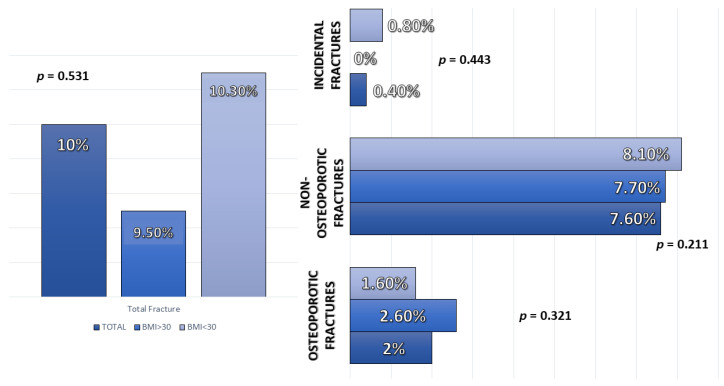
Background and aims: The relationship between obesity and bone metabolism is controversial. In recent decades, the protective role of obesity in the development of osteoporosis is questioned. The aims of this study are the following: to evaluate the differences in bone turnover markers between postmenopausal women with and without obesity and to compare the risk of fracture at five years between these groups. Methods: An observational longitudinal prospective cohort study of postmenopausal women with obesity (O) (body mass index (BMI) > 30 kg/m2) and non-obesity (NoO) (BMI < 30 kg/m2) is designed. 250 postmenopausal women are included in the study (NoO: 124 (49.6%) and O: 126 (50.4%)). It measures epidemiological variables, dietary variables (calcium intake, vitamin D intake, smoking, alcohol consumption, and physical activity), biochemicals (β-crosslap, type I procollagen amino-terminal peptide (P1NP), 25OH-vitamin D, and parathyroid hormone (PTH)), anthropometric variables, and fracture data five years after the start of the study. The mean age is 56.17 (3.91) years. Women with obesity showed lower levels of vitamin D (O: 17.27 (7.85) ng/mL, NoO: 24.51 (9.60) ng/mL; p < 0.01), and higher levels of PTH (O: 53.24 (38.44−65.96) pg/mL, NoO: 35.24 (25.36−42.40) pg/mL; p < 0.01). Regarding the bone formation marker (P1NP), it was found to be high in women without obesity, O: 45.46 (34.39−55.16) ng/mL, NoO: 56.74 (45.34−70.74) ng/mL; p < 0.01; the bone resorption marker (β-crosslap) was found to be high in women with obesity, being significant in those older than 59 years (O: 0.39 (0.14) ng/mL, NoO 0.24 (0.09) ng/mL; p < 0.05). No differences are observed in the risk of fracture at 5 years based on BMI (OR = 0.90 (95%CI 0.30−2.72); p = 0.85). Conclusions: Postmenopausal women with obesity showed lower levels of bone formation markers; older women with obesity showed higher markers of bone resorption.
肥胖与骨代谢之间的关系存在争议。近几十年来,肥胖对骨质疏松症发展的保护作用受到质疑。本研究的目的如下:评估绝经后肥胖(O)(BMI>30kg/m2)和非肥胖(NoO)(BMI<30kg/m2)女性之间骨转换标志物的差异,并比较这些组五年内骨折的风险。
设计了一项绝经后肥胖(O)(BMI>30kg/m2)和非肥胖(NoO)(BMI<30kg/m2)女性的观察性纵向前瞻性队列研究。共纳入 250 名绝经后妇女(NoO:124(49.6%)和 O:126(50.4%))。测量了流行病学变量、饮食变量(钙摄入量、维生素 D 摄入量、吸烟、饮酒和体力活动)、生化指标(β-crosslap、I 型前胶原氨基端肽(P1NP)、25OH-维生素 D 和甲状旁腺激素(PTH))、人体测量学变量和研究开始后五年的骨折数据。平均年龄为 56.17(3.91)岁。肥胖女性的维生素 D 水平较低(O:17.27(7.85)ng/mL,NoO:24.51(9.60)ng/mL;p<0.01),甲状旁腺激素水平较高(O:53.24(38.44-65.96)pg/mL,NoO:35.24(25.36-42.40)pg/mL;p<0.01)。关于骨形成标志物(P1NP),发现非肥胖女性的水平较高,O:45.46(34.39-55.16)ng/mL,NoO:56.74(45.34-70.74)ng/mL;p<0.01;骨吸收标志物(β-crosslap)在肥胖女性中较高,59 岁以上的女性显著升高(O:0.39(0.14)ng/mL,NoO 0.24(0.09)ng/mL;p<0.05)。基于 BMI,五年内骨折风险无差异(OR=0.90(95%CI 0.30-2.72);p=0.85)。
绝经后肥胖女性的骨形成标志物水平较低;肥胖的老年女性骨吸收标志物水平较高。