Diterlizzi Marianna, Ferretti Anna Maria, Scavia Guido, Sorrentino Roberto, Luzzati Silvia, Boccia Antonella Caterina, Scamporrino Andrea A, Po' Riccardo, Quadrivi Eleonora, Zappia Stefania, Destri Silvia
Istituto di Scienze e Tecnologie Chimiche "Giulio Natta" (SCITEC)-CNR, Sede Via A. Corti 12, 20133 Milano, Italy.
Dipartimento di Scienza dei Materiali, Università degli Studi di Milano-Bicocca, Via Cozzi 55, 20125 Milano, Italy.
Polymers (Basel). 2022 Apr 13;14(8):1588. doi: 10.3390/polym14081588.
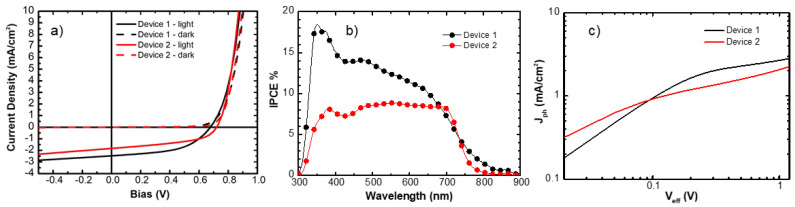
We synthetized a new rod-coil block copolymer (BCP) based on the semiconducting polymerpoly({4,8-bis[(2-ethylhexyl)oxy]benzo[1,2-:4,5-]dithiophene-2,6-diyl}{3-fluoro-2-[(2-ethylhexyl)carbonyl]thieno[3,4-]thiophenediyl}) (PTB7) and poly-4-vinylpyridine (P4VP), tailored to produce water-processable nanoparticles (WPNPs) in blend with phenyl-C71-butyric acid methyl ester (PCBM). The copolymer PTB7--P4VP was completely characterized by means of two-dimensional nuclear magnetic resonance (2D-NMR), matrix-assisted laser desorption/ionization-time of flight (MALDI-TOF) mass spectrometry (MS), size-exclusion chromatography (SEC), and differential scanning calorimetry (DSC) to confirm the molecular structure. The WPNPs were prepared through an adapted miniemulsion approach without any surfactants. Transmission electron microscopy (TEM) images reveal the nano-segregation of two active materials inside the WPNPs. The nanostructures appear spherical with a Janus-like inner morphology. PTB7 segregated to one side of the nanoparticle, while PCBM segregated to the other side. This morphology was consistent with the value of the surface energy obtained for the two active materials PTB7--P4VP and PCBM. The WPNPs obtained were deposited as an active layer of organic solar cells (OSCs). The films obtained were characterized by UV-Visible Spectroscopy (UV-vis), atomic force microscopy (AFM), and grazing incidence X-ray diffraction (GIXRD). J-V characteristics of the WPNP-based devices were measured by obtaining a power conversion efficiency of 0.85%. Noticeably, the efficiency of the WPNP-based devices was higher than that achieved for the devices fabricated with the PTB7-based BCP dissolved in chlorinated organic solvent.
我们合成了一种基于半导体聚合物聚({4,8-双[(2-乙基己基)氧基]苯并[1,2-b:4,5-b']二噻吩-2,6-二基}{3-氟-2-[(2-乙基己基)羰基]噻吩并[3,4-b']噻吩二基})(PTB7)和聚-4-乙烯基吡啶(P4VP)的新型棒-线圈嵌段共聚物(BCP),旨在与苯基-C71-丁酸甲酯(PCBM)共混制备可水加工的纳米颗粒(WPNPs)。通过二维核磁共振(2D-NMR)、基质辅助激光解吸/电离飞行时间(MALDI-TOF)质谱(MS)、尺寸排阻色谱(SEC)和差示扫描量热法(DSC)对共聚物PTB7-P4VP进行了全面表征,以确认其分子结构。WPNPs是通过一种改良的微乳液方法制备的,无需任何表面活性剂。透射电子显微镜(TEM)图像揭示了WPNPs内部两种活性材料的纳米相分离。纳米结构呈球形,具有类雅努斯内部形态。PTB7分离到纳米颗粒的一侧,而PCBM分离到另一侧。这种形态与两种活性材料PTB7-P4VP和PCBM的表面能值一致。所获得的WPNPs作为有机太阳能电池(OSCs)的活性层进行沉积。通过紫外-可见光谱(UV-vis)、原子力显微镜(AFM)和掠入射X射线衍射(GIXRD)对所得薄膜进行了表征。通过测量基于WPNP的器件的功率转换效率为0.85%,得到了其电流-电压(J-V)特性。值得注意的是,基于WPNP的器件的效率高于用溶解在氯化有机溶剂中的基于PTB7的BCP制造的器件所达到的效率。