Ferretti Anna Maria, Diterlizzi Marianna, Porzio William, Giovanella Umberto, Ganzer Lucia, Virgili Tersilla, Vohra Varun, Arias Eduardo, Moggio Ivana, Scavia Guido, Destri Silvia, Zappia Stefania
Laboratorio di Nanotecnologie, Istituto di Scienze e Tecnologie Chimiche "Giulio Natta" (SCITEC)-CNR, Sezione Via G. Fantoli 16/15, 20138 Milano, Italy.
Istituto di Scienze e Tecnologie Chimiche "Giulio Natta" (SCITEC)-CNR, Sede Via A. Corti 12, 20133 Milano, Italy.
Nanomaterials (Basel). 2021 Dec 29;12(1):84. doi: 10.3390/nano12010084.
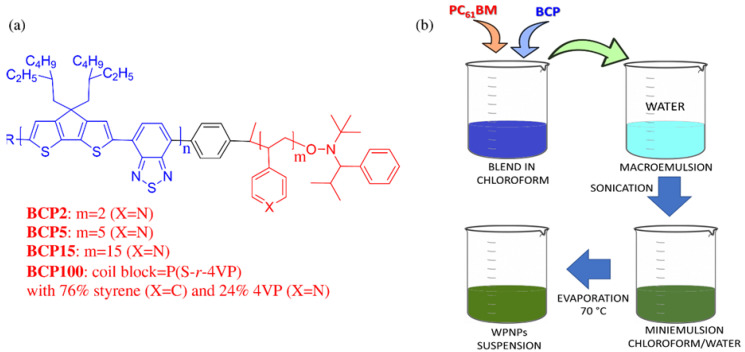
The use of water-processable nanoparticles (WPNPs) is an emerging strategy for the processing of organic semiconducting materials into aqueous medium, dramatically reducing the use of chlorinated solvents and enabling the control of the nanomorphology in OPV active layers. We studied amphiphilic rod-coil block copolymers (BCPs) with a different chemical structure and length of the hydrophilic coil blocks. Using the BCPs blended with a fullerene acceptor material, we fabricated NP-OPV devices with a sustainable approach. The goal of this work is to clarify how the morphology of the nanodomains of the two active materials is addressed by the hydrophilic coil molecular structures, and in turn how the design of the materials affects the device performances. Exploiting a peculiar application of TEM, EFTEM microscopy on WPNPs, with the contribution of AFM and spectroscopic techniques, we correlate the coil structure with the device performances, demonstrating the pivotal influence of the chemical design over material properties. BCP5, bearing a coil block of five repeating units of 4-vinilpyridine (4VP), leads to working devices with efficiency comparable to the solution-processed ones for the multiple PCBM-rich cores morphology displayed by the blend WPNPs. Otherwise, BCP2 and BCP15, with 2 and 15 repeating units of 4VP, respectively, show a single large PCBM-rich core; the insertion of styrene units into the coil block of BCP100 is detrimental for the device efficiency, even if it produces an intermixed structure.
使用可水加工的纳米颗粒(WPNPs)是一种将有机半导体材料加工到水介质中的新兴策略,可大幅减少氯化溶剂的使用,并能控制有机光伏(OPV)活性层中的纳米形态。我们研究了具有不同化学结构和亲水线圈嵌段长度的两亲性棒-线圈嵌段共聚物(BCPs)。通过将BCPs与富勒烯受体材料混合,我们采用可持续方法制造了NP-OPV器件。这项工作的目的是阐明亲水性线圈分子结构如何影响两种活性材料的纳米域形态,进而材料设计如何影响器件性能。利用透射电子显微镜(TEM)、能量过滤透射电子显微镜(EFTEM)对WPNPs的特殊应用,并结合原子力显微镜(AFM)和光谱技术,我们将线圈结构与器件性能相关联,证明了化学设计对材料性能的关键影响。BCP5带有由五个4-乙烯基吡啶(4VP)重复单元组成的线圈嵌段,对于混合WPNPs呈现的多个富含PCBM的核形态,其制成的工作器件效率与溶液处理的器件相当。否则,分别带有2个和15个4VP重复单元的BCP2和BCP15显示出单个大的富含PCBM的核;即使BCP100的线圈嵌段中插入苯乙烯单元会产生混合结构,但对器件效率不利。