Department of Forensic Sciences, College of Criminal Justice, Naif Arab University for Security Sciences, Riyadh 14812, Saudi Arabia.
Center of Excellence in Cybercrime and Digital Forensics, College of Criminal Justice, Naif Arab University for Security Sciences, Riyadh 14812, Saudi Arabia.
Sensors (Basel). 2022 Apr 15;22(8):3053. doi: 10.3390/s22083053.
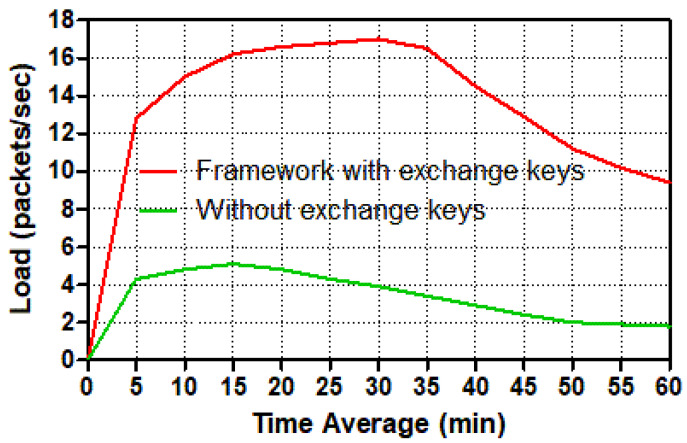
Recently, smart cities have increasingly been experiencing an evolution to improve the lifestyle of citizens and society. These emerge from the innovation of information and communication technologies (ICT) which are able to create a new economic and social opportunities. However, there are several challenges regarding our security and expectation of privacy. People are already involved and interconnected by using smart phones and other appliances. In many cities, smart energy meters, smart devices, and security appliances have recently been standardized. Full connectivity between public venues, homes, cares, and some other social systems are on their way to be applied, which are known as Internet of Things. In this paper, we aim to enhance the performance of security in smart city communication networks by using a new framework and scheme that provide an authentication and high confidentiality of data. The smart city system can achieve mutual authentication and establish the shared session key schemes between smart meters and the control center in order to secure a two-way communication channel. In our extensive simulation, we investigated and evaluated the security performance of the smart city communication network with and without our proposed scheme in terms of throughput, latency, load, and traffic received packet per seconds. Furthermore, we implemented and applied a man-in-the-middle (MITM) attack and network intrusion detection system (NIDS) in our proposed technique to validate and measure the security requirements maintaining the constrained resources.
近年来,智慧城市为了改善市民和社会的生活方式,正逐渐经历一场变革。这些变革源于信息和通信技术(ICT)的创新,它能够创造新的经济和社会机遇。然而,在我们的安全和隐私期望方面,还存在着一些挑战。人们已经通过使用智能手机和其他设备参与并相互连接。在许多城市,智能电表、智能设备和安全设备最近已经标准化。公共场所、家庭、护理院和其他一些社会系统之间的全面连接即将实现,这就是物联网。在本文中,我们旨在通过使用新的框架和方案来提高智慧城市通信网络的安全性,该框架和方案提供了数据的身份验证和高度机密性。智能城市系统可以实现智能电表和控制中心之间的相互认证,并建立共享会话密钥方案,以确保双向通信通道的安全。在我们广泛的仿真中,我们研究和评估了带有和不带有我们提出的方案的智慧城市通信网络的安全性能,包括吞吐量、延迟、负载和每秒接收的数据包数量。此外,我们在提出的技术中实现并应用了中间人(MITM)攻击和网络入侵检测系统(NIDS),以验证和衡量在保持有限资源的情况下满足安全要求的能力。