Division of Medical Oncology, National Center for Tumor Diseases (NCT), University Hospital Heidelberg, Im Neuenheimer Feld 460, 69120, Heidelberg, Germany.
Department of Internal Medicine I, University Hospital Heidelberg, Im Neuenheimer Feld 410, 69120, Heidelberg, Germany.
BMC Cancer. 2022 Apr 22;22(1):440. doi: 10.1186/s12885-022-09497-1.
Graft-versus-host disease (GvHD) remains a major complication and limitation to successful allogeneic hematopoietic stem cell transplantation. Treatment of GvHD is challenging due to its heterogeneous nature of presentation, with steroids remaining the established first-line treatment. Long-term doses of systemic corticosteroids have many well-known side-effects including muscle atrophy. Despite the fact that reports in non-cancer clinical populations treated with glucocorticoids demonstrated that resistance training can reverse atrophy and weakness, no RCT has evaluated the potential of resistance training on preventing the disease- and treatment-induced loss of skeletal muscle mass and function in GvHD patients yet. In this context, ensuring adequate nutrition is important as protein deprivation may accelerate the wasting process. As GvHD patients are commonly found to be malnourished, nutritional medical care should be considered when investigating the effect of exercise in GvHD patients. Therefore, the aim of the present "Impact of Resistance Exercise and Nutritional Endorsement on physical performance in patients with GvHD" - Study (IRENE-G) is to evaluate the effects of resistance exercise in combination with nutritional endorsement on physical, nutritional and patient-reported outcomes in GvHD patients.
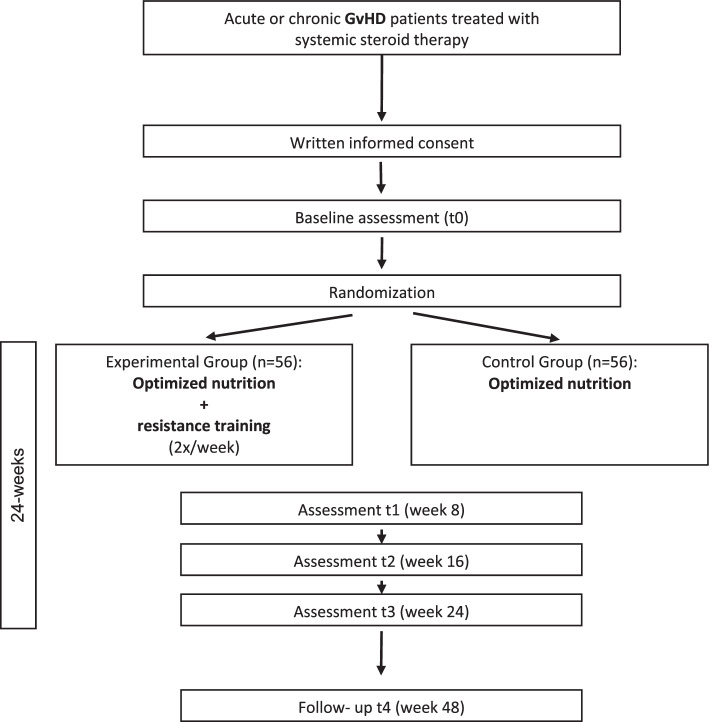
IRENE-G is a 24-week prospective interventional RCT. One hundred twelve participants will be randomly allocated (1:1) to one of two arms: resistance exercise and nutritional optimization (experimental) vs. nutritional optimization only (control). Participants in the experimental group will engage in a supervised, progressive moderate-to-high intensity resistance training that is consistent with exercise guidelines for cancer patients, while additionally receiving nutritional support/therapy. Subjects of the control group solely receive nutritional support/therapy based on individual needs. Participants will be assessed at baseline, at 8, 16, 24 weeks for physical performance and various physiological, nutritional and patient-reported outcomes. Follow-up will be 6 months after intervention completion.
To our knowledge, this will be the first RCT to assess and compare the effects of a resistance intervention supplemented by nutritional support/therapy against nutritional support only on various health-related outcomes in GvHD patients. The study will contribute to our understanding of the value of exercise and nutritional endorsement in counteracting the negative consequences of GvHD and its treatment.
ClinicalTrials.gov : NCT05111834 . Registered 8 November 2021 - Retrospectively registered.
移植物抗宿主病(GvHD)仍然是异基因造血干细胞移植成功的主要并发症和限制因素。由于其表现呈异质性,类固醇仍然是既定的一线治疗方法,因此治疗 GvHD 具有挑战性。长期使用全身皮质类固醇有许多众所周知的副作用,包括肌肉萎缩。尽管有报道称,在接受糖皮质激素治疗的非癌症临床人群中,阻力训练可以逆转萎缩和虚弱,但尚无 RCT 评估阻力训练预防 GvHD 患者疾病和治疗引起的骨骼肌质量和功能丧失的潜力。在这种情况下,确保充足的营养很重要,因为蛋白质缺乏可能会加速消耗过程。由于 GvHD 患者通常被发现存在营养不良,因此在研究运动对 GvHD 患者的影响时,应考虑营养医疗护理。因此,本研究的目的是评估阻力运动结合营养支持对 GvHD 患者身体表现、营养和患者报告结果的影响。
IRENE-G 是一项为期 24 周的前瞻性干预性 RCT。将 112 名参与者随机分配(1:1)至以下两个组之一:阻力运动和营养优化(实验组)或仅营养优化(对照组)。实验组参与者将接受监督的、渐进的中高强度阻力训练,该训练与癌症患者的运动指南一致,同时还接受营养支持/治疗。对照组仅根据个人需求接受营养支持/治疗。参与者将在基线、8、16 和 24 周时进行身体表现和各种生理、营养和患者报告结果的评估。干预完成后进行 6 个月的随访。
据我们所知,这将是第一项评估和比较阻力干预联合营养支持/治疗与仅营养支持对 GvHD 患者各种健康相关结局影响的 RCT。该研究将有助于我们了解运动和营养支持在对抗 GvHD 及其治疗的负面影响方面的价值。
ClinicalTrials.gov:NCT05111834。注册于 2021 年 11 月 8 日-回溯性注册。