Ng Tommy K C, Lo Man Fung, Fong Ben Y F, Yee Hilary H L
School of Professional Education and Executive Development, College of Professional and Continuing Education, The Hong Kong Polytechnic University, Kowloon, Hong Kong.
Faculty of Social Science, The Chinese University of Hong Kong, New Territories, Hong Kong.
BMC Complement Med Ther. 2022 Apr 22;22(1):113. doi: 10.1186/s12906-022-03598-x.
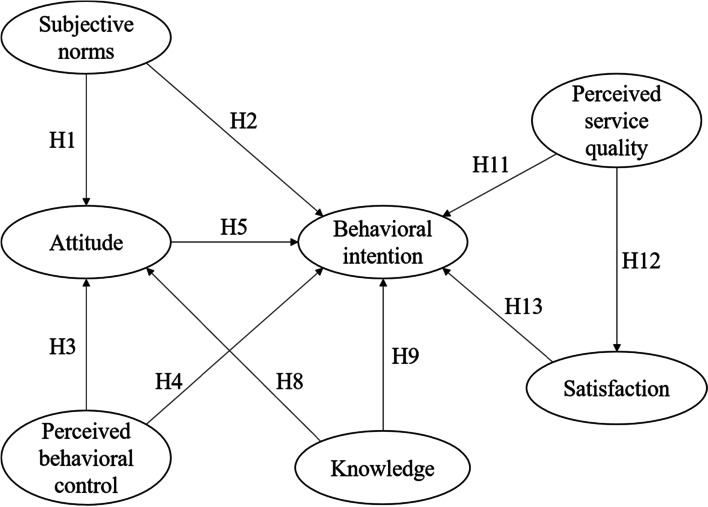
Traditional Chinese medicine (TCM) and Western medicine are available and have a long history in Hong Kong. Little is known on the intention to use TCM in Hong Kong. In this study, the intention to use TCM was examined by the extended theory of planned behavior.
An online cross-sectional survey was conducted from 15 and 29 November 2021. Respondents' attitude towards using TCM, intention to use TCM, knowledge, perceived behavioral control, perceived service quality, satisfaction, subjective norms and demographic characteristics were collected from the survey. To examine the conceptual framework in this study, partial least square structural equation model (PLS-SEM) was adopted.
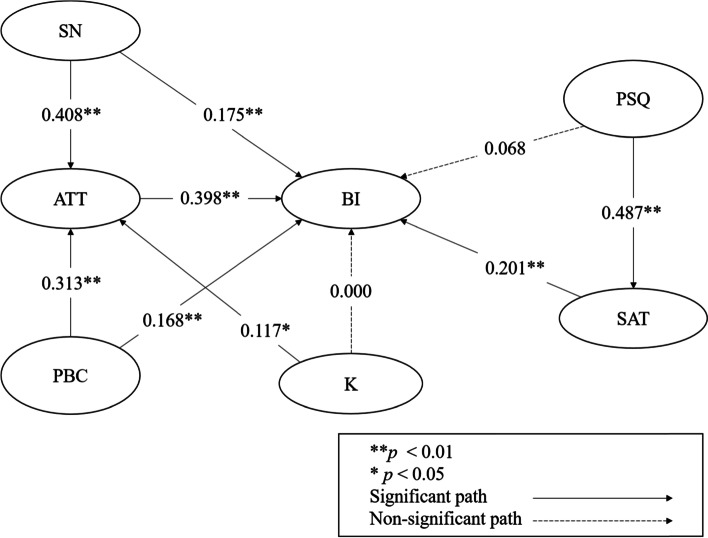
In total, 446 responses (completion rate = 74.3%) were analysed. Attitude towards TCM was the strongest predictor to the intention to use TCM followed by satisfaction and subjective norms. Attitude had a partial mediating effect on the relationship between subjective norms, perceived behavioral control and intention to use TCM. Attitude had a full mediating effect on the relationship between knowledge and intention to use TCM. Satisfaction had a full mediating effect on the relationship between perceived service quality and intention to use TCM.
This is the first study to investigate the predictors of the intention to use TCM in Hong Kong by using TPB. Individuals' attitude towards TCM has showed stronger effect to the intention to use TCM than other predictors, such as satisfaction, perceived behavioral control and subjective norms. To enhance the intention to use TCM in Hong Kong, key stakeholders, including TCM professional organisations, health professionals and policymakers, should develop a positive attitude towards TCM among Hong Kong population.
传统中医(TCM)和西医在香港都有应用且历史悠久。对于香港地区使用中医的意向了解甚少。在本研究中,运用计划行为扩展理论对使用中医的意向进行了考察。
于2021年11月15日至29日开展了一项在线横断面调查。通过该调查收集了受访者对使用中医的态度、使用中医的意向、知识、感知行为控制、感知服务质量、满意度、主观规范以及人口统计学特征。为检验本研究中的概念框架,采用了偏最小二乘结构方程模型(PLS - SEM)。
共分析了446份回复(完成率 = 74.3%)。对中医的态度是使用中医意向的最强预测因素,其次是满意度和主观规范。态度在主观规范、感知行为控制与使用中医意向之间的关系中具有部分中介作用。态度在知识与使用中医意向之间的关系中具有完全中介作用。满意度在感知服务质量与使用中医意向之间的关系中具有完全中介作用。
这是第一项通过计划行为理论来探究香港地区使用中医意向预测因素的研究。个体对中医的态度对使用中医意向的影响比其他预测因素(如满意度、感知行为控制和主观规范)更强。为提高香港地区使用中医的意向,包括中医专业组织、健康专业人员和政策制定者在内的关键利益相关者应在香港民众中培养对中医的积极态度。