Lo Iacono Sergio, Daniel Dores Cruz Terence
Umeå University, Umeå, Sweden.
University of Essex, Colchester, UK.
R Soc Open Sci. 2022 Apr 20;9(4):211504. doi: 10.1098/rsos.211504. eCollection 2022 Apr.
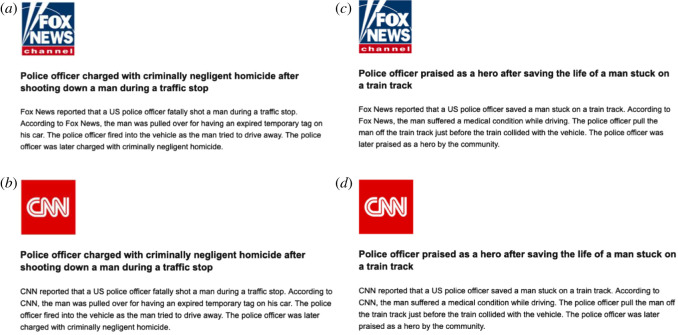
Hostile media perception (HMP) theory suggests that partisans perceive neutral coverage of news by outlets opposite to their political leaning as biased against their side. We conducted two pre-registered online experiments to assess the effect of HMP on news bias and news sharing intentions regarding two salient and controversial topics in the US: police conduct (Study 1, = 817) and COVID-19 norms (Study 2, = 819). Results show that partisans perceive neutral coverage of news by outlets opposite to their political leaning as biased, even when we account for their prior beliefs regarding the media outlet and news content. However, HMP seems to be limited in its consequences, as it has little impact on partisans' willingness to share news from outlets of opposite political leaning, even though the news is perceived as biased.
敌对媒体认知(HMP)理论表明,党派人士会将与他们政治倾向相反的媒体对新闻的中立报道视为对他们一方有偏见。我们进行了两项预先注册的在线实验,以评估HMP对美国两个突出且有争议的话题的新闻偏见和新闻分享意图的影响:警察行为(研究1,样本量=817)和新冠疫情规范(研究2,样本量=819)。结果表明,即使我们考虑到党派人士对媒体和新闻内容的先验信念,他们仍会将与他们政治倾向相反的媒体对新闻的中立报道视为有偏见。然而,HMP的影响似乎有限,因为它对党派人士分享来自政治倾向相反的媒体的新闻的意愿几乎没有影响,尽管这些新闻被视为有偏见。