Science, Innovation, Technology, and Entrepreneurship (SITE) Department, University of Exeter Business School, Exeter, EX4 4PU, UK.
Sloan School of Management, Massachusetts Institute of Technology, Cambridge, MA, 02138, USA.
Nat Commun. 2021 Feb 10;12(1):921. doi: 10.1038/s41467-020-20043-0.
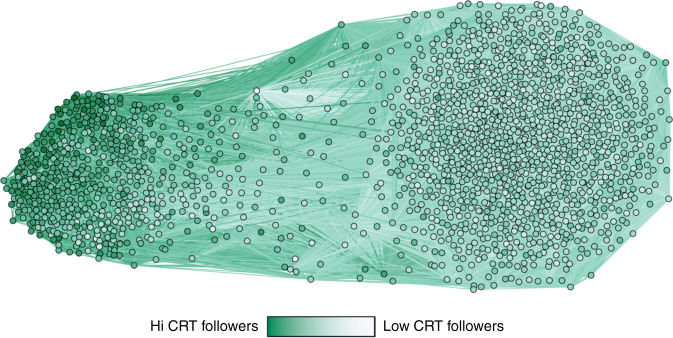
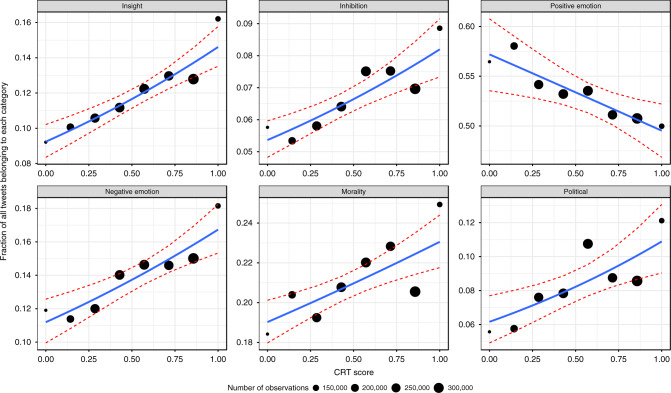
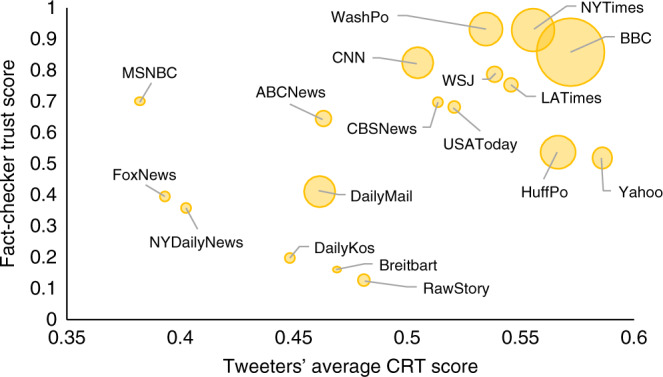
We investigate the relationship between individual differences in cognitive reflection and behavior on the social media platform Twitter, using a convenience sample of N = 1,901 individuals from Prolific. We find that people who score higher on the Cognitive Reflection Test-a widely used measure of reflective thinking-were more discerning in their social media use, as evidenced by the types and number of accounts followed, and by the reliability of the news sources they shared. Furthermore, a network analysis indicates that the phenomenon of echo chambers, in which discourse is more likely with like-minded others, is not limited to politics: people who scored lower in cognitive reflection tended to follow a set of accounts which are avoided by people who scored higher in cognitive reflection. Our results help to illuminate the drivers of behavior on social media platforms and challenge intuitionist notions that reflective thinking is unimportant for everyday judgment and decision-making.
我们利用 Prolific 平台上的 1901 名便利样本个体,研究了个体认知反射差异与社交媒体平台 Twitter 上行为之间的关系。我们发现,在认知反射测试中得分较高的人——这是一种广泛用于衡量反思性思维的测试——在社交媒体使用方面更加有辨别力,这表现在他们关注的账户类型和数量,以及他们分享的新闻来源的可靠性上。此外,网络分析表明,回音壁现象(即更倾向于与志同道合的人交流的现象)不仅局限于政治领域:在认知反射方面得分较低的人往往会关注一套由认知反射方面得分较高的人所回避的账户。我们的研究结果有助于阐明社交媒体平台上行为的驱动因素,并挑战了直观主义者的观点,即反思性思维对日常判断和决策不重要。