Sue and Bill Gross School of Nursing, University of California, Irvine, Irvine, CA, United States.
Donald Bren School of Information and Computer Sciences, University of California, Irvine, Irvine, CA, United States.
Front Public Health. 2022 Apr 7;10:808763. doi: 10.3389/fpubh.2022.808763. eCollection 2022.
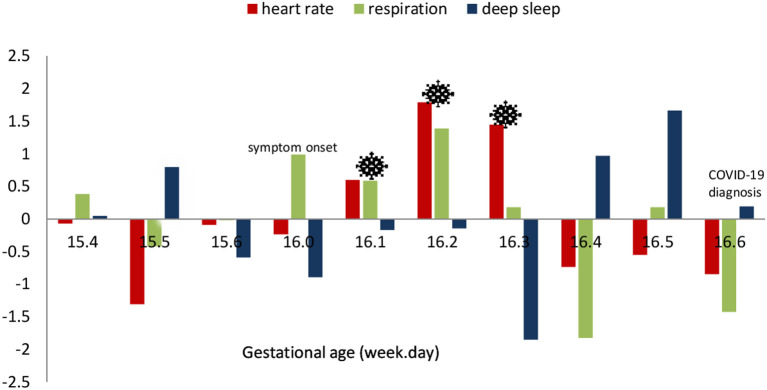
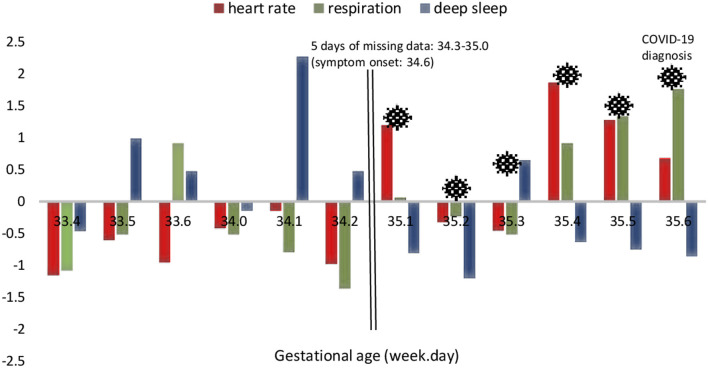
Continuous monitoring of perinatal women in a descriptive case study allowed us the opportunity to examine the time during which the COVID-19 infection led to physiological changes in two low-income pregnant women. An important component of this study was the use of a wearable sensor device, the ring, to monitor and record vital physiological parameters during sleep. Two women in their second and third trimesters, respectively, were selected based on a positive COVID-19 diagnosis. Both women were tested using the polymerase chain reaction method to confirm the presence of the virus during which time we were able to collect these physiological data. In both cases, we observed 3-6 days of peak physiological changes in resting heart rate (HR), heart rate variability (HRV), and respiratory rate (RR), as well as sleep surrounding the onset of COVID-19 symptoms. The pregnant woman in her third trimester showed a significant increase in resting HR ( = 0.006) and RR ( = 0.048), and a significant decrease in HRV ( = 0.027) and deep sleep duration ( = 0.029). She reported experiencing moderate COVID-19 symptoms and did not require hospitalization. At 38 weeks of gestation, she had a normal delivery and gave birth to a healthy infant. The participant in her second trimester showed similar physiological changes during the 3-day peak period. Importantly, these changes appeared to return to the pre-peak levels. Common symptoms reported by both cases included loss of smell and nasal congestion, with one losing her sense of taste. Results suggest the potential to use the changes in cardiorespiratory responses and sleep for real-time monitoring of health and well-being during pregnancy.
在一项描述性病例研究中对围产期女性进行连续监测,使我们有机会研究 COVID-19 感染导致两名低收入孕妇生理变化的时间。本研究的一个重要组成部分是使用可穿戴传感器设备——戒指,监测和记录睡眠期间的重要生理参数。根据 COVID-19 阳性诊断,分别选择了处于第二和第三孕期的两名女性。这两名女性均通过聚合酶链反应方法进行了检测,以确认病毒的存在,在此期间我们能够收集这些生理数据。在这两种情况下,我们观察到静息心率 (HR)、心率变异性 (HRV) 和呼吸率 (RR) 的峰值生理变化持续 3-6 天,以及 COVID-19 症状发作前后的睡眠。处于第三孕期的孕妇静息 HR(=0.006)和 RR(=0.048)显著增加,HRV(=0.027)和深度睡眠时间(=0.029)显著减少。她报告出现中度 COVID-19 症状,无需住院治疗。在 38 周妊娠时,她进行了正常分娩,生下了一个健康的婴儿。处于第二孕期的参与者在 3 天的高峰期也表现出类似的生理变化。重要的是,这些变化似乎恢复到了峰值前的水平。两名患者都报告了常见的症状,包括嗅觉丧失和鼻塞,其中一人味觉丧失。结果表明,有潜力利用心肺反应和睡眠的变化来实时监测怀孕期间的健康和幸福。