Hajduczok Alexander G, DiJoseph Kara M, Bent Brinnae, Thorp Audrey K, Mullholand Jon B, MacKay Stuart A, Barik Sabrina, Coleman Jamie J, Paules Catharine I, Tinsley Andrew
Division of Internal Medicine, Department of Medicine, Penn State Health Milton S. Hershey Medical Center, Hershey, PA, United States.
Department of Biomedical Engineering, Duke University, Durham, NC, United States.
JMIR Form Res. 2021 Aug 4;5(8):e28568. doi: 10.2196/28568.
The Pfizer-BioNTech COVID-19 vaccine uses a novel messenger RNA technology to elicit a protective immune response. Short-term physiologic responses to the vaccine have not been studied using wearable devices.
We aim to characterize physiologic changes in response to COVID-19 vaccination in a small cohort of participants using a wearable device (WHOOP Strap 3.0). This is a proof of concept for using consumer-grade wearable devices to monitor response to COVID-19 vaccines.
In this prospective observational study, physiologic data from 19 internal medicine residents at a single institution that received both doses of the Pfizer-BioNTech COVID-19 vaccine was collected using the WHOOP Strap 3.0. The primary outcomes were percent change from baseline in heart rate variability (HRV), resting heart rate (RHR), and respiratory rate (RR). Secondary outcomes were percent change from baseline in total, rapid eye movement, and deep sleep. Exploratory outcomes included local and systemic reactogenicity following each dose and prophylactic analgesic use.
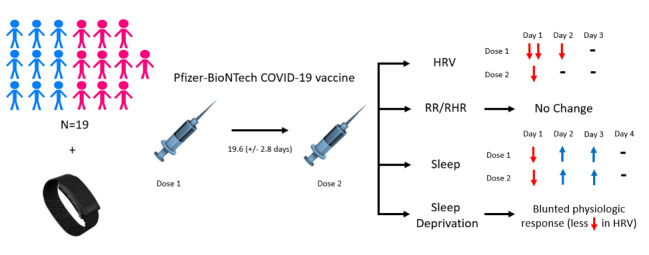
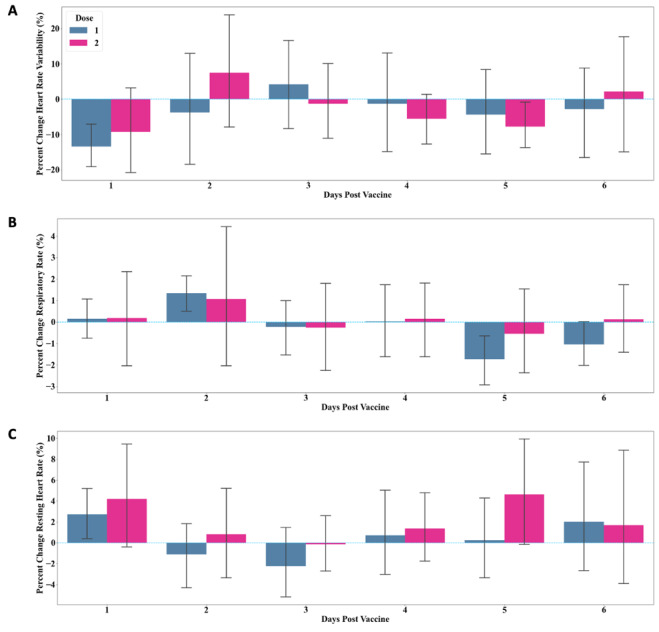
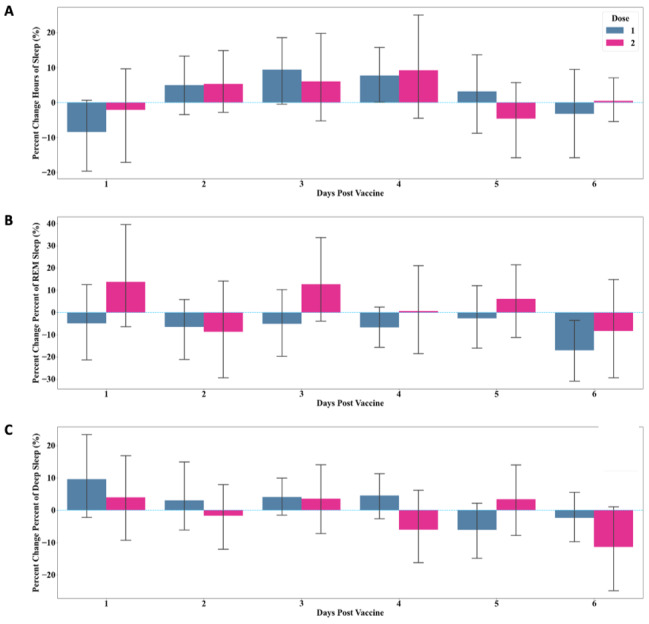
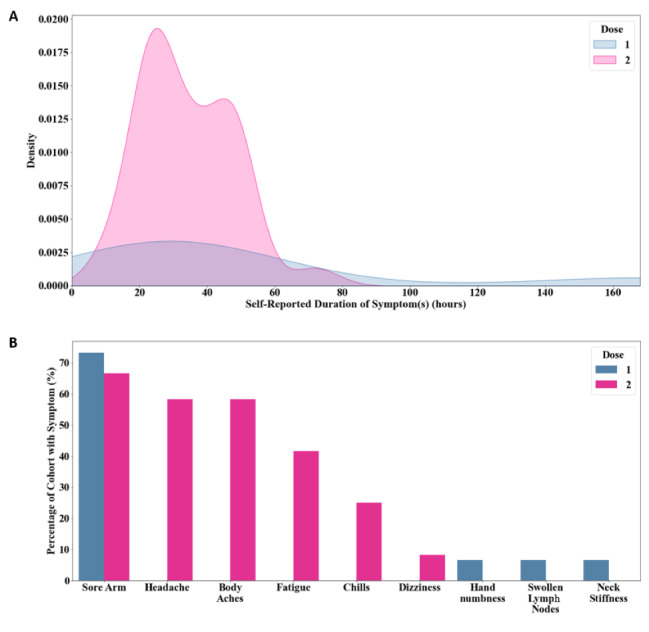
In 19 individuals (mean age 28.8, SD 2.2 years; n=10, 53% female), HRV was decreased on day 1 following administration of the first vaccine dose (mean -13.44%, SD 13.62%) and second vaccine dose (mean -9.25%, SD 22.6%). RHR and RR showed no change from baseline after either vaccine dose. Sleep duration was increased up to 4 days post vaccination, after an initial decrease on day 1. Increased sleep duration prior to vaccination was associated with a greater change in HRV. Local and systemic reactogenicity was more severe after dose two.
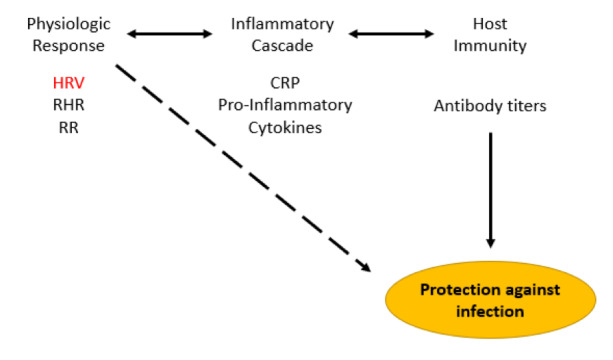
This is the first observational study of the physiologic response to any of the novel COVID-19 vaccines as measured using wearable devices. Using this relatively small healthy cohort, we provide evidence that HRV decreases in response to both vaccine doses, with no significant changes in RHR or RR. Sleep duration initially decreased following each dose with a subsequent increase thereafter. Future studies with a larger sample size and comparison to other inflammatory and immune biomarkers such as antibody response will be needed to determine the true utility of this type of continuous wearable monitoring in regards to vaccine responses. Our data raises the possibility that increased sleep prior to vaccination may impact physiologic responses and may be a modifiable way to increase vaccine response. These results may inform future studies using wearables for monitoring vaccine responses.
ClinicalTrials.gov NCT04304703; https://www.clinicaltrials.gov/ct2/show/NCT04304703.
辉瑞 - 生物科技公司的新冠疫苗采用了一种新型信使核糖核酸技术来引发保护性免疫反应。尚未使用可穿戴设备对该疫苗的短期生理反应进行研究。
我们旨在使用可穿戴设备(WHOOP Strap 3.0)对一小群参与者接种新冠疫苗后的生理变化进行特征描述。这是使用消费级可穿戴设备监测对新冠疫苗反应的概念验证。
在这项前瞻性观察性研究中,使用WHOOP Strap 3.0收集了来自单一机构的19名接受两剂辉瑞 - 生物科技公司新冠疫苗的内科住院医师的生理数据。主要结局指标为心率变异性(HRV)、静息心率(RHR)和呼吸频率(RR)相对于基线的变化百分比。次要结局指标为总睡眠时间、快速眼动睡眠时间和深度睡眠时间相对于基线的变化百分比。探索性结局指标包括每次接种后的局部和全身反应原性以及预防性镇痛药物的使用情况。
在19名个体(平均年龄28.8岁,标准差2.2岁;10名女性,占53%)中,接种第一剂疫苗后第1天HRV降低(平均降低13.44%,标准差13.62%),接种第二剂疫苗后第1天HRV也降低(平均降低9.25%,标准差22.6%)。接种任何一剂疫苗后,RHR和RR与基线相比均无变化。接种疫苗后睡眠时长最多增加4天,最初在第1天有所减少。接种疫苗前睡眠时长增加与HRV的更大变化相关。第二剂接种后的局部和全身反应原性更严重。
这是第一项使用可穿戴设备测量新型新冠疫苗生理反应的观察性研究。通过这个相对较小的健康队列,我们提供了证据表明,两剂疫苗接种后HRV均降低,而RHR或RR无显著变化。每次接种后睡眠时长最初减少,随后增加。未来需要更大样本量的研究,并与其他炎症和免疫生物标志物(如抗体反应)进行比较,以确定这种连续可穿戴监测在疫苗反应方面的真正效用。我们的数据提出了接种疫苗前睡眠增加可能影响生理反应且可能是增强疫苗反应的一种可改变方式的可能性。这些结果可能为未来使用可穿戴设备监测疫苗反应的研究提供参考。
ClinicalTrials.gov NCT04304703;https://www.clinicaltrials.gov/ct2/show/NCT04304703