He Qiongyao, Dong Hui, Gong Minmin, Guo Yujin, Xia Qingsong, Gong Jing, Lu Fuer
Institute of Integrated Traditional Chinese and Western Medicine, Tongji Hospital, Tongji Medical College, Huazhong University of Science and Technology, Wuhan, China.
Grade 2017 of Integrated Traditional Chinese and Western Clinical Medicine, Second Clinical School, Tongji Hospital, Tongji Medical College, Huazhong University of Science and Technology, Wuhan, China.
Front Pharmacol. 2022 Apr 5;13:862831. doi: 10.3389/fphar.2022.862831. eCollection 2022.
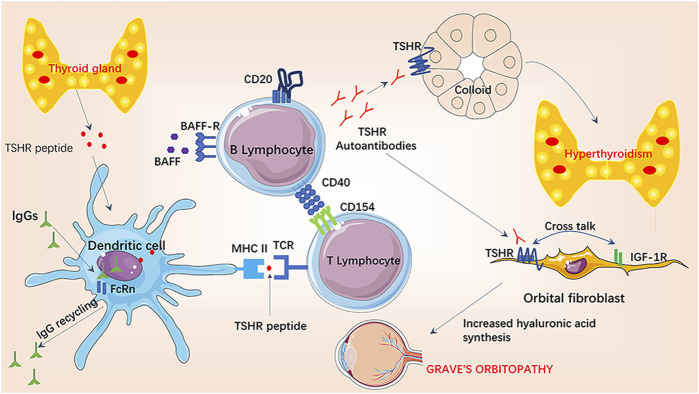
Graves' disease is an autoimmune disease characterized by goiter and hyperthyroidism, and 25% patients develop GO. Traditional treatment options, such as antithyroid drugs, radioiodine or thyroidectomy, have remained largely unchanged over the past 70 years. For many patients, there is a high rate of recurrence after antithyroid drugs and lifelong hypothyroidism after ablation and thyroidectomy. The symptoms and quality of life of some patients have not been effectively improved. The clinical demand for new therapeutic regimens, coupled with a deeper understanding of the pathophysiology and immunobiology of Graves' disease, has led to the emergence of several new therapeutic ideas, including biologics, small molecule peptides, immunomodulators and teprotumumab, a specific antibody targeting IGF-1R. Besides, the elements of TCM have attracted more and more interests in modern medicine, because some effective components have been successfully used in the treatment of autoimmune diseases. Based on the pathophysiology and efficacy of clinical management and treatment in Graves' hyperthyroidism, here we review the new strategies under investigation and summarize the effective components of traditional Chinese medicine used for Graves' hyperthyroidism, and explore their mechanisms. These therapies have opened a new window for the treatment of Graves' disease, but the exact mechanism and the research direction still need to be further explored.
格雷夫斯病是一种自身免疫性疾病,其特征为甲状腺肿大和甲状腺功能亢进,25%的患者会发展为 Graves 眼病(GO)。传统治疗方法,如抗甲状腺药物、放射性碘或甲状腺切除术,在过去 70 年里基本没有变化。对许多患者来说,抗甲状腺药物治疗后复发率高,而消融和甲状腺切除术后会出现终身甲状腺功能减退。一些患者的症状和生活质量并未得到有效改善。对新治疗方案的临床需求,以及对格雷夫斯病病理生理学和免疫生物学的更深入了解,催生了几种新的治疗理念,包括生物制剂、小分子肽、免疫调节剂以及靶向胰岛素样生长因子 -1 受体(IGF-1R)的特异性抗体替普罗单抗。此外,中医元素在现代医学中越来越受到关注,因为一些有效成分已成功用于治疗自身免疫性疾病。基于格雷夫斯病甲亢的病理生理学以及临床管理和治疗的疗效,我们在此综述正在研究的新策略,总结用于格雷夫斯病甲亢的中药有效成分,并探讨其作用机制。这些疗法为格雷夫斯病的治疗打开了一扇新窗口,但确切机制和研究方向仍需进一步探索。