Moffett Emma R, Fryxell David C, Simon Kevin S
School of Environment The University of Auckland Auckland New Zealand.
Ecol Evol. 2022 Apr 19;12(4):e8853. doi: 10.1002/ece3.8853. eCollection 2022 Apr.
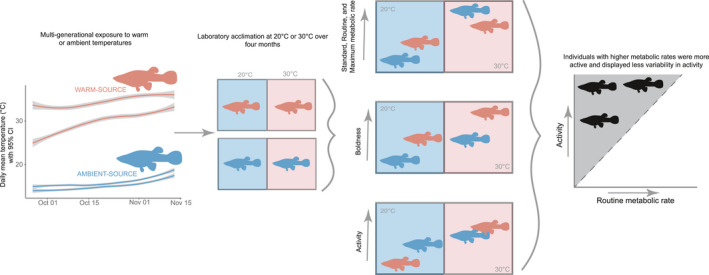
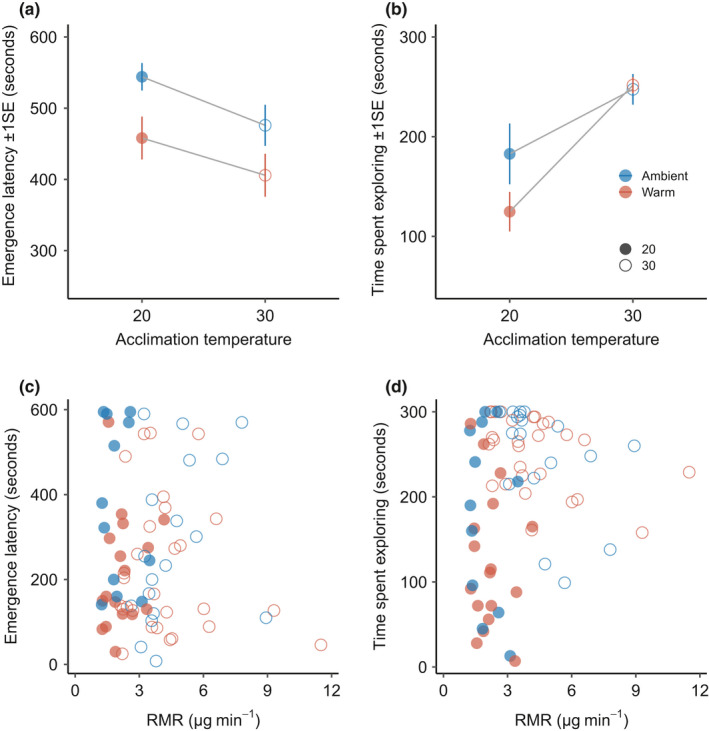
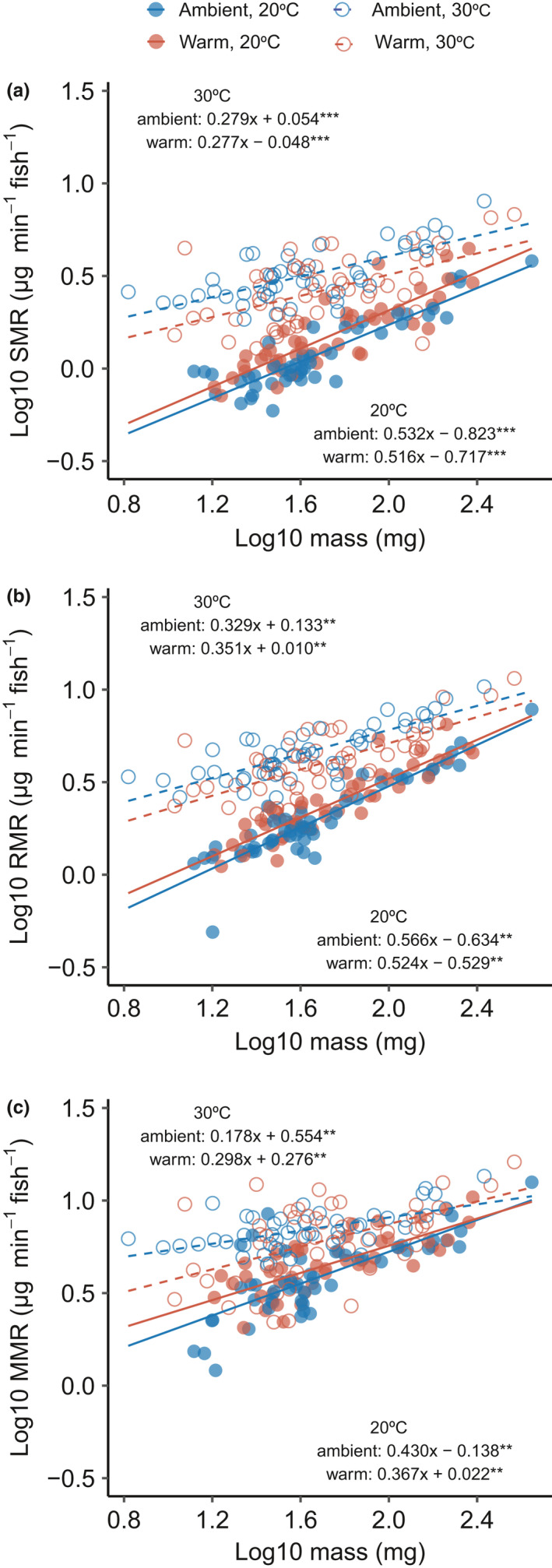
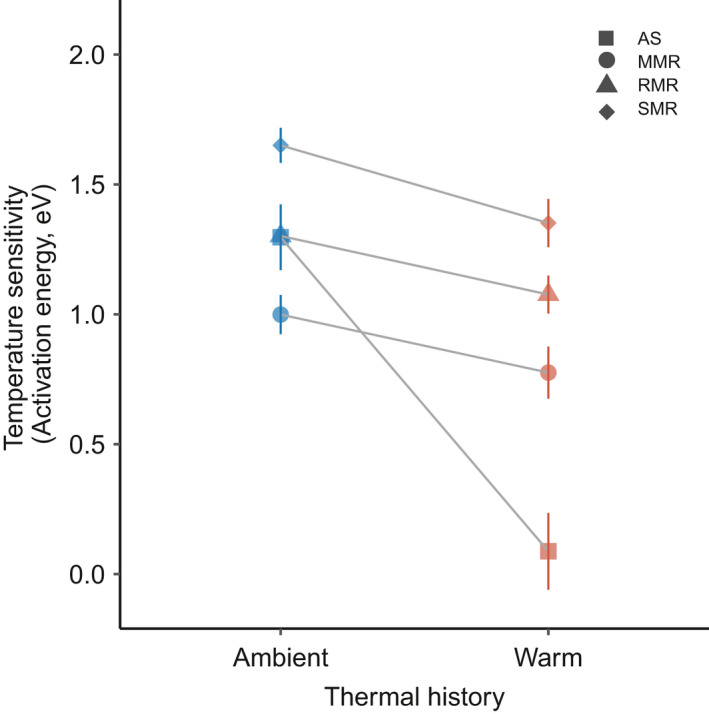
Acute exposure to warming temperatures increases minimum energetic requirements in ectotherms. However, over and within multiple generations, increased temperatures may cause plastic and evolved changes that modify the temperature sensitivity of energy demand and alter individual behaviors. Here, we aimed to test whether populations recently exposed to geothermally elevated temperatures express an altered temperature sensitivity of metabolism and behavior. We expected that long-term exposure to warming would moderate metabolic rate, reducing the temperature sensitivity of metabolism, with concomitant reductions in boldness and activity. We compared the temperature sensitivity of metabolic rate (acclimation at 20 vs. 30°C) and allometric slopes of routine, standard, and maximum metabolic rates, in addition to boldness and activity behaviors, across eight recently divergent populations of a widespread fish species (). Our data reveal that warm-source populations express a reduced temperature sensitivity of metabolism, with relatively high metabolic rates at cool acclimation temperatures and relatively low metabolic rates at warm acclimation temperatures compared to ambient-source populations. Allometric scaling of metabolism did not differ with thermal history. Across individuals from all populations combined, higher metabolic rates were associated with higher activity rates at 20°C and bolder behavior at 30°C. However, warm-source populations displayed relatively bolder behavior at both acclimation temperatures compared to ambient-source populations, despite their relatively low metabolic rates at warm acclimation temperatures. Overall, our data suggest that in response to warming, multigenerational exposure (e.g., plasticity, adaptation) may not result in trait change directed along a simple "pace-of-life syndrome" axis, instead causing relative decreases in metabolism and increases in boldness. Ultimately, our data suggest that multigenerational warming may produce a novel combination of physiological and behavioral traits, with consequences for animal performance in a warming world.
急性暴露于升温环境会增加变温动物的最低能量需求。然而,在多代及代内,温度升高可能会导致可塑性变化和进化变化,从而改变能量需求的温度敏感性并改变个体行为。在这里,我们旨在测试近期暴露于地热升温环境的种群是否表现出新陈代谢和行为的温度敏感性改变。我们预期长期暴露于升温环境会使代谢率适度降低,降低新陈代谢的温度敏感性,同时伴随着大胆程度和活动量的降低。我们比较了一种广泛分布的鱼类的八个近期分化种群的代谢率温度敏感性(在20°C和30°C下驯化)以及常规、标准和最大代谢率的异速生长斜率,此外还比较了大胆程度和活动行为。我们的数据显示,与环境源种群相比,热源种群表现出较低的新陈代谢温度敏感性,在凉爽驯化温度下代谢率相对较高,而在温暖驯化温度下代谢率相对较低。新陈代谢的异速生长缩放与热历史无关。在所有种群的个体中,较高的代谢率与20°C时较高的活动率以及30°C时更大胆的行为相关。然而,尽管热源种群在温暖驯化温度下代谢率相对较低,但与环境源种群相比,它们在两种驯化温度下都表现出相对更大胆的行为。总体而言,我们的数据表明,作为对升温的响应,多代暴露(例如可塑性、适应性)可能不会导致沿着简单的“生活节奏综合征”轴的性状变化,反而会导致新陈代谢相对降低和大胆程度增加。最终,我们的数据表明多代升温可能会产生生理和行为性状的新组合,对变暖世界中的动物表现产生影响。