Lin Jingfang, Liao Yanling, Gong Cansheng, Yu Lizhu, Gao Fei, Yu Jing, Chen Jianghu, Chen Xiaohui, Zheng Ting, Zheng Xiaochun
Department of Anesthesiology, Fujian Provincial Hospital, Shengli Clinical Medical College of Fujian Medical University, Fuzhou, China.
Front Med (Lausanne). 2022 Apr 6;9:842332. doi: 10.3389/fmed.2022.842332. eCollection 2022.
A variety of regional analgesia methods are used during video-assisted thoracic surgery (VATS). Our network meta-analysis (NMA) sought to evaluate the advantages of various methods of localized postoperative pain management in VATS patients.
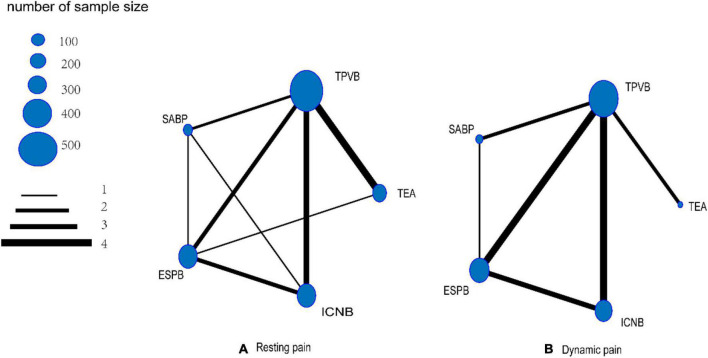
PubMed, the Cochrane Library, and EMBASE were searched from their date of inception to May 2021 for randomized controlled trials (RCTs) comparing two or more types of locoregional analgesia in adults using any standardized clinical criteria. This was done using Bayesian NMA.
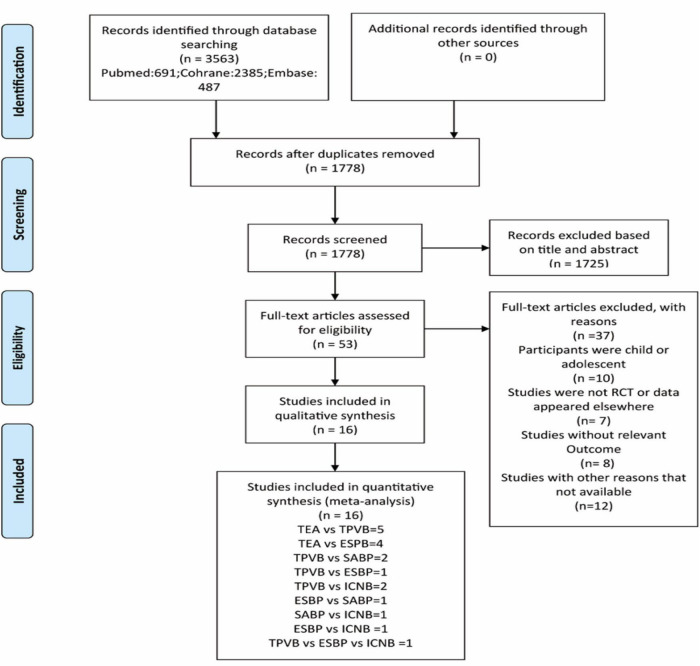
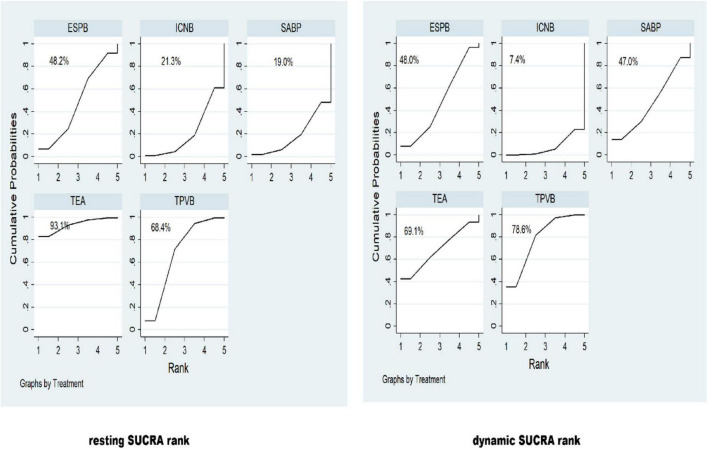
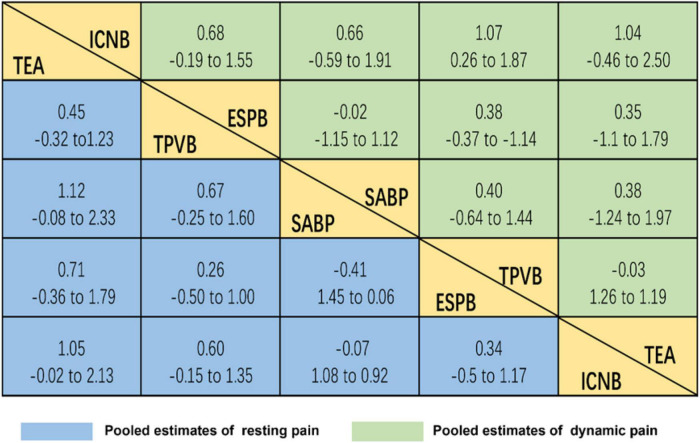
A total of 3,563 studies were initially identified, and 16 RCTs with a total of 1,144 participants were ultimately included. These studies, which spanned the years 2014 to 2021 and included data from eight different countries, presented new information. There were a variety of regional analgesia techniques used, and in terms of analgesic effect, thoracic epidural anesthesia (TEA) [SMD (standard mean difference) = 1.12, CrI (Credible interval): (-0.08 to -2.33)], thoracic paravertebral block (TPVB) (SMD = 0.67, CrI: (-0.25 to 1.60) and erector spinae plane block (ESPB) (SMD = 0.34, CrI: (-0.5 to 1.17) were better than other regional analgesia methods.
Overall, these findings show that TEA, TPVB and ESPB may be effective forms of regional analgesia in VATS. This research could be a valuable resource for future efforts regarding the use of thoracic regional analgesia and enhanced recovery after surgery.
Identifier [PROSPERO CRD42021253218].
在电视辅助胸腔镜手术(VATS)期间会使用多种区域镇痛方法。我们的网络荟萃分析(NMA)旨在评估VATS患者术后局部疼痛管理的各种方法的优势。
从创刊至2021年5月,在PubMed、Cochrane图书馆和EMBASE中检索比较使用任何标准化临床标准的两种或更多种局部区域镇痛方法的成人随机对照试验(RCT)。这是通过贝叶斯NMA完成的。
最初共识别出3563项研究,最终纳入了16项RCT,共有1144名参与者。这些研究涵盖2014年至2021年,包括来自八个不同国家的数据,提供了新信息。使用了多种区域镇痛技术,在镇痛效果方面,胸段硬膜外麻醉(TEA)[标准化均数差(SMD)=1.12,可信区间(CrI):(-0.08至-2.33)]、胸段椎旁阻滞(TPVB)(SMD = 0.67,CrI:(-0.25至1.60))和竖脊肌平面阻滞(ESPB)(SMD = 0.34,CrI:(-0.5至1.17))优于其他区域镇痛方法。
总体而言,这些发现表明TEA、TPVB和ESPB可能是VATS中有效的区域镇痛形式。这项研究可能是未来有关胸段区域镇痛使用和术后加速康复努力的宝贵资源。
标识符[PROSPERO CRD42021253218]