
基于局部晚期鼻咽癌颅底侵犯预测骨转移风险
Predicting Bone Metastasis Risk Based on Skull Base Invasion in Locally Advanced Nasopharyngeal Carcinoma.
作者信息
Wu Bo, Guo Yu, Yang Hai-Hua, Gao Qian-Gang, Tian Ye
机构信息
Department of Radiotherapy and Oncology, The Second Affiliated Hospital of Soochow University, Suzhou, China.
Department of Radiotherapy, Taizhou Central Hospital (Taizhou University Hospital), Taizhou, China.
出版信息
Front Oncol. 2022 Apr 7;12:812358. doi: 10.3389/fonc.2022.812358. eCollection 2022.
OBJECTIVE
To develop and validate a bone metastasis prediction model based on skull base invasion (SBI) in patients with locally advanced nasopharyngeal carcinoma (LA-NPC).
METHODS
This retrospective cohort study enrolled 290 patients with LA-NPC who received intensity-modulated radiation therapy in two hospitals from 2010 to 2020. Patient characteristics were grouped by SBI and hospital. Both unadjusted and multivariate-adjusted models were used to determine bone metastasis risk based on SBI status. Subgroup analysis was performed to investigate heterogeneity using a forest graph. Cox proportional hazard regression analysis was used to screen for risk factors of bone metastasis-free survival (BMFS). A nomogram of BMFS based on SBI was developed and validated using C-index, receiver operating characteristic curve, calibration curves, and decision curve analysis after Cox proportional hazard regression analysis.
RESULTS
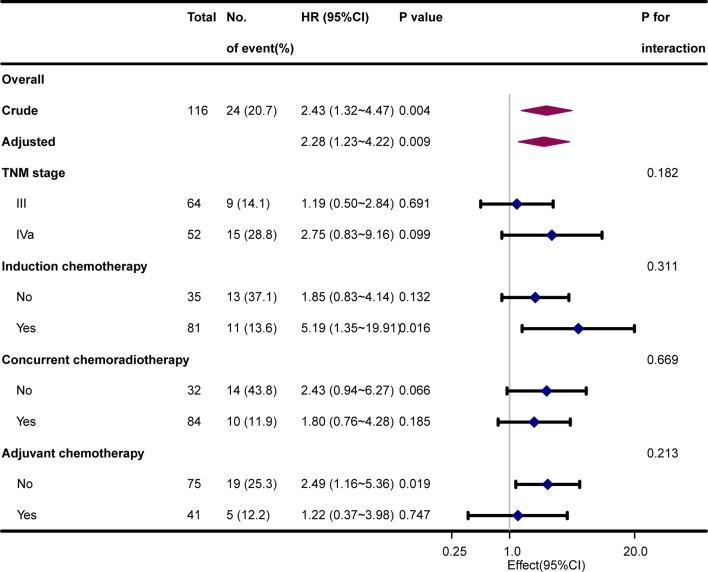
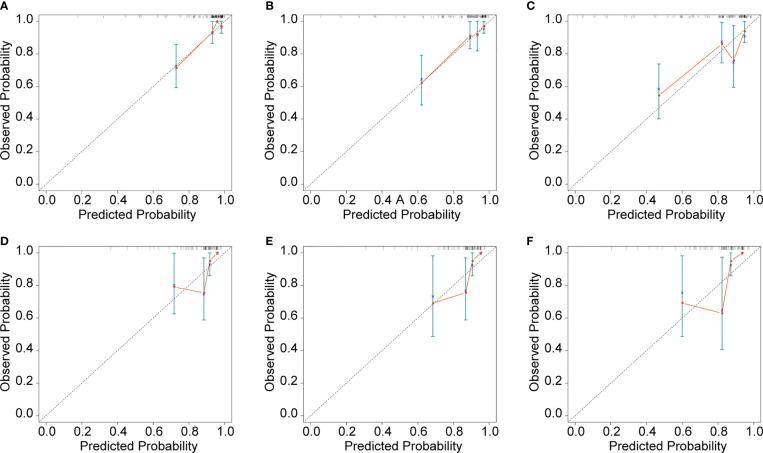
The incidence of bone metastasis was 14.83% (43/290), 20.69% (24/116), and 10.92% (19/174) in the overall population, SBI-positive group, and SBI-negative group, respectively. In the unadjusted model, SBI was associated with reduced BMFS [HR 2.43 (1.32-4.47), = 0.004], and the results remained stable after three continuous adjustments (0.05). No significant interaction was found in the subgroup analyses ( for interaction >0.05). According to Cox proportional hazard regression analysis and clinical value results, potential risk factors included SBI, Karnofsky performance status, TNM stage, induction chemotherapy, concurrent chemoradiotherapy, and adjuvant chemotherapy. Using a training C-index of 0.80 and a validation C-index of 0.79, the nomogram predicted BMFS and demonstrated satisfactory prognostic capability in 2, 3, and 5 years (area under curve: 83.7% vs. 79.6%, 81.7% vs. 88.2%, and 79.0% vs. 93.8%, respectively).
CONCLUSION
Skull base invasion is a risk factor for bone metastasis in patients with LA-NPC. The SBI-based nomogram model can be used to predict bone metastasis and may assist in identifying LA-NPC patients at the highest risk of bone metastasis.
目的
建立并验证基于局部晚期鼻咽癌(LA-NPC)患者颅底侵犯(SBI)的骨转移预测模型。
方法
这项回顾性队列研究纳入了2010年至2020年期间在两家医院接受调强放疗的290例LA-NPC患者。患者特征按SBI和医院进行分组。使用未调整模型和多变量调整模型根据SBI状态确定骨转移风险。采用森林图进行亚组分析以研究异质性。使用Cox比例风险回归分析筛选无骨转移生存期(BMFS)的危险因素。在Cox比例风险回归分析后,基于SBI绘制了BMFS列线图,并使用C指数、受试者工作特征曲线、校准曲线和决策曲线分析进行验证。
结果
总体人群、SBI阳性组和SBI阴性组的骨转移发生率分别为14.83%(43/290)、20.69%(24/116)和10.92%(19/174)。在未调整模型中,SBI与BMFS降低相关[风险比(HR)2.43(1.32 - 4.47),P = 0.004],经过三次连续调整(P < 0.05)后结果保持稳定。亚组分析未发现显著的交互作用(交互作用P > 0.05)。根据Cox比例风险回归分析和临床价值结果,潜在危险因素包括SBI、卡诺夫斯基功能状态、TNM分期、诱导化疗、同步放化疗和辅助化疗。列线图的训练C指数为0.80,验证C指数为0.79,预测了BMFS,并在2年、3年和5年显示出令人满意的预后能力(曲线下面积分别为:83.7%对79.6%、81.7%对88.2%、79.0%对93.8%)。
结论
颅底侵犯是LA-NPC患者骨转移的危险因素。基于SBI的列线图模型可用于预测骨转移,并可能有助于识别骨转移风险最高的LA-NPC患者。




 Zotero 插件