Department of Cardiovascular Surgery, The Second Hospital of Jilin University, Changchun, Jilin, China.
Department of Ophthalmology, The First Hospital of Jilin University, Changchun, China.
ESC Heart Fail. 2024 Oct;11(5):2521-2530. doi: 10.1002/ehf2.14730. Epub 2024 Mar 11.
Serum calcium level is widely used for evaluating disease severity, but its impact on clinical outcomes in patients with congestive heart failure (CHF) remains poorly understood. The aim of this study is to investigate the relationship between serum calcium levels and in-hospital mortality in CHF patients.
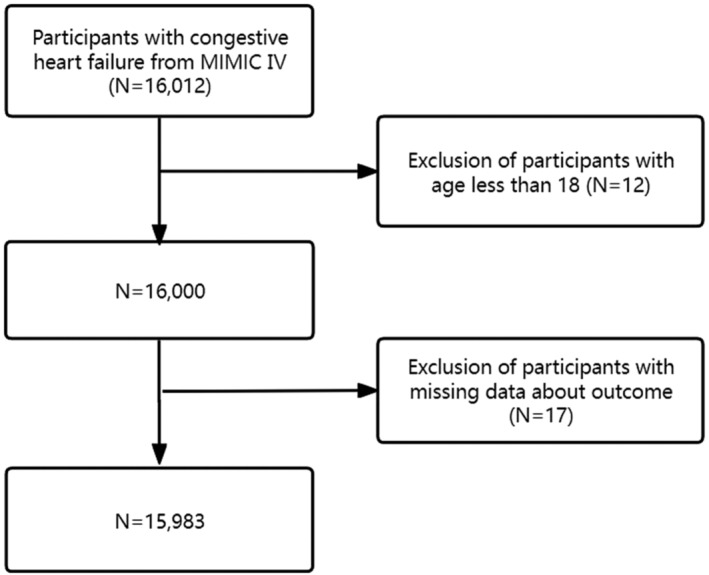
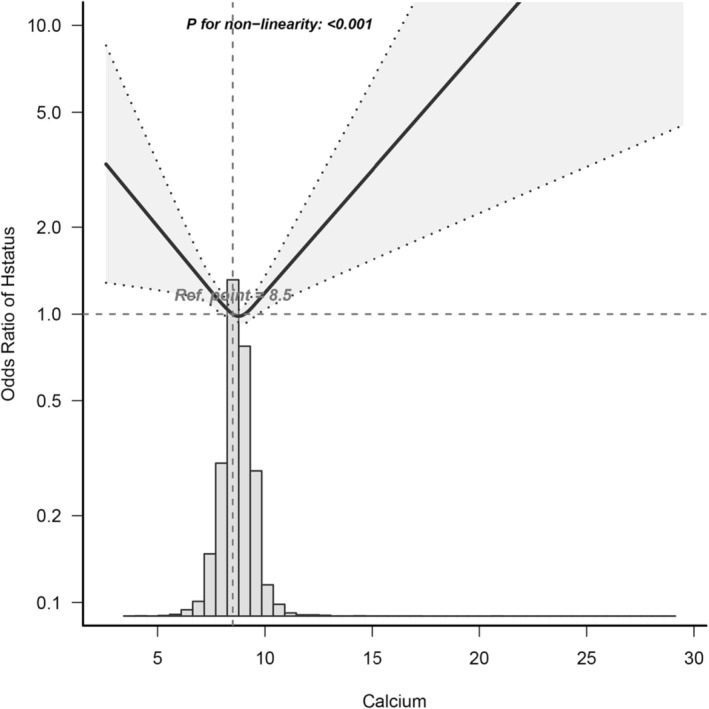
We conducted a retrospective analysis utilizing clinical data from the Medical Information Mart for Intensive Care database, encompassing a cohort of 15 983 CHF patients. This cohort was stratified based on their serum calcium levels, with the primary objective being the determination of in-hospital mortality. To assess the impact of admission serum calcium levels on in-hospital mortality, we employed various statistical methodologies, including multivariable logistic regression models, a generalized additive model, a two-piecewise linear regression model, and subgroup analysis. Comparative analysis of the reference group (Q3) revealed increased in-hospital mortality in the first quintile (Q1, the group with the lowest blood calcium level) and the fifth quintile (Q5, the group with the highest blood calcium level), with fully adjusted odds ratios of 1.38 [95% confidence interval (CI): 1.13-1.68, P = 0.002] and 1.23 (95% CI: 1.01-1.5, P = 0.038), respectively. A U-shaped relationship was observed between serum calcium levels and in-hospital mortality, with the lowest risk occurring at a threshold of 8.35 mg/dL. The effect sizes and corresponding CIs below and above this threshold were 0.782 (95% CI: 0.667-0.915, P = 0.0023) and 1.147 (95% CI: 1.034-1.273, P = 0.0094), respectively. Stratified analyses confirmed the robustness of this correlation.
Our study identifies a U-shaped association between serum calcium levels and in-hospital mortality in CHF patients, with a notable inflection point at 8.35 mg/dL. Further investigation through prospective, randomized, and controlled studies is warranted to validate the findings presented in this study.
血清钙水平广泛用于评估疾病严重程度,但它对充血性心力衰竭(CHF)患者临床结局的影响仍知之甚少。本研究旨在探讨血清钙水平与 CHF 患者住院死亡率之间的关系。
我们利用医疗信息集市重症监护数据库中的临床数据进行了回顾性分析,纳入了 15983 例 CHF 患者。根据血清钙水平对该队列进行分层,主要目的是确定住院死亡率。为了评估入院时血清钙水平对住院死亡率的影响,我们采用了多种统计学方法,包括多变量逻辑回归模型、广义加性模型、两段线性回归模型和亚组分析。与参考组(Q3)相比,第一五分位数(Q1,血钙最低组)和第五五分位数(Q5,血钙最高组)的住院死亡率更高,校正后的比值比分别为 1.38(95%可信区间[CI]:1.13-1.68,P=0.002)和 1.23(95% CI:1.01-1.5,P=0.038)。血清钙水平与住院死亡率之间呈 U 型关系,在 8.35mg/dL 时风险最低。该阈值以下和以上的效应大小和相应的 CI 分别为 0.782(95% CI:0.667-0.915,P=0.0023)和 1.147(95% CI:1.034-1.273,P=0.0094)。分层分析证实了这种相关性的稳健性。
本研究发现 CHF 患者血清钙水平与住院死亡率之间呈 U 型关系,在 8.35mg/dL 时有一个明显的拐点。需要通过前瞻性、随机对照研究进一步验证本研究中的发现。