Peng Ling, Zhu Liping, Sun Yilan, Stebbing Justin, Selvaggi Giovanni, Zhang Yongchang, Yu Zhentao
Cancer Center, Department of Pulmonary and Critical Care Medicine, Zhejiang Provincial People's Hospital, Affiliated People's Hospital, Hangzhou Medical College, Hangzhou, China.
Department of Medical Oncology, Shouguang Hospital of Traditional Chinese Medicine, Shouguang, China.
Front Oncol. 2022 Apr 6;12:863461. doi: 10.3389/fonc.2022.863461. eCollection 2022.
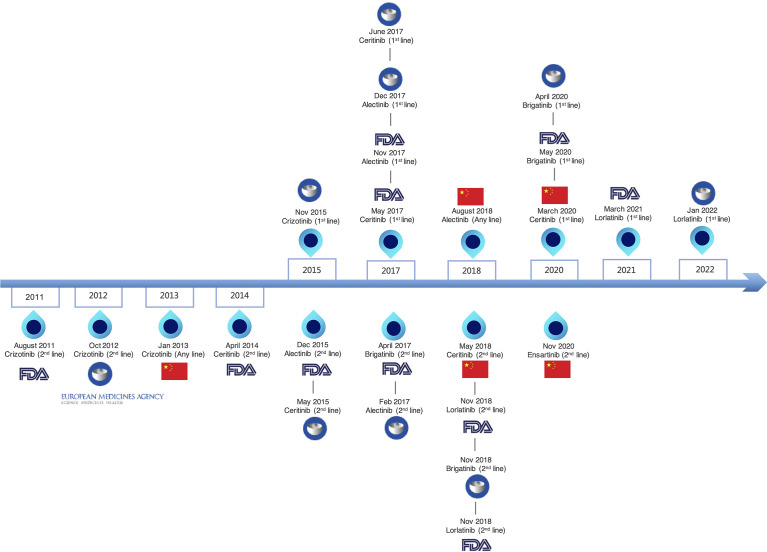
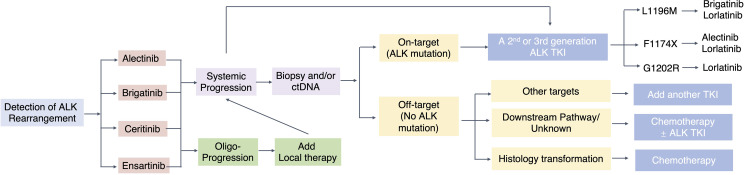
Anaplastic lymphoma kinase (ALK) alterations in non-small cell lung cancer (NSCLC) can be effectively treated with a variety of ALK-targeted drugs. After the approval of the first-generation ALK inhibitor crizotinib which achieved better results in prolonging the progression-free survival (PFS) compared with chemotherapy, a number of next-generation ALK inhibitors have been developed including ceritinib, alectinib, brigatinib, and ensartinib. Recently, a potent, third-generation ALK inhibitor, lorlatinib, has been approved by the Food and Drug Administration (FDA) for the first-line treatment of ALK-positive (ALK+) NSCLC. These drugs have manageable toxicity profiles. Responses to ALK inhibitors are however often not durable, and acquired resistance can occur as on-target or off-target alterations. Studies are underway to explore the mechanisms of resistance and optimal treatment options beyond progression. Efforts have also been undertaken to develop further generations of ALK inhibitors. This review will summarize the current situation of targeting the ALK signaling pathway.
非小细胞肺癌(NSCLC)中的间变性淋巴瘤激酶(ALK)改变可通过多种ALK靶向药物进行有效治疗。在第一代ALK抑制剂克唑替尼获批后,与化疗相比,其在延长无进展生存期(PFS)方面取得了更好的效果,随后又开发了多种下一代ALK抑制剂,包括色瑞替尼、阿来替尼、布加替尼和恩莎替尼。最近,一种强效的第三代ALK抑制剂洛拉替尼已被美国食品药品监督管理局(FDA)批准用于一线治疗ALK阳性(ALK+)NSCLC。这些药物的毒性特征可控。然而,对ALK抑制剂的反应通常并不持久,可能会因靶向或非靶向改变而产生获得性耐药。目前正在进行研究以探索耐药机制和进展后的最佳治疗方案。人们也一直在努力开发更新一代的ALK抑制剂。本综述将总结靶向ALK信号通路的现状。