Guangzhou Xinhua University, 248 Yanjiangxi Road, Machong Town, Dongguan, Guangdong 523133, China.
The Fifth Affiliated Hospital, Southern Medical University, No. 566, Congcheng Avenue, Conghua District, Guangzhou, Guangdong 510900, China.
Biomed Res Int. 2022 Apr 15;2022:4895611. doi: 10.1155/2022/4895611. eCollection 2022.
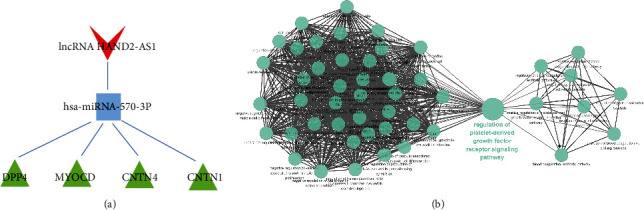
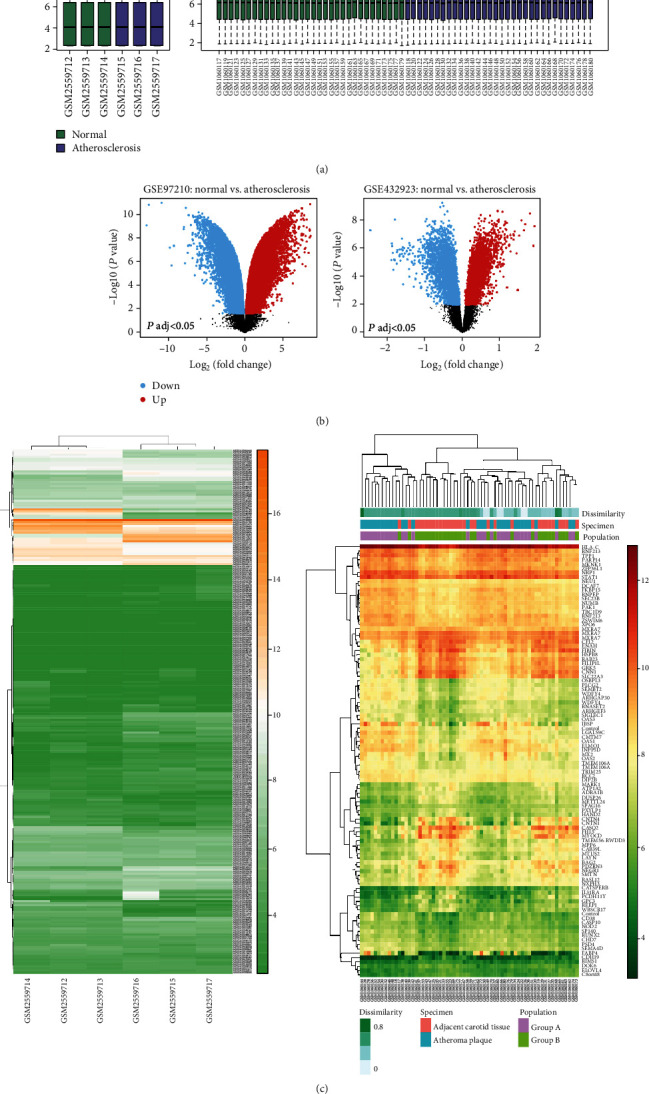
Atherosclerosis (AS) is a vascular disease with plaque formation. Unstable plaques can be expected to result in cardiovascular disease, such as myocardial infarction and stroke. Studies have verified that long noncoding RNAs (lncRNAs) play a critical role in atherosclerotic plaque formation (APF), including MALAT1, GAS5, and H19. A ceRNA network is a combination of these two interacting processes, which regulate the occurrence and progression of many diseases. However, lncRNA-associated ceRNA network in terms of APF is limited. This study sought to discover novel potential biomarkers and ceRNA network for APF. We designed a triple network based on the lncRNA-miRNA and mRNA-miRNA pairs obtained from lncRNASNP and starBase. Differentially expressed genes (DEGs) and lncRNAs in human vascular tissues derived from the Gene Expression Omnibus database (GSE43292, GSE97210) were systematically selected and analyzed. A ceRNA network was constructed by hypergeometric test, including 8 lncRNAs, 243 miRNAs, and 8 mRNAs. APF-related ceRNA structure was discovered for the first time by combining network analysis and statistical validation. Topological analysis determined the key lncRNAs with the highest centroid. GO and KEGG enrichment analysis indicated that the ceRNA network was primarily enriched in "regulation of platelet-derived growth factor receptor signaling pathway," "negative regulation of leukocyte chemotaxis," and "axonal fasciculation." A functional lncRNA, HAND2-AS1, was identified in the ceRNA network, and the main miRNA (miRNA-570-3p) regulated by HAND2-AS1 was further screened. This present study elucidated the important function of lncRNA in the origination and progression of APF and indicated the potential use of these hub nodes as diagnostic biomarkers and therapeutic targets.
动脉粥样硬化(AS)是一种斑块形成的血管疾病。不稳定斑块可导致心血管疾病,如心肌梗死和中风。研究已经证实,长链非编码 RNA(lncRNA)在动脉粥样硬化斑块形成(APF)中发挥着关键作用,包括 MALAT1、GAS5 和 H19。ceRNA 网络是这两个相互作用过程的结合,调节着许多疾病的发生和发展。然而,lncRNA 相关的 ceRNA 网络在 APF 方面的研究还很有限。本研究旨在发现用于 APF 的新型潜在生物标志物和 ceRNA 网络。我们基于从 lncRNASNP 和 starBase 获得的 lncRNA-miRNA 和 mRNA-miRNA 对设计了一个三重网络。系统地选择和分析了来自基因表达综合数据库(GSE43292、GSE97210)的人类血管组织中的差异表达基因(DEGs)和 lncRNA。通过超几何检验构建了 ceRNA 网络,包括 8 个 lncRNA、243 个 miRNA 和 8 个 mRNA。通过网络分析和统计验证首次发现了与 APF 相关的 ceRNA 结构。拓扑分析确定了具有最高质心的关键 lncRNA。GO 和 KEGG 富集分析表明,ceRNA 网络主要富集在“血小板衍生生长因子受体信号通路的调节”、“白细胞趋化作用的负调节”和“轴突聚集”。在 ceRNA 网络中鉴定了一个功能性 lncRNA HAND2-AS1,并进一步筛选出由 HAND2-AS1 调节的主要 miRNA(miRNA-570-3p)。本研究阐明了 lncRNA 在 APF 起源和进展中的重要功能,并表明这些枢纽节点可作为诊断生物标志物和治疗靶点的潜在用途。