Daraz Yasmeen M, Abdelghffar Omar H
Internal Medicine, Montefiore Medical Center, Bronx, USA.
Internal Medicine, Icahn School of Medicine at Mount Sinai, Elmhurst Hospital Center, Elmhurst, USA.
Cureus. 2022 Mar 19;14(3):e23310. doi: 10.7759/cureus.23310. eCollection 2022 Mar.
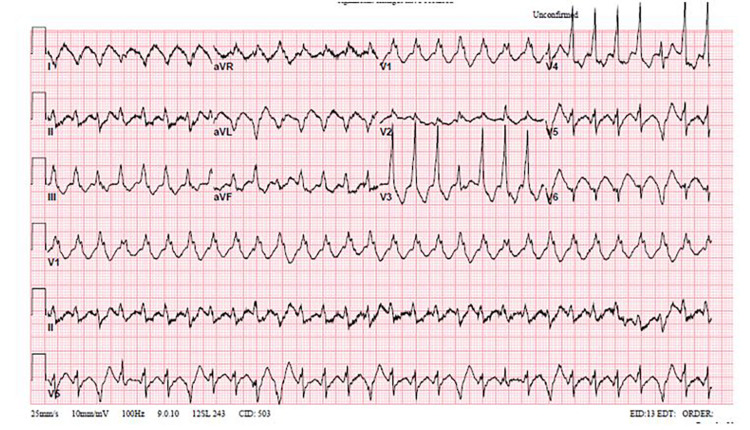
As a renowned local anesthetic agent of choice, lidocaine is also a class 1b antiarrhythmic agent that is primarily used for the treatment of ventricular arrhythmias. Although lidocaine systemic toxicity is rare, it may be life-threatening; thus, its early identification and management are of vital importance. This case report details the clinical scenario of intravenous lidocaine administration to a patient at high risk of toxicity in a 64-year-old patient, who initially presented with sustained monomorphic ventricular tachycardia received lidocaine and subsequently developed neurologic manifestations of lidocaine toxicity, including altered mental status and seizure. The patient was treated promptly with benzodiazepine and discontinuation of lidocaine as the offending agent, with complete resolution of adverse effects.
作为一种著名的局部麻醉首选药物,利多卡因也是一种1b类抗心律失常药物,主要用于治疗室性心律失常。尽管利多卡因全身毒性罕见,但可能危及生命;因此,其早期识别和处理至关重要。本病例报告详细描述了一名64岁有中毒高风险患者静脉注射利多卡因的临床情况,该患者最初表现为持续性单形性室性心动过速,接受利多卡因治疗后出现利多卡因毒性的神经学表现,包括精神状态改变和癫痫发作。患者立即接受苯二氮䓬类药物治疗,并停用作为致病因素的利多卡因,不良反应完全消退。