Qi Chuchu, Chen Andi, Mao Honghui, Hu Erling, Ge Junye, Ma Guaiguai, Ren Keke, Xue Qian, Wang Wenting, Wu Shengxi
Department of Neurobiology, School of Basic Medicine, Fourth Military Medical University, Xi'an, China.
MOE Key Laboratory of Modern Teaching Technology, Center for Teacher Professional Ability Development, Shaanxi Normal University, Xi'an, China.
Front Mol Neurosci. 2022 Apr 6;15:860275. doi: 10.3389/fnmol.2022.860275. eCollection 2022.
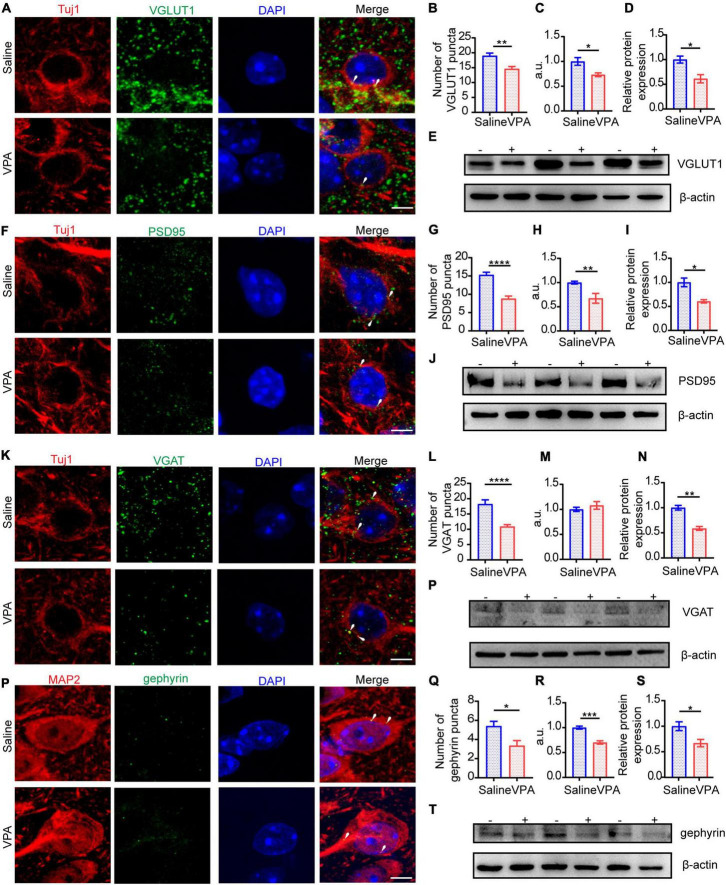
Environmental factors, such as medication during pregnancy, are one of the major causes of autism spectrum disorder (ASD). Valproic acid (VPA) intake during pregnancy has been reported to dramatically elevate autism risk in offspring. Recently, researchers have proposed that VPA exposure could induce excitatory or inhibitory synaptic dysfunction. However, it remains to be determined whether and how alterations in the excitatory/inhibitory (E/I) balance contribute to VPA-induced ASD in a mouse model. In the present study, we explored changes in the E/I balance during different developmental periods in a VPA mouse model. We found that typical markers of pre- and postsynaptic excitatory and inhibitory function involved in E/I balance markedly decreased during development, reflecting difficulties in the development of synaptic plasticity in VPA-exposed mice. The expression of brain-derived neurotrophic factor (BDNF), a neurotrophin that promotes the formation and maturation of glutamatergic and GABAergic synapses during postnatal development, was severely reduced in the VPA-exposed group. Treatment with exogenous BDNF during the critical E/I imbalance period rescued synaptic functions and autism-like behaviors, such as social defects. With these results, we experimentally showed that social dysfunction in the VPA mouse model of autism might be caused by E/I imbalance stemming from BDNF deficits during the developmental stage.
环境因素,如孕期用药,是自闭症谱系障碍(ASD)的主要病因之一。据报道,孕期摄入丙戊酸(VPA)会显著增加后代患自闭症的风险。最近,研究人员提出,VPA暴露可能会导致兴奋性或抑制性突触功能障碍。然而,在小鼠模型中,兴奋性/抑制性(E/I)平衡的改变是否以及如何导致VPA诱导的ASD仍有待确定。在本研究中,我们探讨了VPA小鼠模型在不同发育阶段E/I平衡的变化。我们发现,参与E/I平衡的突触前和突触后兴奋性及抑制性功能的典型标志物在发育过程中显著降低,这反映了VPA暴露小鼠突触可塑性发育存在困难。脑源性神经营养因子(BDNF)是一种神经营养因子,在出生后发育过程中促进谷氨酸能和γ-氨基丁酸能突触的形成和成熟,其在VPA暴露组中的表达严重降低。在关键的E/I失衡期用外源性BDNF进行治疗可挽救突触功能和自闭症样行为,如社交缺陷。基于这些结果,我们通过实验表明,自闭症VPA小鼠模型中的社交功能障碍可能是由发育阶段BDNF缺乏导致的E/I失衡引起的。