Rinaldi Louisa J, Smees Rebecca, Ward Jamie, Simner Julia
School of Psychology, University of Sussex, Brighton, United Kingdom.
Front Psychol. 2022 Apr 6;13:808379. doi: 10.3389/fpsyg.2022.808379. eCollection 2022.
Misophonia is an unusually strong aversion to a specific class of sounds - most often human bodily sounds such as chewing, crunching, or breathing. A number of studies have emerged in the last 10 years examining misophonia in adults, but little is known about the impact of the condition in children. Here we set out to investigate the well-being profile of children with misophonia, while also presenting the first validated misophonia questionnaire for children.
We screened 142 children (10-14 years; Mean 11.72 SD 1.12; 65 female, 77 male) using our novel diagnostic [the ()]. This allowed us to identify a group of children already manifesting misophonia at that age - the first population-sampled cohort of child misophonics examined to date. Children and their parents also completed measures of well-being (for convergent validation of our SMS-Adolescent) and creative self-construct (for discriminant validation).
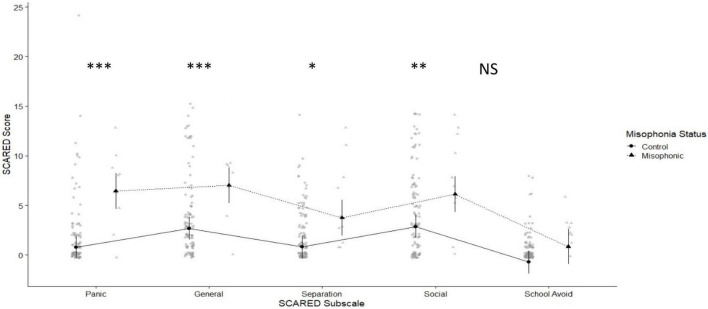
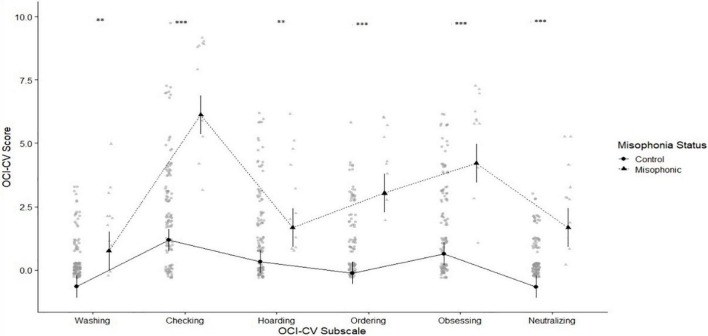
Data show that children with misophonia have significantly elevated levels of anxiety and obsessive compulsive traits. Additionally children with misophonia have significantly poorer life-satisfaction, and health-related quality of life. As predicted, they show no differences in creative self-construct.
Together our data suggest the first evidence in population sampling of poorer life outcomes for children with misophonia, and provide preliminary convergent and discriminant validation for our novel misophonia instrument. Our data suggest a need for greater recognition and therapeutic outlets for adolescents with misophonia.
恐音症是对特定类别的声音异常强烈的厌恶——最常见的是人类身体发出的声音,如咀嚼声、嘎吱声或呼吸声。在过去10年里出现了一些研究成年人恐音症的研究,但对于这种病症对儿童的影响知之甚少。在此,我们着手调查患有恐音症的儿童的幸福状况,同时还展示了首个经过验证的儿童恐音症问卷。
我们使用我们新颖的诊断方法([具体诊断方法名称])对142名儿童(10 - 14岁;平均年龄11.72岁,标准差1.12;65名女性,77名男性)进行了筛查。这使我们能够识别出在那个年龄就已表现出恐音症的一组儿童——这是迄今为止首个进行人群抽样的儿童恐音症队列。儿童及其父母还完成了幸福感测量(用于对我们的SMS - 青少年量表进行聚合效度验证)和创造性自我建构测量(用于区分效度验证)。
数据显示,患有恐音症的儿童焦虑水平和强迫特质显著升高。此外,患有恐音症的儿童生活满意度和与健康相关的生活质量明显更差。正如预期的那样,他们在创造性自我建构方面没有差异。
我们的数据共同表明,在人群抽样中首次有证据表明患有恐音症的儿童生活结果较差,并为我们新颖的恐音症测量工具提供了初步的聚合效度和区分效度验证。我们的数据表明,需要对患有恐音症的青少年给予更多的认识和治疗途径。