
老挝人民民主共和国采用 G6PD 诊断检测根治恶性疟原虫的成本效益分析:经济建模研究。
Cost-effectiveness analysis of G6PD diagnostic test for Plasmodium vivax radical cure in Lao PDR: An economic modelling study.
机构信息
Department of Health Policy, London School of Economics and Political Science, London, United Kingdom.
Mahidol-Oxford Tropical Medicine Research Unit, Faculty of Tropical Medicine, Mahidol University, Bangkok, Thailand.
出版信息
PLoS One. 2022 Apr 25;17(4):e0267193. doi: 10.1371/journal.pone.0267193. eCollection 2022.
BACKGROUND
Plasmodium vivax (Pv) infections were 68% of the total malaria burden in Laos in 2019. The parasite causes frequent relapses, which can be prevented by primaquine (PMQ). Testing for glucose-6-phosphate-dehydrogenase (G6PD) deficiency is recommended before giving PMQ to avoid haemolysis. Because of the risk of haemolysis in G6PD intermediate deficiencies among females, Laos uses the PMQ 14-days regimen only in G6PD normal females. Among G6PD point-of-care tests, qualitative tests cannot differentiate between G6PD normal and intermediate females. Quantitative tests are required to differentiate between G6PD normal and intermediate deficiencies. However, the quantitative test lacks the cost-effectiveness evidence necessary for decision-making for large-scale adoption. This study examined the cost-effectiveness of quantitative G6PD test, with either supervised PMQ treatment or unsupervised PMQ treatment, against the usual unsupervised PMQ 8-weeks strategy. Supervised PMQ 8-weeks strategy without G6PD testing was also compared against the unsupervised PMQ 8-weeks strategy since the former had recently been adopted in malaria high burden villages that had village malaria volunteers. A budget impact analysis was conducted to understand the incremental cost and effect needed for a nationwide scale-up of the chosen strategy.
METHODS
A decision tree model compared the cost-effectiveness of implementing four strategies at one health facility with an average of 14 Pv cases in one year. The strategies were unsupervised PMQ strategy, supervised PMQ strategy, G6PD test with unsupervised PMQ strategy, and G6PD test with supervised PMQ strategy. Disability Adjusted Life Years (DALYs) was the effect measure. Costs were calculated from a payer perspective, and sensitivity analyses were conducted. One Gross Domestic Product (GDP) per capita of Laos was set as the cost-effectiveness threshold. Budget impact analysis was conducted using the health facility wise Pv data in Laos in 2020.
FINDINGS
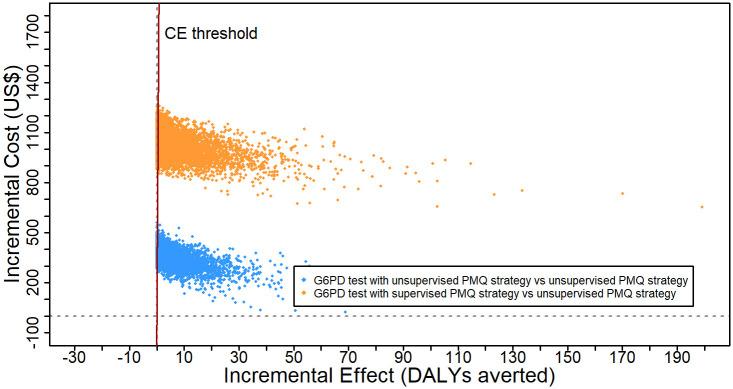
Supervised PMQ strategy was extendedly dominated by G6PD test strategies. When compared against the unsupervised PMQ strategy, both G6PD test strategies were more costly but more effective. Their Incremental Cost-Effectiveness Ratios (ICER) were 96.72US$ for the G6PD test with unsupervised PMQ strategy and 184.86US$ for the G6PD test with supervised PMQ strategy. Both ICERs were lower than one GDP per capita in Laos. Following the sensitivity analysis, low adherence for PMQ 14 days made both G6PD test strategies less cost-effective. The lower the Pv case number reported in a health facility, the higher the ICER was. In the budget impact analysis, the expected budget need was only half a million US$ when the G6PD test rollout was discriminately done depending on the Pv case number reported at the health facilities. Indiscriminate roll out of G6PD test to all health facilities was most expensive with least effect impact.
背景
2019 年,老挝疟疾总负担的 68%由间日疟原虫(Pv)感染引起。该寄生虫会导致频繁的复发,而通过使用伯氨喹(PMQ)可以预防复发。在使用 PMQ 之前,建议检测葡萄糖-6-磷酸脱氢酶(G6PD)缺乏症,以避免溶血性贫血。由于女性中间型 G6PD 缺乏症存在溶血性贫血风险,老挝仅在 G6PD 正常的女性中使用 PMQ 14 天疗程。在 G6PD 即时检测中,定性检测无法区分 G6PD 正常和中间型女性。需要定量检测来区分 G6PD 正常和中间型缺乏症。然而,定量检测缺乏大规模采用所需的成本效益证据。本研究考察了定量 G6PD 检测在监督 PMQ 治疗或非监督 PMQ 治疗中的成本效益,与常规非监督 PMQ 8 周策略相比。由于最近在疟疾高负担村庄中采用了有村疟疾志愿者的监督 PMQ 8 周策略,因此还比较了没有 G6PD 检测的监督 PMQ 8 周策略与非监督 PMQ 8 周策略。进行了预算影响分析,以了解在全国范围内扩大选定策略所需的增量成本和效果。
方法
决策树模型比较了在一个拥有 14 例 Pv 年平均病例的卫生机构中实施四种策略的成本效益。这些策略是非监督 PMQ 策略、监督 PMQ 策略、G6PD 检测加非监督 PMQ 策略和 G6PD 检测加监督 PMQ 策略。残疾调整生命年(DALYs)是衡量效果的指标。成本从支付者的角度进行计算,并进行了敏感性分析。老挝一个人均国内生产总值(GDP)被设定为成本效益阈值。使用老挝 2020 年每个卫生机构的疟疾病例数据进行了预算影响分析。
结果
监督 PMQ 策略被 G6PD 检测策略广泛替代。与非监督 PMQ 策略相比,两种 G6PD 检测策略都更昂贵,但更有效。增量成本效益比(ICER)分别为 G6PD 检测加非监督 PMQ 策略为 96.72 美元,G6PD 检测加监督 PMQ 策略为 184.86 美元。这两个 ICER 均低于老挝的人均 GDP。经过敏感性分析,PMQ 14 天的低依从性使两种 G6PD 检测策略的成本效益降低。卫生机构报告的疟疾病例数量越低,ICER 越高。在预算影响分析中,当根据卫生机构报告的疟疾病例数量有区别地开展 G6PD 检测时,预计预算需求仅为 50 万美元。在所有卫生机构中不加区别地开展 G6PD 检测是最昂贵的,效果影响最小。


 Zotero 插件