Department of Medical Psychology and Psychotherapy, Medical University Graz, Graz, Austria.
Department of Psychiatry, Psychotherapy, Psychosomatics and Medical Psychology, Medical University Innsbruck, Innsbruck, Austria.
Sci Rep. 2022 Apr 26;12(1):6809. doi: 10.1038/s41598-022-10787-8.
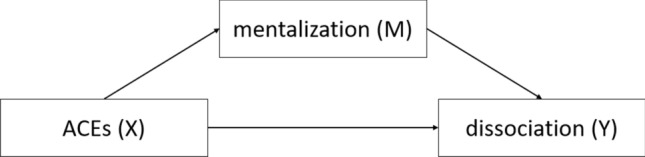
.Impairment of mentalization may impact coping strategies, regulation of affect and stress. The influence of impaired mentalization on dissociation in patients with adverse childhood experiences (ACEs) could be important for treatment strategies. The aim of this study is to assess the relationship between ACEs, mentalizing and dissociation in adult individuals. Sixty-seven patients with ACEs completed the Mentalization Questionnaire (MZQ), the Essener Trauma Inventory (ETI) and the Brief Symptom Inventory-18 (BSI-18). The SPSS PROCESS macro tool was applied to test if mentalization mediated the relationship of ACEs and dissociation. ACEs were significantly associated with higher dissociation (β = 0.42, p < 0.001) and lower mentalization (β = - 0.49, p < 0.001). When mentalization was added to the model as a predictor, the association of ACEs with dissociation was no longer significant (β = 0.11, p = 0.31) and a statistically significant indirect effect was found (β = 0.32, 95% CI 0.16-0.47). The overall explained variance of dissociation notably improved after inclusion of mentalization (17.5% to 49.1%). Thus, the results indicated that the association of ACEs on dissociation was fully mediated by mentalization. Our results suggest that ACEs are associated with lower mentalization and higher dissociation. Lower mentalization was also associated with worse depression, anxiety, somatization and PTSD symptoms. These findings underline the increasing importance of early treatment of individuals affected by ACEs with a focus to foster the development of mentalization.
心理化能力受损可能会影响应对策略、情感调节和压力。心理化能力受损对经历过不良童年经历(ACEs)的患者的分离状态的影响可能对治疗策略很重要。本研究旨在评估成人 ACEs、心理化和分离状态之间的关系。67 名 ACEs 患者完成了心理化问卷(MZQ)、埃森创伤量表(ETI)和简明症状量表-18(BSI-18)。采用 SPSS PROCESS 宏工具检验心理化是否在 ACEs 和分离状态之间的关系中起中介作用。ACEs 与较高的分离状态显著相关(β=0.42,p<0.001)和较低的心理化显著相关(β=-0.49,p<0.001)。当心理化作为预测因素加入模型时,ACEs 与分离状态之间的关联不再显著(β=0.11,p=0.31),并且发现了一个具有统计学意义的间接效应(β=0.32,95%CI 0.16-0.47)。纳入心理化后,分离状态的总解释方差显著提高(17.5%至 49.1%)。因此,结果表明 ACEs 对分离状态的关联完全由心理化介导。我们的研究结果表明,ACEs 与较低的心理化和较高的分离状态相关。较低的心理化也与更严重的抑郁、焦虑、躯体化和创伤后应激障碍症状相关。这些发现强调了早期治疗受 ACEs 影响的个体的重要性,重点是促进心理化的发展。