Hamidi Sarah, Boucher Andrée, Lemieux Bernard, Rondeau Geneviève, Lebœuf Rebecca, Ste-Marie Louis-Georges, Le Xuan Kim, Mircescu Hortensia
Division of Endocrinology, Department of Medicine, Centre Hospitalier de l'Université de Montréal, Montréal, QC H2X0C1, Canada.
Division of Medical Oncology, Department of Medicine, Centre Hospitalier de l'Université de Montréal, Montréal, QC H2X0C1, Canada.
J Endocr Soc. 2022 Mar 23;6(6):bvac048. doi: 10.1210/jendso/bvac048. eCollection 2022 Jun 1.
The SELECT trial led to the approval of lenvatinib for the treatment of advanced radioiodine-refractory differentiated thyroid carcinomas (DTCs) but also revealed an important adverse event (AE) profile which may limit its use in clinical practice.
We aim to describe the efficacy and toxicity profiles of lenvatinib in real life.
We included all patients who received lenvatinib for an advanced DTC at our institution, enrolling 27 patients. We reviewed retrospectively electronic medical records to assess efficacy and AEs.
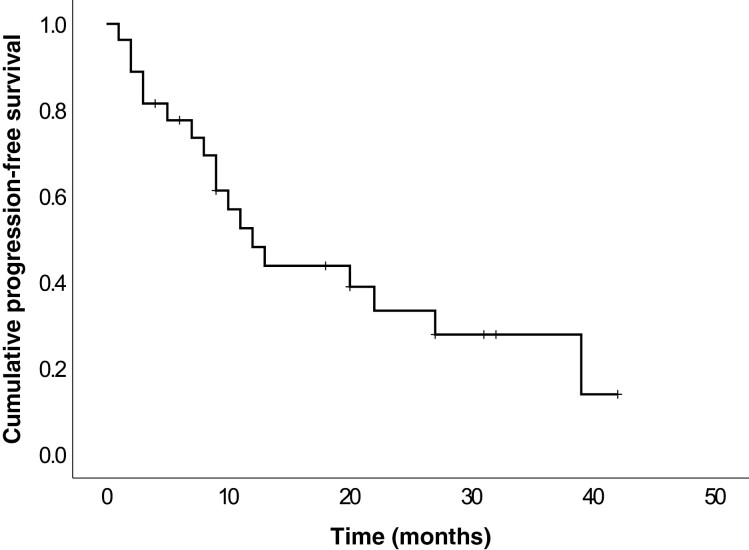
Among the 24 patients with evaluation of tumor response during treatment, overall response rate (ORR) was 37.0% (95% CI, 19.4%-57.6%), and disease control rate was 85.2% (95% CI, 66.3%-95.8%). The median progression-free survival (PFS) was 12 months (95% CI, 7.5-16.5]. The most prevalent AEs were hypertension (77.8%), fatigue (55.6%), and weight loss (51.9%). At least one grade ≥ 3 AE was experienced by 25/27 patients (92.6%), mostly hypertension (59.3%). Lenvatinib was discontinued due to AEs in 13/27 patients (48.1%). Interestingly, 1 patient experienced a grade 4 posterior reversible encephalopathy syndrome, and another developed a Takotsubo cardiomyopathy.
The safety profile of lenvatinib in our cohort was similar to that reported in the literature, with a predominance of hypertension. Rigorous blood pressure control is therefore essential to avoid discontinuing therapy. We also report 2 severe and rarely described AEs that physicians should watch for. As for efficacy, although less than in the SELECT trial, ORR and PFS were similar to other real-life studies.
SELECT试验促使乐伐替尼被批准用于治疗晚期放射性碘难治性分化型甲状腺癌(DTC),但也揭示了一个重要的不良事件(AE)特征,这可能会限制其在临床实践中的应用。
我们旨在描述乐伐替尼在实际应用中的疗效和毒性特征。
我们纳入了在我们机构接受乐伐替尼治疗晚期DTC的所有患者,共纳入27例患者。我们回顾性查阅电子病历以评估疗效和不良事件。
在24例治疗期间评估肿瘤反应的患者中,总体缓解率(ORR)为37.0%(95%CI,19.4%-57.6%),疾病控制率为85.2%(95%CI,66.3%-95.8%)。中位无进展生存期(PFS)为12个月(95%CI,7.5-16.5)。最常见的不良事件是高血压(77.8%)、疲劳(55.6%)和体重减轻(51.9%)。25/27例患者(92.6%)经历了至少1次≥3级不良事件,主要是高血压(59.3%)。13/27例患者(48.1%)因不良事件停用乐伐替尼。有趣的是,1例患者发生4级后部可逆性脑病综合征,另1例发生Takotsubo心肌病。
我们队列中乐伐替尼的安全性特征与文献报道相似,以高血压为主。因此,严格控制血压对于避免停药至关重要。我们还报告了2种严重且罕见描述的不良事件,医生应予以关注。至于疗效,虽然低于SELECT试验,但ORR和PFS与其他实际研究相似。