Lise Meitner Research Group Cognition and Plasticity, Max Planck Institute for Human Cognitive and Brain Sciences, Stephanstr. 1a, 04103, Leipzig, Germany.
Institute of Information Science, Academia Sinica, Taipei, Taiwan.
Brain Struct Funct. 2023 Jan;228(1):273-291. doi: 10.1007/s00429-022-02493-y. Epub 2022 Apr 27.
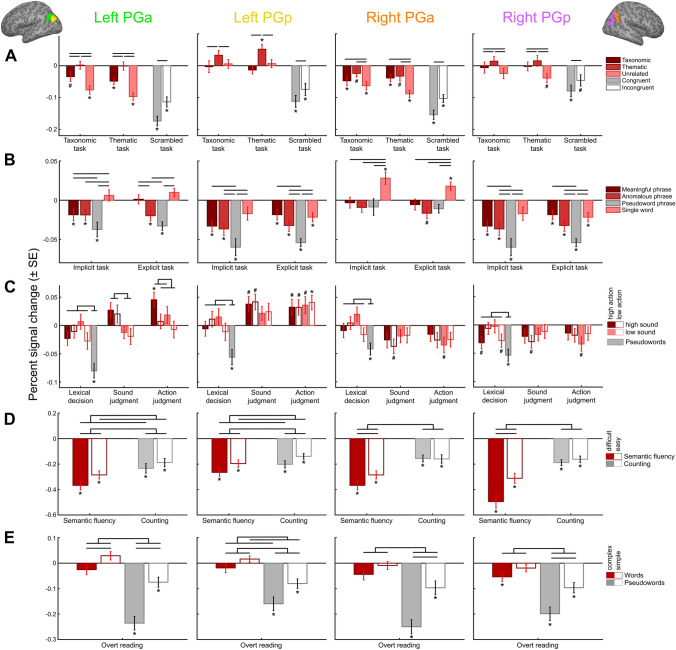
Semantic knowledge is central to human cognition. The angular gyrus (AG) is widely considered a key brain region for semantic cognition. However, the role of the AG in semantic processing is controversial. Key controversies concern response polarity (activation vs. deactivation) and its relation to task difficulty, lateralization (left vs. right AG), and functional-anatomical subdivision (PGa vs. PGp subregions). Here, we combined the fMRI data of five studies on semantic processing (n = 172) and analyzed the response profiles from the same anatomical regions-of-interest for left and right PGa and PGp. We found that the AG was consistently deactivated during non-semantic conditions, whereas response polarity during semantic conditions was inconsistent. However, the AG consistently showed relative response differences between semantic and non-semantic conditions, and between different semantic conditions. A combined analysis across all studies revealed that AG responses could be best explained by separable effects of task difficulty and semantic processing demand. Task difficulty effects were stronger in PGa than PGp, regardless of hemisphere. Semantic effects were stronger in left than right AG, regardless of subregion. These results suggest that the AG is engaged in both domain-general task-difficulty-related processes and domain-specific semantic processes. In semantic processing, we propose that left AG acts as a "multimodal convergence zone" that binds different semantic features associated with the same concept, enabling efficient access to task-relevant features.
语义知识是人类认知的核心。角回(AG)被广泛认为是语义认知的关键大脑区域。然而,AG 在语义处理中的作用存在争议。主要的争议涉及到反应极性(激活与去激活)及其与任务难度、侧化(左 AG 与右 AG)以及功能-解剖细分(PGa 与 PGp 亚区)的关系。在这里,我们结合了五项语义处理的 fMRI 研究数据(n=172),并分析了来自左、右 PGa 和 PGp 相同解剖感兴趣区的反应特征。我们发现,AG 在非语义条件下始终处于去激活状态,而在语义条件下的反应极性则不一致。然而,AG 在语义和非语义条件之间以及不同语义条件之间始终表现出相对的反应差异。对所有研究的综合分析表明,AG 的反应可以最好地用任务难度和语义处理需求的可分离效应来解释。无论半球如何,任务难度的影响在 PGa 中比 PGp 更强。无论亚区如何,语义效应在左 AG 中比右 AG 更强。这些结果表明,AG 参与了一般领域的任务难度相关过程和特定领域的语义过程。在语义处理中,我们提出左 AG 充当“多模态汇聚区”,它将与同一概念相关的不同语义特征绑定在一起,从而能够有效地访问与任务相关的特征。